Showing posts with label Curlew. Show all posts

Thursday, 25 July 2019

Arrivals and departures- the early autumn avian hub

(This post is a little different, being a copy of my original speaker notes for an informal talk given today aboard the Jacob Marley, on an estuary cruise in support of Living River Foundation.
Rather than waste the time on the water with a lengthy lecture full of facts/figures, the talk was pared down to be short, general and informal, but with this lengthier blog then available with additional info after the event. Hope the general approach here of interest to some.)

----------


Arrivals and departures- the early autumn avian hub


Introduction


Grey Plovers

Forget the argument for a Boris Island. The north Kent marshes already handle internationally important numbers of flights every year.

The marshes are well known for the high numbers of overwintering wildfowl and waders. Why each of the north Kent hubs, the Thames, the Medway and the Swale, is recognised as internationally important and are internationally protected: Ramsar, SSSI, MPA.

The north Kent marshes also hold significant numbers of important breeding species.

But what about on migration? How many birds use the Medway? And what do they use it for?


Scheduled flights in July/ August
Wader passage starts in mid-June. For several species, the female's work is done by then, as she leaves the male to look after the eggs/young. Failed breeders and immature birds (some do not breed until they are four or five years old) also wander back in small numbers from mid-June onward. A hardened birder might enjoy getting out and finding the few returners, but not really a spectacle- yet.

By the last 10 days of July more people are noticing a build in numbers, as small flocks start to appear- tens, twenties for most, but some species already well into the hundreds. The rest of the breeding adults have started to move now. They will often desert their young, who then only follow on a few more weeks later.


The East Atlantic Flyway

The Medway is one hub within of a large network of refueling stations strung out along the main carrier route between the high Arctic and Africa. As we will see in the individual species accounts, different species have different travel plans for travelling the flyway, and will use the Medway in different ways.


Departures

Sandwich Terns

Birds are also leaving us now. Our breeding seabird species have nearly all left. A simple premise with colonial nesters- as any colony is a magnet for predators, as soon as your young fledge, move away.

Some that are estuary feeders might only move a short distance from colony (e.g. Common Terns, often to adjacent creeks and fleets), while others move their young to more open water elsewhere (Sandwich Terns, which feed more readily in open water, have now moved off to places such as east Kent).

Gull species that feed on the flats might now spend their time on higher mud nearer the shore, rarely visiting the colonies. And most will be back on the water to roost. Mediterranean Gulls are harder to find as, feeding more on insects, tend to move inland en masse (mostly via the North Downs).


Arrivals

Black-tailed Godwits

But there will be more arriving than departing.

Like people-watching the crowds at any hub airport, a little hard to tell who's coming/going by a quick look around the terminal; those same departing Gull/Tern species are also arriving from elsewhere; colony dispersers from elsewhere around the UK coast/ near continent. Why any series of counts of the estuary will never really give an idea of the total number of birds that pass through.

The waders are easier to call as arrivals. There were so few here for the summer for a start. And there can be many. Of course, we concentrate on peak wintering numbers, and some arriving now will indeed stay for the winter. One species known to prefer carrying out post-breeding moult on wintering grounds is the Curlew. July to March, some birds spend more time here each year than anywhere else, but we just think of them as 'wintering'.

But many autumn bird move on.


Connecting flights

Oystercatchers

Inter-continental journeys, from the north American high arctic, or from Siberia, then on to African shores, often have to be made in stages. Too long a journey for a single flight. Stop and refuel, stop and refuel.

Often not as simple as a quick feed-up, often need a few days, weeks, to rebuild reserves. These are their scheduled short-haul flights; many older birds use the same estuaries, even the same small creek on the same estuary, year after year; they enjoyed the facilities before, so they'll use them again.

This is why some species actually have their peak numbers in autumn, rather than winter as many of us are led to believe.

And if you look carefully enough, some wintering species have two distinct peaks, a mid-/late- winter peak and an autumn peak- a gap between the movers and the stayers. Others have numbers departing for warmer climes obscured by arrivals from other continental hubs (continental hubs tend to be much more challenging in winter than those on our mild UK Atlantic coastline). Monthly counts in autumn may look fairly similar to winter, but the individual turnover has been much higher than the numbers show. (Where individual monitoring through methods such as colour-ringing and radio-tagging comes in useful to prove hub usage.)


Stopovers, long and short stays
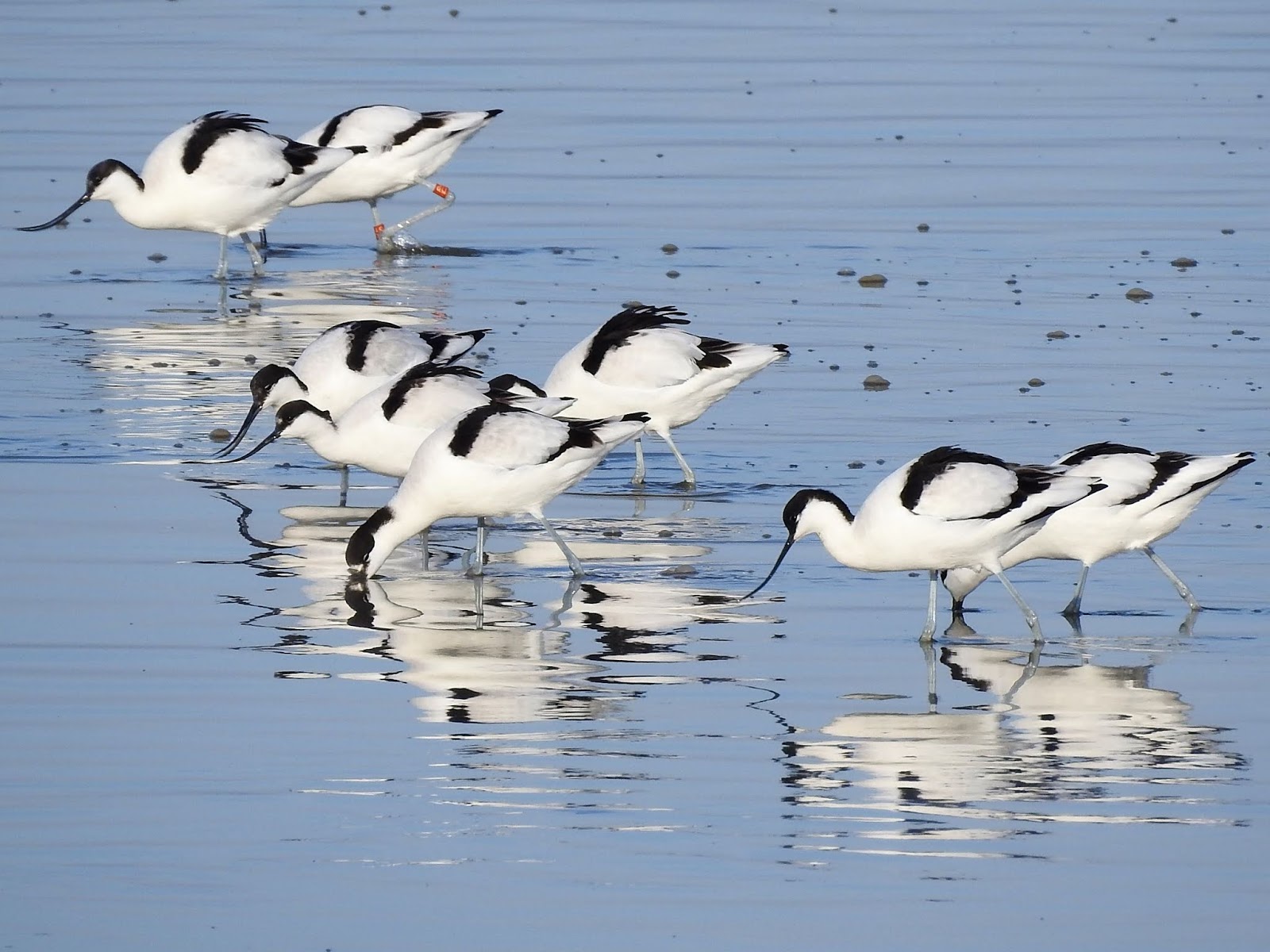
Avocets

Migration isn't cheap. As well as fuel, there's feather wear and tear. All birds have to replace their plumage. This takes more time in larger birds, for most waders around 90 days.

Redshank love the stopover facilities on the Medway. First birds are back on the flats post breeding, late June. Local breeders are joined by birds from the near continent, then later from northern Europe and finally Iceland. The 'continental' birds are most likely to continue south after moulting, on to as far as west Africa for the winter. The Icelandic usually tend to stay on here- they don't mind the cold, being slightly bigger birds. All populations within a species have different degrees of attachment to an area. Redshank overall numbers are smallest in summer, highest on autumn passage, somewhat lower during winter. Why we need to survey through the whole of the year to understand what goes on.

Several species behave similarly but differently, with populations having different strategies; when Grey Plovers arrive, some wil moult and then stay, others simply refuel, then carry on south to moult later.


Diverted air traffic

Black-tailed Godwits

Youngsters have a general idea where they're heading, but are more prone to land at unscheduled sites. Why those rarities that twitchers chase often turn out to be youngsters. If they find a rare adult wader, why twitchers then they have high hopes it might well turn back up same time following year.


Customs on arrival

Turnstones

We've seen it isn't that easy to spot the incoming, what with so many other movements going on during the twice-daily ebb and flow. The Medway, as an 'inland estuary', doesn't really have a coastline, so we don't see birds fly 'in-off'..

So, one of the easier ways to pick out arrivals is on a covering tide. Birds are wary. Even if they know the area, they will still need to check that last autumn's safe roost site is still safe. Juveniles have no idea, they watch and wait out on the flats, often until the tide is up to their bellies, before dashing to a roost; they will have watched local birds leaving long before to settle for the high tide.

Also, the main runway for arrivals appears to usually be mid-estuary. Makes sense, the quietest areas will be central to this 60 square kilometre eastuary. A chance to rest up upon touchdown before exploring. Small flights of 10s, 20s, 30s can often be seen dropping in from height (local/settled birds rarely bother to gain too much height when traversing the area- why waste energy?)

So, the individual species- how do they use the Medway? A short cut-out-and-keep guide follows.

----------

Plain spotting at the hub:

A short guide to the common wader species
found on the Medway 
during late July/early August


Curlew

The following accounts are simplified guides to the commonest waders using the Medway as a hub in July and August, including:
- Points of departure
- Final destinations
- length of stay in the UK
- Reason for visit (their moult strategies whilst on the Medway)
- Passenger number estimates: average maximum figures for July and August are taken from WeBS/KOS reports. There are two sets, illustrative only, as  surveying has often been incomplete since the turn of the century. The first figures, for the 90s, were done partly when the Medway was better surveyed. The 00s counts are now acknowledged as probably unfit for purpose. Finally my comments, which are based on my own nigh-daily visits to the estuary, from 2013 to date.


Oystercatcher


Local breeding population: Most choose not to fly far from the estuary, though a few (mainly their youngsters) head south (to near continent, exceptionally as far as Africa).

Local non-breeding population: stay local all year, augmented by very young Norwegian birds (who from age of two tend to move nearer their natal grounds in summer).

Main winter arrivals are not until October/November. Chiefly Fennoscandian birds, mainly Norwegian. Others from the Low Countries, with small numbers from Iceland e. to Estonia.

Moult (adult)- postbreeding, complete: flight feathers usually changed September- December, may occasionally arrest during passage (technical term- the moult halts then later begins again from the start by changing both new and remaining old flight feathers). Why the bulk of our wintering birds, moulting somewhere else along the flyway nearer to their nesting grounds, do not start to arrive until much later in the year.

Average nos 1990-99 July 616 August 1,008
Average nos 2000-09 July 700 August 670
In recent years more sampling has revealed numbers to still be in four figures from around now, but the picture is complicated by individuals using one estuary (Greater Thames) to feed then roosting in another (Medway), if disturbed or if spring tides reduce carrying capacities- numbers can be tripled over certain tides


Avocet


Chiefly short-distance flights at present, switching between local breeding estuaries (east Anglia southwards) and local moulting grounds (such as the Thames at Cliffe). They then Settle on a choice of estuary for winter, usually within southern UK- but not necessarily the one they bred on.

Moult (adult)- postbreeding, complete. Flight feathers start in July, to October (November). Winter numbers on the Medway do not peak until after this time.

Average nos 1990-99 July 66 August 182
Average nos 2000-09 July 135 August 147
In recent years, due to increasing breeding numbers, July numbers have continued to grow, but most will have left for safer moulting areas by month end- August has similarly low numbers nowadays.


Ringed Plover


A collapse in numbers in recent decades, now almost extinct as a breeding species on the estuary. Any remaining local birds will be joined by birds from northern Europe for the winter, with 'tundrae' (birds from the high north of Scandinavia e. into Siberia) passing through in variable numbers during autumn. A definite early autumn peak in passage numbers, but birds 'short stop' and may only be present for a short period. Counts are often missed.

Moult (adult)- postbreeding, complete. Highly variable sequences, usually starting on breeding grounds, from mid-June to as late as October, most suspending the primary feather moult during peak passage period (August- September). Right now they will have grown a small number of new flight feathers to help their journey south, our breeders perhaps going as far as France/Spain while the Scandinavians 'leap-frog' us to go as far as Africa

Average nos 1990-99 July 124 August 904
Average nos 2000-09 July 12 August 155
In recent years numbers have remained low, just double figures most days, although the odd three-figure count does still get made- just as for breeding, Ringed Plovers find our increased activity and urbanisation have made the Medway less attractive. Any high shoreline fronts (their favoured areas) are too disturbed (or more often flooded by increasingly high spring tides) for hold them for long.


Golden Plover


A small number arrive around now and will remain to overwinter. Origins unknown, possibly British/ near continent.

Varying numbers then arrive in late autumn/early winter. ('last minute bookings' to escape harshest of the winter weather on the continent). Further urbanisation of the green areas surrounding the Medway will reduce the Medway's carrying capacity- birds that spend the day roosting on marshes such as Chetney do need inland fields in which to feed at night.

Moult (adult)- postbreeding, complete. Starts late May- July, often suspends July-August, restarting mid-September- early November. July August is the move from breeding grounds, the flight feathers are pristine at the start of winter ready for 'escape movements' from bad weather.

Average nos 1990-99 July 7 August 40
Average nos 2000-09 July 11 August 97
Numbers on the Funton mudflats have, in recent years, been slightly higher (up to around the 200 mark) and, interestingly, these birds then tend to continue to roost on the flats rather than join the later arrivals in the fields.


Grey Plover


First landings are usually  scheduled for late July, the start of adult passage, with youngsters then not turning up until September.

Moult (adult)- postbreeding, complete. Starts on wintering ground or on specific staging ground. Starts flight feathers between August- early October, but birds starting from September onwards will suspend from mid-October and only restart in spring. ('Suspend' another technical term; stops, then restarts later from point where halted earlier- so, different from 'arrest'.) Birds present on the Medway in early August will either be adults about to either pass through quickly, or here to establish a feeding territory and remain to moult. Why easy to miss the highest counts if only counting a few times each month.

Average nos 1990-99 July 180 August 1,556
Average nos 2000-09 July 7 August 131
Recent numbers still reflect 1990 figures. Most of the larger flocks do tend to favour the less-disturbed flats mid-estuary, perhaps hinting at their being 'short-stayers'.


Lapwing

Small numbers will have been arriving since June, mainly from the near continent. Some return year after year to winter, mainly late Sept-Nov, but the biggest numbers only will only be seen if they need to escape poor bad winter weather. Biggest numbers will always be on the fields rather than the mudflats.

Moult (adult)- postbreeding, complete. May/June- August/September. The species has a very fast moult of outer primaries to aid early autumn movements.

Average nos 1990-99 July 313 August 513
Average nos 2000-09 July 138 August 347
Another species where older records better reflect the present position- incomplete coverage has underplayed the estuary's true numbers. The drier the summer, the more easily detectable out on the mudflats (instead hidden up in the harder-to-view/count fields spread around the marshes).


Knot


Small numbers on autumn passage. Biggest numbers are December-February, made up of wintering wanderers who, having spent first part of winter elsewhere on the east coast, take a short flight to enjoy the Medway cuisine. Fussy eaters, Knot rely on molluscs more than many of the other calidrid species (why they are fixated with only certain muflats here).

Moult (adult)- postbreeding, complete. Might start on breeding grounds, but usually not until in wintering area. Subspecies canutus starts when reaches Mauritania in August-September, subspecies islandica start as soon as arrive in western Europe (July/August) but these stay mainly on recognised moult grounds (e.g. Morecambe Bay, the Wash); 'our' August birds are usually of the race canutus, from western Siberia, heading for Africa.

Average nos 1990-99 July 0 August 171
Average nos 2000-09 July 0 August 50
Recent years very similar, and erratic in number from year to year. A clear example of flight diversions by way of a departure from the scheduled route- here, birds usually relocate after a day or so, probably having overshot the Wash or the Waddenzee (Netherlands).


Dunlin


schinzii- Greenland/Iceland to Norway- small numbers on transit through the early autumn.
alpina- northern Europe to north-west Siberia- these are our overwinterers, not booking in until October/November.

Moult- postbreeding, complete. Just as each race has its own wintering preferences, each has a differing moult strategy. Schinzii moults after migration, alpina may start and then suspend before migrating, often to complete on other specific staging grounds along the flyway before finishing in October (just in time for many to make the final flight to their north Kent wintering grounds). Why many of the small number of adults seen now are likely schinzii, making short stopovers before racing off south.

Average nos 1990-99 July 350 August 1,774
Average nos 2000-09 July 8 August 443
One of the few species where a decline appears to have continued; hard work nowadays for three-figure count at this time of year. Clearly refueling elsewhere. If their main flyway is west to Norway then down through Europe, most will stick to the continental side of the Channel- when they do drift over, they stay more to the south coast than north Kent.


Black-tailed Godwit


Often higher numbers in autumn than in winter. First returnees from Iceland arrive late June, continuing to build through August, to make a moult stopover, with many then moving on to spend the later winter months on the south coast, over in France, or as far south as Portugal.

Moult (adult, islandica)- postbreeding, complete. The flight feather moult takes place after main flight from Iceland, from August to December, when birds may then move on. Birds seen now on the Medway will intend to stay here on the north Kent marshes to see out this important stage of their moult cycle.

Average nos 1990-99 July 232 August 979
Average nos 2000-09 July 298 August 570
Nowadays, four figure counts in August are the norm. (Reflecting the growth in breeding numbers in Iceland).


Whimbrel

Small numbers pass through in early autumn. A species which we see more in the spring than the autumn. The bulk of their population moving through the UK (breeding in Iceland) adjusts their flightline to Africa, sticking to the west via Ireland. The birds we see in the autumn are more likely from Scaninavian/Siberian populations.

Moult (adult)- postbreeding, complete. Usually not started until on wintering grounds in Africa, September/October onwards (a neat aide to separating from moulting Curlew in distant flight at this time of year). Stopovers here are for refueling purposes only.

Average nos not readily available from the old printed annual reports. Partly because they weren't here in any number then. Whimbrel can be fickle and switch refueling sites every few years. Recently a three figure roost has become regular around Nor/Friars/Oakham at this time of year, but only for a matter of a few weeks before continuing on to the wintering grounds to moult.


Curlew


Annual peak numbers are in the autumn, usually September. Safe moulting out around the Medway islands. The drop off in monthly counts later in the winter is probably down to feeding strategies as Curlew, more specifically the shorter-billed males, prefer to feed in fields as winter progresses. Further urbanisation will affect the Medway's carrying capacity.

Moult (adult)- postbreeding, complete. Primary flight feathers start in July/ August, shortly after arriving on wintering grounds. Take 12 weeks to complete.

Average nos 1990-99 July 786 August 1,599
Average nos 2000-09 July 134 August 178
Recent numbers reflect the more methodical counts of the 1990s. In fact, a series of counts will often produce peaks- like Oystercatcher, under certain tidal conditions/ disturbance levels, many of the Thames birds will join the Medway (and Swale) moulters. Another reason why counts should be coordinated not only within the Medway estuary, but on the Thames and Swale as well.


Redshank


Late autumn peak, although moulting numbers are already quite high. Rough and ready rule of thumb, most Icelandics overwinter, quite a few continentals carry on south. And some local movement to the near continent.

Moult (adult)- postbreeding, complete. Flight feathers start in late June to September. Usually remain on moulting grounds throughout, but can still continue on migration before finishedif needs must (a strategy more prevalent in continental birds).

Average nos 1990-99 July 2,294 August 3,523
Average nos 2000-09 July 208 August 404
Numbers moulting within my study area (the southern shoreline) probably reflect an autumn population perhaps only a little under those 1990 figures. Get the count time right (on the rise for birds retiring into the spartina) and single creek roosts here can exceed 700, 800 birds.


Greenshank


Small numbers build to a first peak at the end of July, when the bulk of the breeding adults arrive. A second peak follows two- three weeks later, as the juveniles join them. Very small numbers then remain to overwinter.

Moult (adult)- postbreeding, complete. Moult of flight feathers might start on breeding grounds, then suspend until reach moulting  grounds such as the Medway. Moult takes place July to September (though some may then suspend unifinished moult until they reach their wintering grounds).
Birds here in early autumn are here for safe moulting.

Average nos 1990-99 July 21 August 60
Average nos 2000-09 July 17 August 54
Greenshank behave a lot like their red-shanked cousins, and are often hidden up over the usual WeBS counting period (high tide itself); by counting birds into roost, three figure counts are in truth easily achievable during August.


Turnstone


Fennoscandian population: on transit for south
Greenland/Canada: arriving slightly later, for winter.

Moult (adult)- postbreeding, complete. Birds make a choice of two strategies. #One, starting late-June- August by birds intending to overwinter in northern hemisphere. #Two, for birds overwintering south of the equator, flight feather replacement commences mid-September.

Many of the Turnstone on the Medway in the early autumn peak show no sign of a wing moult, hinting at a short stopover and a long journey ahead.

Average nos 1990-99 July 97 August 726
Average nos 2000-09 July 22 August 43
Again, counts are more usually closer to the 1990s. A species that shows a clear weekend disturbance pattern (more often heading to central estuary roosts rather than the old hulks closer to the shoreline footpaths).

----------

Hopefully this short introduction to the Medway's early autumn bird migrants has helped illustrate the large numbers of waders that will use the estuary during an autumn. It is a complex situation, with every month different; making sense of the way the birds continue to use this estuary is challenging but highly rewarding. Because the estuary needs to be understood if we are to protect it- which brings me neatly back to our hosts tonight, the Living River Foundation- we really do need to know what effect plastic is having on our breeders, our migrants, our overwinterers, on their fuel living in the estuary? I'm sure we all wish them well in their monitoring work- and thank you for coming out and supporting them tonight.


Saturday, 3 February 2018

You'd best practise some more..

Returning to yesterday's post on the problems with counting the Medway Islands on a spring, look at a wader, for a completely different, historic problem.

To explain, let's focus on Curlew. They love central/east Greenborough on a neap tide. Offshore, safe. They love it so much they'll shrink their core area on a 'norm' but they do have to change on a spring. They'll chop and change their refuge, dependent on onshore disturbance. Today, for many the unimproved pasture elsewhere was deemed unsafe so they were on the flooded wet fields of Barksore (that green circle on yesterday's screengrab map). And the majority had been since the tide had been on the rise, liking to roost earlier than many other wader spp., way before the rib turned up. So, unless they take flight, they are hidden from waterborne observers by a high sea wall.


This is one reason why Curlew can be under-represented on old WeBS counts. If the land-based counters are out on a neap, they will not have such large numbers present- they'll be out on Greenborough. If, hypothetically, that boat had been doing a WeBS, they'd have missed them (and others) ashore. And here's the problem when counts are out by a several days: the two nearest WeBS dates are highlighted on this tide-table snapshot. Much lower tides than today's.

http://www.visitmyharbour.com/tides/395/uk-tables/sheerness-river-medway-tide-tables


The Medway estuary has a unique situation of a large island network within a man-made basin estuary (the Victorian brick industry shaped it) but counters on other estuaries shouldn't be complacent. Here, 'Thames' waders will use the Medway roosts under certain conditions. So even if (and I don't know) the Thames does manage to follow the BTO direction of 'estuary co-ordination imperative', if they are on a different day to the Medway, there could be a chunk missing that may not even be picked up when the Medway counters are out.

Some will claim this to be a favourite sermon of mine of course, heard here before, and they'll be right: it remains worth repeating for any newer readers who might be WeBS counters elsewhere. Here the BTO spent time puzzling over the lack of waders on the Medway some years back, without questioning the data itself. More recently, this past couple of years Natural England have been puzzling over the relatively low numbers in relation to habitat available. It is all too easy to take WeBS as Gospel where it has been incomplete and executed poorly.

I know this is probably just how us 'soft sarfeners' don't like talking to neighbours, but a good example why it is worth any estuary WeBS counter chatting with their seawall count neighbour; to see if peaks and troughs on the ebbs and floods mirror. Or just to see if they're out and about at the same time. Putting in place those best practices the BTO promote.

Monday, 1 January 2018

Rise of the Curlews

A half-hour before dawn, and a lone Curlew calls over, would you believe it, Curlew Avenue, Lower Halstow. I hurry on down to the sea wall to beat the rising tide. Sixteen more Curlew go south, calling. I scan the flats. A gathering of Curlew are by Twinney Creek. Usually when gathering to roost Curlew gather alongside Millfordhope, never this close to shore. These are going inland. Twenty more take off. Then some singletons, then thirty-one together, and so on until 106 have made the flight to south of the village.

Scanning Millfordhope, just fourteen on the favoured flat. Another 26 around and about the creeks. Roughly 70% of the Lower Halstow Curlew had gone inland. Some would be on the fields at Forge Lane, others will go as far as Gore, or the Rift Valley.

Whilst some of the Curlew to the west of Ham Green head on land at Horsham and Bayford, birds further west have nowhere else to go, thanks to the urban sprawl of the Medway Towns. East of Lower Halstow, birds spread all along the Callum ridge.

This accounts for one of the routine WeBS problems during the winter months; the 'mid-day' counts underestimate the number of birds using the Medway as an evening roost. Unless you count Curlews at dawn, you will lose a fair number inland; a trawl around the fields between Iwade south to Bobbing, west to Newington then Moor Street, will turn up two or three times the number I'd had pass overhead this morning. Many get disturbed as the day goes on, but often they move further inland to keep field- feeding, rather than head for the mud.

Then there's Queenborough. Stand on that wall just before dawn, and you'll soon appreciate how many birds out in the fields around Sheerness use the Medway for their evening roost (mainly heading back over to the Shepherds Creek/Tailness area).


Of course, this won't bring the numbers up anywhere near the nationally important minimum, but explains why the estuary total can be exceeded along the south shore from time to time.
All an excuse to explore inland a bit more I guess..


Tuesday, 3 October 2017

Horrid autumn- 3/10/17

A short while after coming back from Sussex I gave up owning a car, and took to the pushbike, or walked. Actually, I gave up owning a 4x4 truck, the beast had been brilliant offroad over the farmland in the Brede Valley, but was a bit too OTT for the Rainham estates.

It wasn't all about saving the world, it was about saving money. Besides, from time to time I could borrow a car, so I wasn't that green to turn down the chance. Because, like every dear reader, I'm dying. Very slowly, since my twenties, just like you.

Back then I believed 'coughs and sneezes spread diseases' and didn't really appreciate what disease is; a disorder of structure or disfunction in the body. We bring some upon ourselves (if you don't know what 'The Western disease' is, look it up. I'm busy putting lots of people off Maccy D and the likes nowadays) others happen when we think our slowly reducing muscle mass can still operate as well as 30 years ago, and then things just pop out.. We're all diseased, we're all going to fall apart. Get out and bird now. Retirement won't be what you think for a lot of you. Long and the short of it, I'm walking with a stick until I have an operation to sort out some worn parts.

So, choosing Horrid seemed like a good idea for days when I could borrow transport. A tad worse on other days, which could find me walking in, then diverting to Twydall for a lift back at least. Some mornings, to get to Horrid for Dawn, I just had to grit my teeth for an hour's limp.


You can always tell the days I walk. There's a bloomin' big BHG number in the notebook. Today? 5,220 Black-headed Gulls, south to the Downs in the half-hour it took to walk the edge of the Park. These are counts that can be really messy, but more fun watching for odd behaviour- sometimes not many leaving that early (they know when the ground is frozen, covered), or big numbers arriving early (no guess, sometimes perhaps a movement, sometimes just really good early feeding or a lot of disturbance down on the farms?


I was really tempted by a tired Woodpigeon as I arrived at Horrid, one I could have picked up and stroked; migration? A man can dream.. (Answer- no. Just, well, no.)


So, what was there?

06:45-09:45
Viz mig: Brent Goose 47 (+89 offshore), Peregrine 2, Kestrel, Sparrowhawk, Sandwich Tern 13, Common Tern, Swallow 4, Sand Martin 2, Skylark 8, Meadow Pipit 104, Pied Wagtail 2, Lesser Redpoll, Linnet 27, Chaffinch 2, Goldfinch 2.

Point: Chiffchaff 4, Linnet 14, Reed Bunting 2.

Watched the Curlews for a bit. Last few days, flightline to roost were settled (red). Today? West basin birds behaving, but eastern lot having none of it around Friars (yellow). Gave it a wide berth and instead formed two large groups over on Oakham. Haven't heard anything of late on the ongoing ownership questions. WAGBI, Wildfowlers Association of GB and Ireland, long-term loaned it to the CEGB, Central Electricity Generating Board. Both gone through name changes, affiliations, both present regenerations having trouble locating their copies of the paperwork.

Friday, 22 September 2017

Horrid autumn- 22/9/17

A quiet passage day:
Point: Chiffchaff 2, Blackcap, Goldcrest, Linnet 5, Reed Bunting.
Viz mig (west): Gadwall 2 (south), Marsh Harrier (south-east), Black-tailed Godwit 10 (south), Sandwich Tern 13, Common Tern, Swallow 17, Meadow Pipit 20, Rock Pipit 1, Grey Wagtail (east).

After that, Horrid Hill 08:40-16:00.
What? Yup, I hung on a bit today. I often have two or three short birding session a day this time of year, all around the estuary. Today I'd decided on a count known as a 'through-the-tide count' (TTTC). Seven sets of counts, one every hour, to give an idea of how an area is utilised. What today's count showed is precisely why estuary WeBS counts should be coordinated; once the tide was in, the birds spent varying amounts of time in up to six different subsites. This is the track of the Grey Plovers:


The map was taken from the BTO webpages. In reality, not been counted by seven different people for some years, Nor, Friars and Bishop counted by boat when first I returned. The interchange between Rainham Saltings, Rainham Creek and Motney saltings clear, and I've found over the years there is also routine exchange between Copperhouse Marsh and the whole of the bay to the east of Horrid Hill.

Motney is blue, as it is an area with a counter vacancy. Doesn't mean they don't still need counters for the other sectors; some of the best organised estuary counts around the U.K. have subs (-titutes, nor marines) to count on the actual date if the regular counter can't make it. The regular might do a week later to keep their own run complete, and both can be submitted- supplemental counts are welcomed by the BTO. Some of the very best organised estuaries even try for annual LTCs (Low Tide Counts).

The important thing is for individual counters to really appreciate the importance of co-ordination. There is every possibility of a major mis-representation, and here on the Medway, such movements as shown will mean under-estimates; birds may spend a lot of the time out of your area while you're counting, and they certainly not spending equal amounts of time in each- the probability is you will miss some of them. So, going at different times of the high tide period really isn't the best for waders either. Just covered? Numbers higher along the shore, but these birds may well be mid-Channel come high tide itself.

Hopefully I'm not teaching many WeBS counters their job here. The reason I mention now is that I've been told by a couple of counters this winters' counts will be more coordinated. Absolutely brilliant news. I don't know if that includes the islands, clear that it really should; but if the boat can still only go weekdays, then one can dream of enough volunteers to get a mid-week count as well as the core date around the shore; results would be intriguing- the different rates of area usage weekdays to weekends would be clear for all to see.

Back at the results, you don't have to go all pictorial, you can just as easily chart. Here's a screengrab of three species counts that day- Oystercatcher, Curlew and Black-tailed Godwit:


Oystercatcher- on the top of the tide, some birds are getting pushed off and wandering (by now, main roost is over on the northern shore, Kingsnorth Power Station apron wall).

Curlew- all off to Oakham saltings for the high tide, after finishing feeding at Rainham Saltings. They can often choose Motney, but often avoid for a few days after disturbance.

Black-tailed Godwit- classic early season feeding effort on a low tide through from dawn- enough light to feed up out towards centre, have a pre-roost rest before tide even fully covers (today they chose Oakham island); different from later in season when have to work flats hard and follow right up Rainham Saltings/ Rainham Creek.

A TTTC is of the sort of survey your average consultant undertakes. They will be full of data, but if they get interpretation wrong, it then throws the lot. Why worth having a go at few yourselves. Here I've seen some very odd conclusions drawn for the north shore- statements that certain species do not use at certain times of the tide; utter pants, but unless the locals go about assimilating good information, hard to present. Even if you have a grasp of things, these sort of counts help refine your understanding, and you can argue your case so much easier.

Nothing wrong with playing at this either, on your own beach/shore/mudflat- say a mini-version, 3 or 4 hrs over the covered rising waters, 3 or 4 hours over the covering mud. You don't have to be as mad/sad/lonely as me. What I've been concentrating on these past few years is just the one central hour, mud-flat covering time, collecting data for all whole south shore areas up to three times a month. I'm beginning to suss what happens, but I know from carrying out a few TTTCs as well there's a lot to learn about those other hours. You could also very easily clarify/discover a few things about your own area. Grab your chairs, flasks and lunchboxes.. Shouldn't really leave it just to WeBS/LTCs and those bloomin' consultants.

Tuesday, 19 September 2017

Horrid autumn- 19/9/17


Point: Chiffchaff 2, Teal 4 (don't knock it, that's good for the small tidal pond).

Vis mig (w): Brent Goose 12, Wigeon 68 (+120 north-west), Teal 35(southwest), Dunlin 76, Snipe 1, Spotted Redshank, Greenshank 4, Black-tailed Godwit 30 (north), Sandwich Tern 47 (and 11 offshore), Common Tern, Wheatear, Meadow Pipit 10.


Yesterday I mentioned disturbance to roosts. Thankfully birders do not flush the roosts every day. Nor do the dogwalkers. But add them all together.. Today? That seaplane. Motney then on to put up everything on Burntwick and Greenborough. Everything. Waders forced to cross the estuary, duck as well. Easy to make out some individual species than others; the Greenborough Curlew roost went up as one. The larger the wader, the easier they spook. Hopefully they won't be as easily put off as the summering flock this year, whose numbers were extremely low once they'd been put to flight, by flight.

The seaplane can land to play on the water where marked in red. It can bank and turn over the islands to do so. Today, most of the curlew and duck came up from the stretch marked in green. Go figure.


Saturday, 2 September 2017

Horrid autumn- 2/9/17

Distant odd goings on with the Grey Herons- seven at the tip of Ham Green struck out north, twice, only to give up and turn back.


Nearer odd 'goings off'- the Friars Curlew had given up and moved to Oakham, perhaps down to the opening of the wildfowling season the previous day. It was interesting to watch birds arriving from Ham Green (usually roosting Greenborough), only to skirt Friars and circle Oakham before finally setting down.


-----------
02/09/17

Pt- Whitethroat 2, Willow Warbler, Chiffchaff, Blackcap 2, Lesser Whitethroat 2.

vm- Yellow Wagtail 4 west, Greenshank 1 high west, Golden Plover 6 west, Meadow Pipit 3 west.

Offshore- One Peregrine hunting the Rainham mudflats, last seen heading off over Otterham. Common Tern 5, Sandwich Tern 2.

Monday, 28 August 2017

Horrid autumn- 28/8/17

A Horrid factoid- The two RSPB reserves on the estuary, Nor Marsh and Motney Hill, have no access for visitors. Horrid is the best viewpoint, where an interpretation board has been installed on behalf of both the RSPB and Medway Council, freeholders of Nor and Motney.

If you are prepared to bring your own folding chair, the board can act as a fairly poor windbreak.


-----------
28/08/17
06:00-08:00

Robin- common beach feeders on Horrid

Point- Single Reed Warbler.

Viz mig- Seven Yellow Wagtail south, five Common Tern south-west. Two Grey Wagtail east-northeast (the usual direction for early autumn dispersal as birds move downriver)

Offshore- Two Kingfisher on the rocks either side of the Point; once they met up, a chase to Copperhouse ensued.

So, quiet then- back to yesterday's game of count the dispersing wader roost. The texts will say waders tend to leave in a set order, this does does generally work as a rule. Each day brings differences; on a slightly lower tide, more Redshank had been able to hang on at the Rainham saltings roost and there was less urgency to return, and the Curlew had roosted on Oakham, so were in no mood to rush back.

In general though, tide-edge followers are first away. With few Dunlin in, it could be blink-and-you-miss-them. Black-tailed Godwit are happy to start feeding close to shore (and can remain until disturbed). Some Grey Plover and Redshank established territories on the flats. A good many others are still working as loose flocks; these mix-in, often wanting to get to their spots as soon as uncovered, so the movement is pretty much over once the main departure takes place. Turnstone aren't really living up to their names at the moment, carrying out an awful lot of 'peck-feeding' on the mud (most are refueling to continue their migrations south, our overwinterers have yet to arrive). The larger the wader, the slower out the blocks. Oystercatcher and Curlew are among the last to leave roost. Presumably their specialist feeding techniques mean they are not having to compete with other species that much, can feed up and retire. Or, they like to supplement the mudflat feeding with a bit of fieldwork when the ground is damp, so they can carry on over throughout a tidal cycle if needs be.

Not setting the world alight with such observations, just enjoying seeing the texts come to life, and getting to understand more about how all the habitats in and around the estuary play a part. The land migrants might be missing, but there's always something to enjoy.


-----

Rewarded myself with a second trip at high tide (having made a covering tide count nearby). Impressed to find a minimum of 880 Starling using Horrid as a high-tide roost. The idea that large roosts act as 'information centres' felt spot on; the constant short bursts from individual birds felt like a 'look at me, I'm well-fed'. Anthropomorphic twaddle, but fun nonetheless.

And something even the public noticed. A couple stopped me (thinking that I looked liked someone who'd know about birds, think the 'scope gave it away) to ask all about them, and then said they'd heard about murmurations thanks to 'Autumnwatch' and would love to see one. Gave them details, but made me think *memo to County Society/ local RSPB Groups*- why not hold a well- promoted/publicised trip to view a murmuration, for the general public? (You're welcome.)

Shame to see the Nor and Friars roosts cleared by a low-flying microlight. Certainly when Kingsnorth Power Station was operational the rule of the estuary was no flying below 150 feet; the reverend, working out on Oakham, was often reporting low-flyers. Today's disturbed birds made west for the Greenborough complex, or north (as in the case of the Curlew pictured) to Oakham. Birds need an awful lot of safe sites. Especially when somewhere like Nor (an RSPB reserve) isn't as safe throughout the tide as some believe.


Sunday, 27 August 2017

Horrid autumn- 27/8/17

A Horrid factoid- The wreck near the start of the causeway, found ad nauseum in any google image search of Horrid Hill, is the tug boat "Waterloo".  She was built in 1891 by Thomas Scott of Goole, Yorkshire, and was originally called "No. 6". She had probably often sailed past that most famous of U.K. bird peninsulas, Spurn, but somehow came to be a Feral Pigeon perch next to the estuary's not-quite so good peninsula.

Yes, the Power Station is in the background- this was 10/5/13

The Waterloo was known as a 'Tom Pudding' tug. 'Tom' meant large (think 'Tom Tit' for Great Tit) and 'Pudding' from the tug's removeable compartments which looked like black pudding. Each compartment could hold 40 tons of coal which would be hauled up by crane directly onto waiting ships. They were most commonly used on the Aire and Calder canals in Yorkshire, from around 1865 right up until the mid-1980s, moving coal from open cast collieries of South Yorkshire down to Goole. In truth, the Waterloo may not have seen Spurn that often, but still more than me (never been).

-----------
27/08/17
05:45-07:55

Point- Three Willow Warbler, singles of Blackcap, Garden Warbler and Linnet.

Viz mig- zilch

Offshore- Peregrine lazing on Nor.


So, time to spare.

Spent it making some sense of the wader movements from roost. A spring high at about 04:30 had pushed many of the Rainham Saltings roosters (predominately Redshank) out north onto Nor and Friars. Birds that roost here, just north of Horrid Hill, do not usually follow the tide out alongside the roost, but return to their favoured feeding areas. Whilst there is usually one big movement, quite a few birds tend to leave in dribs and drabs. Such small numbers often fail to register but can amount to a sizeable proportion of a roost.


Early-returning waders can be back to their feeding zone some time before they can set to feeding. From the go, Redshank were heading back to the just-uncovered Rainham Saltings roost site, where they waited for the mud to uncover. Birds moving slightly later tend to head for two main 'waiting zones' around Rainham Saltings, one along the northern edge close to Mariners Creek, the other the sheltered south-east corner of the saltings just above the Bloors drain.


Not all the species favour the Nor walls; Black-tailed Godwit for the main part, will use central Friars. Others may go that little bit further for safety. Curlew will use Friars, but change for Bishop to the north (or even Oakham over the main channel). Similarly, Oystercatcher are happy on neap tides on Friars (parts of the beach are slow to go under) but on springs prefer to put their toes on the hard concrete of the northern seawall at Kingsnorth. Only a small number of Oystercatcher make an early return to Rainham saltings, their preferred feeding being the shell beds east of Bishop and Friars.  

Blue- Oystercatcher   Pink- Turnstone   White- Grey Plover
Red- Redshank   Green- Curlew   Yellow- Black-tailed Godwit
This all goes to explain why Horrid is often quoted in 'Where to watch' guides as one of the better places for viewing waders. Timing is of course everything. Return movement may well start from around the 5.3 metre mark on the ebb, with largest movements usually over by around the 4.4 metre mark- but things can and do vary.

The tide would be good for the following morning as well, a good chance to make some comparisons. That is, if the migrants weren't keeping me busy..