Showing posts with label Redshank. Show all posts

Thursday, 25 July 2019

Arrivals and departures- the early autumn avian hub

(This post is a little different, being a copy of my original speaker notes for an informal talk given today aboard the Jacob Marley, on an estuary cruise in support of Living River Foundation.
Rather than waste the time on the water with a lengthy lecture full of facts/figures, the talk was pared down to be short, general and informal, but with this lengthier blog then available with additional info after the event. Hope the general approach here of interest to some.)

----------


Arrivals and departures- the early autumn avian hub


Introduction


Grey Plovers

Forget the argument for a Boris Island. The north Kent marshes already handle internationally important numbers of flights every year.

The marshes are well known for the high numbers of overwintering wildfowl and waders. Why each of the north Kent hubs, the Thames, the Medway and the Swale, is recognised as internationally important and are internationally protected: Ramsar, SSSI, MPA.

The north Kent marshes also hold significant numbers of important breeding species.

But what about on migration? How many birds use the Medway? And what do they use it for?


Scheduled flights in July/ August
Wader passage starts in mid-June. For several species, the female's work is done by then, as she leaves the male to look after the eggs/young. Failed breeders and immature birds (some do not breed until they are four or five years old) also wander back in small numbers from mid-June onward. A hardened birder might enjoy getting out and finding the few returners, but not really a spectacle- yet.

By the last 10 days of July more people are noticing a build in numbers, as small flocks start to appear- tens, twenties for most, but some species already well into the hundreds. The rest of the breeding adults have started to move now. They will often desert their young, who then only follow on a few more weeks later.


The East Atlantic Flyway

The Medway is one hub within of a large network of refueling stations strung out along the main carrier route between the high Arctic and Africa. As we will see in the individual species accounts, different species have different travel plans for travelling the flyway, and will use the Medway in different ways.


Departures

Sandwich Terns

Birds are also leaving us now. Our breeding seabird species have nearly all left. A simple premise with colonial nesters- as any colony is a magnet for predators, as soon as your young fledge, move away.

Some that are estuary feeders might only move a short distance from colony (e.g. Common Terns, often to adjacent creeks and fleets), while others move their young to more open water elsewhere (Sandwich Terns, which feed more readily in open water, have now moved off to places such as east Kent).

Gull species that feed on the flats might now spend their time on higher mud nearer the shore, rarely visiting the colonies. And most will be back on the water to roost. Mediterranean Gulls are harder to find as, feeding more on insects, tend to move inland en masse (mostly via the North Downs).


Arrivals

Black-tailed Godwits

But there will be more arriving than departing.

Like people-watching the crowds at any hub airport, a little hard to tell who's coming/going by a quick look around the terminal; those same departing Gull/Tern species are also arriving from elsewhere; colony dispersers from elsewhere around the UK coast/ near continent. Why any series of counts of the estuary will never really give an idea of the total number of birds that pass through.

The waders are easier to call as arrivals. There were so few here for the summer for a start. And there can be many. Of course, we concentrate on peak wintering numbers, and some arriving now will indeed stay for the winter. One species known to prefer carrying out post-breeding moult on wintering grounds is the Curlew. July to March, some birds spend more time here each year than anywhere else, but we just think of them as 'wintering'.

But many autumn bird move on.


Connecting flights

Oystercatchers

Inter-continental journeys, from the north American high arctic, or from Siberia, then on to African shores, often have to be made in stages. Too long a journey for a single flight. Stop and refuel, stop and refuel.

Often not as simple as a quick feed-up, often need a few days, weeks, to rebuild reserves. These are their scheduled short-haul flights; many older birds use the same estuaries, even the same small creek on the same estuary, year after year; they enjoyed the facilities before, so they'll use them again.

This is why some species actually have their peak numbers in autumn, rather than winter as many of us are led to believe.

And if you look carefully enough, some wintering species have two distinct peaks, a mid-/late- winter peak and an autumn peak- a gap between the movers and the stayers. Others have numbers departing for warmer climes obscured by arrivals from other continental hubs (continental hubs tend to be much more challenging in winter than those on our mild UK Atlantic coastline). Monthly counts in autumn may look fairly similar to winter, but the individual turnover has been much higher than the numbers show. (Where individual monitoring through methods such as colour-ringing and radio-tagging comes in useful to prove hub usage.)


Stopovers, long and short stays
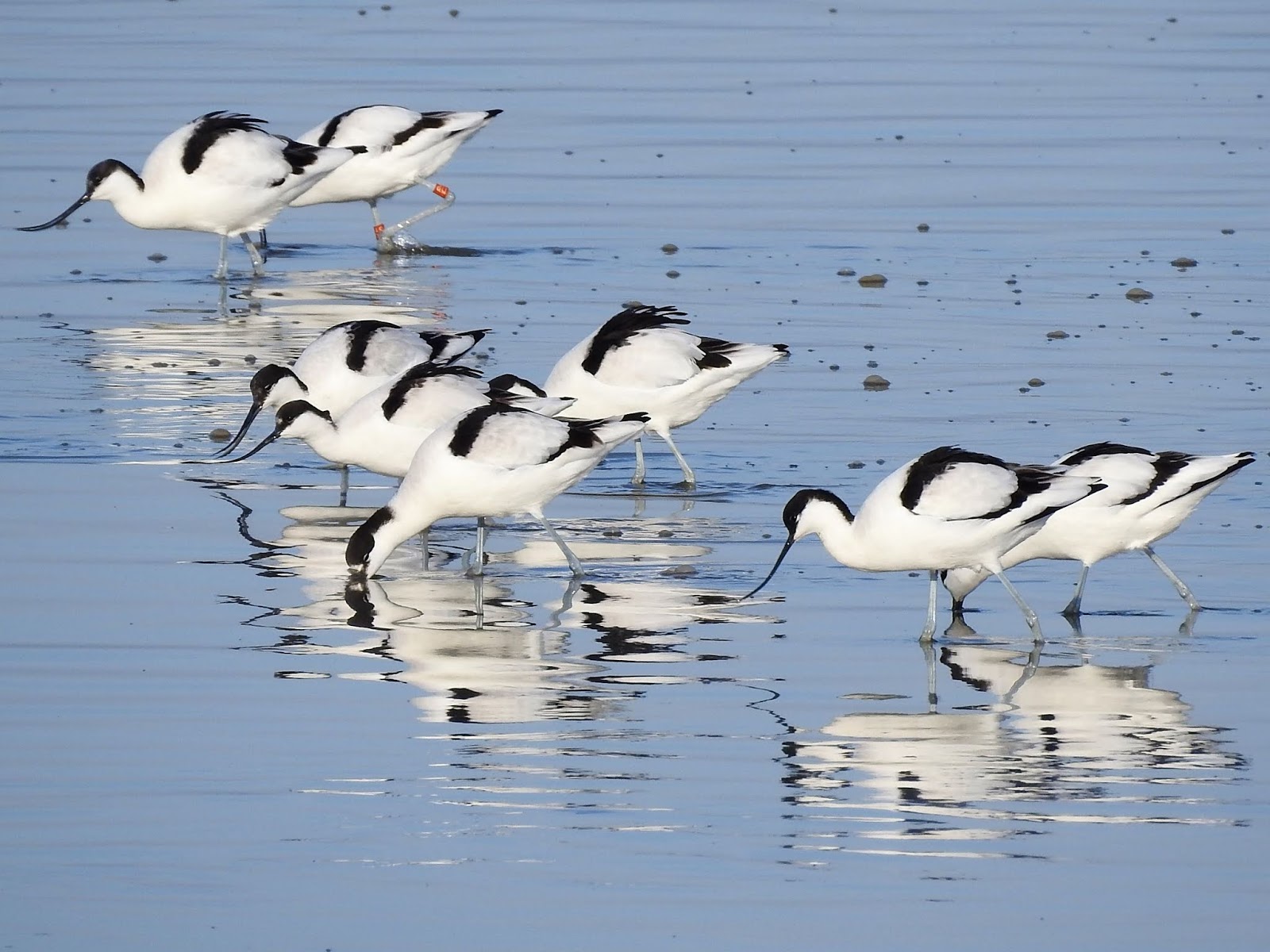
Avocets

Migration isn't cheap. As well as fuel, there's feather wear and tear. All birds have to replace their plumage. This takes more time in larger birds, for most waders around 90 days.

Redshank love the stopover facilities on the Medway. First birds are back on the flats post breeding, late June. Local breeders are joined by birds from the near continent, then later from northern Europe and finally Iceland. The 'continental' birds are most likely to continue south after moulting, on to as far as west Africa for the winter. The Icelandic usually tend to stay on here- they don't mind the cold, being slightly bigger birds. All populations within a species have different degrees of attachment to an area. Redshank overall numbers are smallest in summer, highest on autumn passage, somewhat lower during winter. Why we need to survey through the whole of the year to understand what goes on.

Several species behave similarly but differently, with populations having different strategies; when Grey Plovers arrive, some wil moult and then stay, others simply refuel, then carry on south to moult later.


Diverted air traffic

Black-tailed Godwits

Youngsters have a general idea where they're heading, but are more prone to land at unscheduled sites. Why those rarities that twitchers chase often turn out to be youngsters. If they find a rare adult wader, why twitchers then they have high hopes it might well turn back up same time following year.


Customs on arrival

Turnstones

We've seen it isn't that easy to spot the incoming, what with so many other movements going on during the twice-daily ebb and flow. The Medway, as an 'inland estuary', doesn't really have a coastline, so we don't see birds fly 'in-off'..

So, one of the easier ways to pick out arrivals is on a covering tide. Birds are wary. Even if they know the area, they will still need to check that last autumn's safe roost site is still safe. Juveniles have no idea, they watch and wait out on the flats, often until the tide is up to their bellies, before dashing to a roost; they will have watched local birds leaving long before to settle for the high tide.

Also, the main runway for arrivals appears to usually be mid-estuary. Makes sense, the quietest areas will be central to this 60 square kilometre eastuary. A chance to rest up upon touchdown before exploring. Small flights of 10s, 20s, 30s can often be seen dropping in from height (local/settled birds rarely bother to gain too much height when traversing the area- why waste energy?)

So, the individual species- how do they use the Medway? A short cut-out-and-keep guide follows.

----------

Plain spotting at the hub:

A short guide to the common wader species
found on the Medway 
during late July/early August


Curlew

The following accounts are simplified guides to the commonest waders using the Medway as a hub in July and August, including:
- Points of departure
- Final destinations
- length of stay in the UK
- Reason for visit (their moult strategies whilst on the Medway)
- Passenger number estimates: average maximum figures for July and August are taken from WeBS/KOS reports. There are two sets, illustrative only, as  surveying has often been incomplete since the turn of the century. The first figures, for the 90s, were done partly when the Medway was better surveyed. The 00s counts are now acknowledged as probably unfit for purpose. Finally my comments, which are based on my own nigh-daily visits to the estuary, from 2013 to date.


Oystercatcher


Local breeding population: Most choose not to fly far from the estuary, though a few (mainly their youngsters) head south (to near continent, exceptionally as far as Africa).

Local non-breeding population: stay local all year, augmented by very young Norwegian birds (who from age of two tend to move nearer their natal grounds in summer).

Main winter arrivals are not until October/November. Chiefly Fennoscandian birds, mainly Norwegian. Others from the Low Countries, with small numbers from Iceland e. to Estonia.

Moult (adult)- postbreeding, complete: flight feathers usually changed September- December, may occasionally arrest during passage (technical term- the moult halts then later begins again from the start by changing both new and remaining old flight feathers). Why the bulk of our wintering birds, moulting somewhere else along the flyway nearer to their nesting grounds, do not start to arrive until much later in the year.

Average nos 1990-99 July 616 August 1,008
Average nos 2000-09 July 700 August 670
In recent years more sampling has revealed numbers to still be in four figures from around now, but the picture is complicated by individuals using one estuary (Greater Thames) to feed then roosting in another (Medway), if disturbed or if spring tides reduce carrying capacities- numbers can be tripled over certain tides


Avocet


Chiefly short-distance flights at present, switching between local breeding estuaries (east Anglia southwards) and local moulting grounds (such as the Thames at Cliffe). They then Settle on a choice of estuary for winter, usually within southern UK- but not necessarily the one they bred on.

Moult (adult)- postbreeding, complete. Flight feathers start in July, to October (November). Winter numbers on the Medway do not peak until after this time.

Average nos 1990-99 July 66 August 182
Average nos 2000-09 July 135 August 147
In recent years, due to increasing breeding numbers, July numbers have continued to grow, but most will have left for safer moulting areas by month end- August has similarly low numbers nowadays.


Ringed Plover


A collapse in numbers in recent decades, now almost extinct as a breeding species on the estuary. Any remaining local birds will be joined by birds from northern Europe for the winter, with 'tundrae' (birds from the high north of Scandinavia e. into Siberia) passing through in variable numbers during autumn. A definite early autumn peak in passage numbers, but birds 'short stop' and may only be present for a short period. Counts are often missed.

Moult (adult)- postbreeding, complete. Highly variable sequences, usually starting on breeding grounds, from mid-June to as late as October, most suspending the primary feather moult during peak passage period (August- September). Right now they will have grown a small number of new flight feathers to help their journey south, our breeders perhaps going as far as France/Spain while the Scandinavians 'leap-frog' us to go as far as Africa

Average nos 1990-99 July 124 August 904
Average nos 2000-09 July 12 August 155
In recent years numbers have remained low, just double figures most days, although the odd three-figure count does still get made- just as for breeding, Ringed Plovers find our increased activity and urbanisation have made the Medway less attractive. Any high shoreline fronts (their favoured areas) are too disturbed (or more often flooded by increasingly high spring tides) for hold them for long.


Golden Plover


A small number arrive around now and will remain to overwinter. Origins unknown, possibly British/ near continent.

Varying numbers then arrive in late autumn/early winter. ('last minute bookings' to escape harshest of the winter weather on the continent). Further urbanisation of the green areas surrounding the Medway will reduce the Medway's carrying capacity- birds that spend the day roosting on marshes such as Chetney do need inland fields in which to feed at night.

Moult (adult)- postbreeding, complete. Starts late May- July, often suspends July-August, restarting mid-September- early November. July August is the move from breeding grounds, the flight feathers are pristine at the start of winter ready for 'escape movements' from bad weather.

Average nos 1990-99 July 7 August 40
Average nos 2000-09 July 11 August 97
Numbers on the Funton mudflats have, in recent years, been slightly higher (up to around the 200 mark) and, interestingly, these birds then tend to continue to roost on the flats rather than join the later arrivals in the fields.


Grey Plover


First landings are usually  scheduled for late July, the start of adult passage, with youngsters then not turning up until September.

Moult (adult)- postbreeding, complete. Starts on wintering ground or on specific staging ground. Starts flight feathers between August- early October, but birds starting from September onwards will suspend from mid-October and only restart in spring. ('Suspend' another technical term; stops, then restarts later from point where halted earlier- so, different from 'arrest'.) Birds present on the Medway in early August will either be adults about to either pass through quickly, or here to establish a feeding territory and remain to moult. Why easy to miss the highest counts if only counting a few times each month.

Average nos 1990-99 July 180 August 1,556
Average nos 2000-09 July 7 August 131
Recent numbers still reflect 1990 figures. Most of the larger flocks do tend to favour the less-disturbed flats mid-estuary, perhaps hinting at their being 'short-stayers'.


Lapwing

Small numbers will have been arriving since June, mainly from the near continent. Some return year after year to winter, mainly late Sept-Nov, but the biggest numbers only will only be seen if they need to escape poor bad winter weather. Biggest numbers will always be on the fields rather than the mudflats.

Moult (adult)- postbreeding, complete. May/June- August/September. The species has a very fast moult of outer primaries to aid early autumn movements.

Average nos 1990-99 July 313 August 513
Average nos 2000-09 July 138 August 347
Another species where older records better reflect the present position- incomplete coverage has underplayed the estuary's true numbers. The drier the summer, the more easily detectable out on the mudflats (instead hidden up in the harder-to-view/count fields spread around the marshes).


Knot


Small numbers on autumn passage. Biggest numbers are December-February, made up of wintering wanderers who, having spent first part of winter elsewhere on the east coast, take a short flight to enjoy the Medway cuisine. Fussy eaters, Knot rely on molluscs more than many of the other calidrid species (why they are fixated with only certain muflats here).

Moult (adult)- postbreeding, complete. Might start on breeding grounds, but usually not until in wintering area. Subspecies canutus starts when reaches Mauritania in August-September, subspecies islandica start as soon as arrive in western Europe (July/August) but these stay mainly on recognised moult grounds (e.g. Morecambe Bay, the Wash); 'our' August birds are usually of the race canutus, from western Siberia, heading for Africa.

Average nos 1990-99 July 0 August 171
Average nos 2000-09 July 0 August 50
Recent years very similar, and erratic in number from year to year. A clear example of flight diversions by way of a departure from the scheduled route- here, birds usually relocate after a day or so, probably having overshot the Wash or the Waddenzee (Netherlands).


Dunlin


schinzii- Greenland/Iceland to Norway- small numbers on transit through the early autumn.
alpina- northern Europe to north-west Siberia- these are our overwinterers, not booking in until October/November.

Moult- postbreeding, complete. Just as each race has its own wintering preferences, each has a differing moult strategy. Schinzii moults after migration, alpina may start and then suspend before migrating, often to complete on other specific staging grounds along the flyway before finishing in October (just in time for many to make the final flight to their north Kent wintering grounds). Why many of the small number of adults seen now are likely schinzii, making short stopovers before racing off south.

Average nos 1990-99 July 350 August 1,774
Average nos 2000-09 July 8 August 443
One of the few species where a decline appears to have continued; hard work nowadays for three-figure count at this time of year. Clearly refueling elsewhere. If their main flyway is west to Norway then down through Europe, most will stick to the continental side of the Channel- when they do drift over, they stay more to the south coast than north Kent.


Black-tailed Godwit


Often higher numbers in autumn than in winter. First returnees from Iceland arrive late June, continuing to build through August, to make a moult stopover, with many then moving on to spend the later winter months on the south coast, over in France, or as far south as Portugal.

Moult (adult, islandica)- postbreeding, complete. The flight feather moult takes place after main flight from Iceland, from August to December, when birds may then move on. Birds seen now on the Medway will intend to stay here on the north Kent marshes to see out this important stage of their moult cycle.

Average nos 1990-99 July 232 August 979
Average nos 2000-09 July 298 August 570
Nowadays, four figure counts in August are the norm. (Reflecting the growth in breeding numbers in Iceland).


Whimbrel

Small numbers pass through in early autumn. A species which we see more in the spring than the autumn. The bulk of their population moving through the UK (breeding in Iceland) adjusts their flightline to Africa, sticking to the west via Ireland. The birds we see in the autumn are more likely from Scaninavian/Siberian populations.

Moult (adult)- postbreeding, complete. Usually not started until on wintering grounds in Africa, September/October onwards (a neat aide to separating from moulting Curlew in distant flight at this time of year). Stopovers here are for refueling purposes only.

Average nos not readily available from the old printed annual reports. Partly because they weren't here in any number then. Whimbrel can be fickle and switch refueling sites every few years. Recently a three figure roost has become regular around Nor/Friars/Oakham at this time of year, but only for a matter of a few weeks before continuing on to the wintering grounds to moult.


Curlew


Annual peak numbers are in the autumn, usually September. Safe moulting out around the Medway islands. The drop off in monthly counts later in the winter is probably down to feeding strategies as Curlew, more specifically the shorter-billed males, prefer to feed in fields as winter progresses. Further urbanisation will affect the Medway's carrying capacity.

Moult (adult)- postbreeding, complete. Primary flight feathers start in July/ August, shortly after arriving on wintering grounds. Take 12 weeks to complete.

Average nos 1990-99 July 786 August 1,599
Average nos 2000-09 July 134 August 178
Recent numbers reflect the more methodical counts of the 1990s. In fact, a series of counts will often produce peaks- like Oystercatcher, under certain tidal conditions/ disturbance levels, many of the Thames birds will join the Medway (and Swale) moulters. Another reason why counts should be coordinated not only within the Medway estuary, but on the Thames and Swale as well.


Redshank


Late autumn peak, although moulting numbers are already quite high. Rough and ready rule of thumb, most Icelandics overwinter, quite a few continentals carry on south. And some local movement to the near continent.

Moult (adult)- postbreeding, complete. Flight feathers start in late June to September. Usually remain on moulting grounds throughout, but can still continue on migration before finishedif needs must (a strategy more prevalent in continental birds).

Average nos 1990-99 July 2,294 August 3,523
Average nos 2000-09 July 208 August 404
Numbers moulting within my study area (the southern shoreline) probably reflect an autumn population perhaps only a little under those 1990 figures. Get the count time right (on the rise for birds retiring into the spartina) and single creek roosts here can exceed 700, 800 birds.


Greenshank


Small numbers build to a first peak at the end of July, when the bulk of the breeding adults arrive. A second peak follows two- three weeks later, as the juveniles join them. Very small numbers then remain to overwinter.

Moult (adult)- postbreeding, complete. Moult of flight feathers might start on breeding grounds, then suspend until reach moulting  grounds such as the Medway. Moult takes place July to September (though some may then suspend unifinished moult until they reach their wintering grounds).
Birds here in early autumn are here for safe moulting.

Average nos 1990-99 July 21 August 60
Average nos 2000-09 July 17 August 54
Greenshank behave a lot like their red-shanked cousins, and are often hidden up over the usual WeBS counting period (high tide itself); by counting birds into roost, three figure counts are in truth easily achievable during August.


Turnstone


Fennoscandian population: on transit for south
Greenland/Canada: arriving slightly later, for winter.

Moult (adult)- postbreeding, complete. Birds make a choice of two strategies. #One, starting late-June- August by birds intending to overwinter in northern hemisphere. #Two, for birds overwintering south of the equator, flight feather replacement commences mid-September.

Many of the Turnstone on the Medway in the early autumn peak show no sign of a wing moult, hinting at a short stopover and a long journey ahead.

Average nos 1990-99 July 97 August 726
Average nos 2000-09 July 22 August 43
Again, counts are more usually closer to the 1990s. A species that shows a clear weekend disturbance pattern (more often heading to central estuary roosts rather than the old hulks closer to the shoreline footpaths).

----------

Hopefully this short introduction to the Medway's early autumn bird migrants has helped illustrate the large numbers of waders that will use the estuary during an autumn. It is a complex situation, with every month different; making sense of the way the birds continue to use this estuary is challenging but highly rewarding. Because the estuary needs to be understood if we are to protect it- which brings me neatly back to our hosts tonight, the Living River Foundation- we really do need to know what effect plastic is having on our breeders, our migrants, our overwinterers, on their fuel living in the estuary? I'm sure we all wish them well in their monitoring work- and thank you for coming out and supporting them tonight.


Thursday, 1 November 2018

Neaps and tatties: Peak Redshank numbers on the Medway

This rather lengthy blogpost is the result of a long-planned post being amended for a different purpose, that also never went quite as planned.

The local WeBS set up is in the process of being revamped. For many years the three hugely important estuaries of north Kent, the south Thames, the Medway, and the Swale, have had just one Local Organiser, working without a nominated assistant. Doing a sterling job, but one ultimately better suited to three individual L.O.s with each eventually, hopefully, having their own assistant. The relaunch has happened, and good luck to those involved.

Although on the outside looking in, it has been good to be involved in the debate over the past couple of months leading up to the change. Plus there was a longstanding invite from some of the counters to come and talk at one of their WeBS meetings.

The talk was originally to be about several Medway species but, after discussion, most of the talk was revolved around how to overcome some 'technicalities' in counting to help improve WeBS coverage locally; illustrated by one species- the Redshank. Priorities then evolved based on needs, and much of the talk switched to how to interpret WeBS online data online. Another story in itself for another time, right now though, here's the full Redshank story..

------

The first draft was written as a gale blew, on an afternoon many roosts would have been going under on high spring tides. The differences between the highest and lowest tides always impresses. Just a week before the Redshanks were loafing on the saltings during mundane neaps. On and on the cycle goes.

Spring tide- a tide just after a new or full moon, when there is the greatest difference in tidal height between high and low water.

Neap tide- a tide just after the first or third quarters of the moon when there is the least difference between high and low water.

Redshank activity on both neaps and springs differs greatly, but difficulties for both ensure it is difficult to get an accurate estimate. It is incredibly easy to lose large numbers out and around the Medway for long periods of the tidal cycle.

This snapshot will be for the autumn. The productive time of year for Redshanks on many estuaries around our coast. Daylight hours are still quite long, giving the birds a minimum of one full tidal cycle to feed. Feeding should be good; the mudflats teeming with new life, prey should be plentiful where able to reach it. For Redshanks on the Medway, searching, in the main, for the tiny amphipod Corophium volutator and (just as tiny) young crabs, the wet edge of a creek or tideway is as good, if not better, than any open flat; the prey are more likely to be near the surface where water meets mud.

Often musing on the reasons behind low counts, I first appreciated that Redshanks retreat deep into our creeks under windy conditions, I did not immediately register they would hole up for much of the time during good weather. As well as feeding along the creeks, why not loaf there? Out of sight of many predators. It enables a Redshank to save energy- and at certain times of the year this is vital. Winter, to be fit enough to survive the extremes. The balmy autumn? Just as vital.


Do Redshanks truly flock?

The behaviour section in 'BWP' opens with 'not highly gregarious'. What? Really?

Peer in a tideway and find a few dozen close together, glance at a flat with a few hundred gathered, and it sure looks like they do. But this is a loose flock, many will be keeping a fair distance from others present. Those still feeding do not want others interfering. Small 'tight' groups may well be individuals tolerating each other; those perhaps preening or loafing. Watch long enough and these too will show aggressive behaviour towards each other if, say, one shuffles too close. And there are some that will hold a territory and will defend it until the flat is covered by the tide; no gatherings allowed here, thank you very much.

Throw in a threat, and suddenly they're together, racing in a narrow cluster to cover. This is still every 'shank for himself; you only have to outpace one other, say a dumb young 'un in his first autumn who didn't pick up on the threat as quickly...

Then you start to register they not only hug the creeks, they hide in the cord grass.


Moult strategy

Many adults on the Medway go through their annual complete moult in the autumn. They need to put a lot of energy into feather regrowth, so any unnecessary flight is costly, having as they do a fairly sizeable 'hole' in their wing while their flight feathers regrow.

In any moderately large species, an annual moult has to be long. It will take over three months to grow a new set of feathers. It has a cost, so there has to be a balance. They need to be able to fly still, so flight feathers are replaced slowly, in sequence, pushing a gap, a 'window' down the wing (why many birds at rest show a white flash during autumn- the secondary trailing edge can be seen because there is a window in the primaries).

This slow moult approach allows a wader options. Some species hold their ground for the duration, others might travel short distances south and west, others might start, then halt the moult (known as arresting), fly south with a mix of old and new flight feathers, then restart.

And different populations of a single species might well do different things. They certainly do in Redshanks.


Residents vs. passage birds

"It is well known that when fully fledged the young Redshank disperse from the breeding grounds to the coastal areas and that, in the full winter period as long as weather conditions permit, large congregations resort to the estuary saltings and mud-flats where, in company with Continental and Icelandic immigrants, they spend the time until, with the onset of spring, pairs form and the birds return to their nesting territories..." Bannerman, 'The Birds of the British Isles', v.X (1961)

 #1: Local residents
Come the end of the breeding season (late June onwards), Redshanks are on the move. 'Our' breeding birds might not go far. Although only ringing here on the s. Medway for a couple of years now, already there is a record of a female ringed as a youngster in the nest from the Thames (Cooling) spending her adult moult period here on the Medway. Why might this be? Well, the s. Thames did lose a large percentage of saltings when the raised sea wall went in after the floods of 1953 when a large volume of the cord grass saltings was lost. Nowadays there there simply might not be enough left to support a large safe moult core area in recent years. The Medway may well be of importance to the Thames birds.

#2: Other 'Brits'
One of Kent's greatest ornithologists, Norman Ticehurst, author of many of the migration outlines in Witherby's Handbook, summed up 'British' movements well 80 years ago. While a fair proportion of Britain's Redshanks remain relatively close to home, more than half move to winter here in the south, or just over the Channel and would be well on their way to, or in, their wintering quarters by September. So,  not-so-local Brits, say, from north of the border, might also make the relatively short migration to the south of England, increasing numbers to a peak.

#3: Continental cousins
Cue the Migration Atlas.  The rest of continental Europe is also of our race, the nominate totanus but, within a race can be many populations, doing their own 'thing'. The smallest totanus Redshank, from northern Scandinavia, move the furthest- south into Africa for winter. That population might well be using its own flyway down the Atlantic coast. Another population, say, the Danes, might well just go south overland to the Mediterranean and miss us out. It is complicated. But it is fair to say the nominate, our local Brits and just over the Channel, winter fairly close to home.

West-central European birds fan out in winter, in a spread thought to be from the English Channel down to Senegal. Do they come and stay here? Nigh-impossible as it is to tell populations apart, worse for telling races apart. They are even hard to tell in the hand (unless, like many a mad ringer, you are willing to collect piles of biometrics and even then the results might not be definitive, just indicative).

The texts suggest most moult on their wintering grounds. At the same time some studies have shown some birds can move while in moult to their moult in sunny Africa. This all adds to the Redshank autumn peak in England, which then drops somewhat at the start of winter.

So on the Medway, in autumn, we have residents, staying for the winter.
Birds from other parts of the local population, staying.
Birds from other parts of the national population coming, and perhaps stay
Birds from perhaps several different groups from within mainland Continental populations coming and possibly staying, or coming and possibly going.
And to add to the mix...

#4: Our friends from the north
The largest race, the Icelandic breeders (robusta), winter farthest north, including here around the North Sea. Once again, they are hard to split even in the hand- tonnes of biometrics are needed, including the relatively-recently found to be vital 'toe-tarsus' measurement (yup, if the shoe fits...). The Icelandic robusta finish their moult here in the UK and stay for the winter, keeping total Redshank numbers high.

When you look at the Redshanks on the mud, you are looking at an international mix. The Medway plays home to a minimum three recognised races of a minimum four populations of the two races in any autumn through into winter. Phew. Now you might want to try to see them, and the differences in racial appearance might seem fairly easy if you only go by some texts. But best not to. The reason a separate British race was held as valid for some years was because, in the simplest terms, measurements were more like continentals with plumage closer to Icelandic. That was finally seen through. Too much clinality. Though they look the same, take my word, these birds really do have interesting back stories.


Getting the mix right

A few years ago a paper was published that found the north Kent marshes were important for the nominate race, including the smaller near continental birds, and concluded that "Icelandic birds form an insignificant proportion of the population of Redshank to be found in north Kent in autumn".

That study centred on the Swale. Icelandic birds can and do visit the north Kent marshes, as proven by ringing. There have been recoveries on both the Swale, and the Medway. Medway measurements are suggesting a higher than 'insignificant' proportion of Icelandics. The more data you have, the more detailed the findings. This is not to say that paper's conclusions are wrong for the Swale; it might just be the Swale is better positioned to receive more Continentals on passage. The conclusion that Swale reflected north Kent as a whole might well need refining. It could well be the Medway has the better conditions for moulting birds, and in larger amounts.

No need to memorise all this. Just remember whenever anyone tells you we know enough about the birds already, we really don't.


The drop


So, when late 80s/early 90s WeBS counts showed an autumn peak somewhat higher than the national average, were they reflecting numbers of continental birds short-stopping to refuel, or even stopping for the primary moult duration? Moving on south, to the Mediterranean basin, leaving a mix of sedentary locals, Icelandics and Contis? Could the fact there was then a massive drop on the Medway and not elsewhere in the south-east be answered by different populations?

If moult staging, then the 4, 5, 6,000 birds of the early 90's hinted at the Medway being an internationally important site for 4, 5, 6,000 birds needing a safe site for (three months) to change their flight feathers.

Redshank can, and do, migrate during primary moult. How much extra energy that uses, how this affects length of interim flights, is not known. But it could have been the Medway acted as a vital refuelling site for many more birds as stopover for a few days; 10,000, 20,000 passing through? Who knows?

This is why the size of the crash in Redshank numbers caused concern to the likes of the BTO and (now) Natural England. But before we look at what they did about it...


The changing room

It makes sense to go through the most costly period of moult in a safe spot. The most important thing to now understand is cord grass distribution. Medway has it in spades. Swale has quite a fair bit. The Thames on the Hoo Peninsula lost nearly all after the sea walls were replaced following the 1953 floods.

Redshank love it as a safe roost. Tall enough to hide a leggy wader, not too dense so as to hinder easy movement as the tide progresses. Around the Medway, many preferred roosts are in cord grass. Once fed, large numbers loaf pre-roost close to these sites. And similar numbers are seen most days on each creek- the core areas are indeed small.

Looking at the autumn Redshank peak numbers around the north Kent Marshes, the three estuaries have had different patterns.

Pre-crash, Medway showed a trend that matched the national trend- a big autumn peak, moulting and transit birds. A sizeable wintering population.
Post crash, the autumn peak is gone.

The Swale? A tad erratic, but, yes, a bit of an early autumn 'bump'. It's been mentioned how some texts hint that many Redshank leave breeding grounds and reach their wintering ground before moulting there. Is there enough 'safe moulting space' on the Swale to hold numbers that might be moulting and staying, moulting and moving on? Perhaps not. The Medway is looking more attractive, habitat wise, for biggest numbers. Or was.


Oh Thames, you've never managed to hold a moult population these past few decades, have you? Because you lost most of your cord grass in the 1950s?

If the drop shown in Medway WeBS counts really reflect reality, the Medway crash is devastating.

But did it happen?


Constant effort? The 22967 dollar question: was there really a ruddy great fall in numbers?

The collapse in numbers sounded alarm bells. Reports were written.


Numbers were crunched.


And conclusions were drawn.


For Redshank, one odd thing stood out- how localised the decline was.


Sector 22967.
Hoo, Nor, Bishop, Copperhouse.

On the BTO WeBS pages, it has always been possible for anyone to drill down and find recent count numbers (of actual counts being carried out, not bird totals). The latest upgrades now only allow a ten year drill down, but back when I returned to the Medway in 2012 you could go further. And it made interesting reading.


Essentially, from the time of the collapse in numbers, there appeared to have been a similar collapse in coverage effort. Since that time only Funton, Ham Green, Twinney and Chetney have been covered relatively well in most years. The exercise was carried out for the south Medway not long after my move back here. Recently looked at the last ten years of the north shore (as now you can only go back a decade on the BTO website), there has been a similar devastating crash in coverage.

The Medway should be one of the best estuaries in the UK for wader numbers. Anyone glancing at WeBS totals won't appreciate that. It appears that for a long time it has been woefully under-recorded.

Under-recorded since about the time of that collapse in fact.

Obviously statisticians can do wonderful things with small datasets and create the most probable models. Something could have happened here to move so many birds elsewhere, to switch estuaries. Estuary habitat (say, the ongoing collapse of Nor marsh, or the reclamation of the Lappel Bank), estuary quality (food supplies)...

I could go on. But for this blogpost, habitat focus will be on one aspect- cord grass. The habitat needed for the highest safe roosting numbers during moult. Has that habitat been wrecked? Has it disappeared in large swathes? Using Google earth's excellent historic imagery, no, not really.

1940: lack of cord grass following the die back of the native species

1960: the hybrid replacement has spread

1990: a slow loss.


Thank heavens for Google earth. (A fine example of why annual 'fixed position habitat shots' from land can be useful as well.) And of course, this is only one train of thought. Many others were explored in that extensive BTO report, which is well worth a read.

But that drop in counter effort? Was that the cause of the numerical drop in the results?

Birdtrends confirms a national decline started around 2001, later than this Medway blip.
In the mid-nineties EBCC came in with a population guesstimation of just under 350,000 for the whole of Europe. And in recent years, those numbers are thought to have rallied further. The Medway counts remained low.


Do birds change creeks around the Medway?

Let's start with that question because it is already known Redshank are loathe to change estuaries. Once a young bird finds their first wintering ground, they to stick with it. They know it, they know their way around it. Cold weather escape flights can happen, but history shows us birds will often try to ride out intense winter weather- and birds will die. But they stay because they know that estuary well.

Here, this drop was localised within the estuary. How often within an estuary, might a bird switch core areas? They could, but they usually don't. Colour-ringing shows they are happy to call a small area home. (Habitat creation alongside Cardiff Bay to provide new habitat when the barrage was built didn't work; the birds didn't switch, and numbers dropped.)

Low tide feeding? They have preferred creeks, but will switch short-term. Weather, disturbance. Some are extremely loathe to leave (especially those that defend a small territory). And if they go, they are back after a day or so.

Safe roosting might mean a Redshank's core area includes two, three WeBS count areas. Example- birds from Rainham Docks East can and do cross to Otterham, in ones/twos over the reedbed on the peninsula, usually to carry on feeding. Disturb an early roost at RDE, they will head for Motney or Rainham Saltings. On a spring, to Nor/Friars/Bishop- but they will soon change back to their favourite safe spot. A big disturbance can rock things for a while; late October/ early November many birds switch due to fireworks disturbance (the urge to set off rockets from the sea wall is too much for some).

After the autumn moult, individual core area patterns change. During the moult, the core area is kept small. Enough food, save energy- tolerate your fellow 'shanks a little more. Afterwards, being able to respond to threats at peak performance, adults might be prepared to go further to feed, might be prepared to roost more in the open. By winter a number of birds are prepared to commute to mid-estuary during the tidal cycle. They might also push youngsters out of their loose assemblies, out towards the less safe areas; better an unproven youngster get taken by a local predator than a proven breeder.

This means the end of the moult period is the start of a bit of hike on the detectability scale; small discreet roosts scattered around a salting, more feeding birds out mid-estuary. Some spread towards areas little used during the moult, such as the head of the estuary at St. Mary's/Upnor. Much harder to count (just as the WeBS core season starts; the Medway is not usually counted over the summer). So counts go down, but perhaps by more than the number that have actually just moult staged here and moved on. Could it even be that the majority of Redshank do stay on after their moult, a shallower percentage drop more in line with, say, the nearby Swale? More questions to answer.

First though, can we find some of the missing birds? In the years prior to my return, peaks had supposedly just been in the low hundreds.

Right from the moment of my return in many spots you could beat that number in just one scan of the binoculars at the right time of the tide, if you timed things right. Time it wrong, and there's simply not that many in view. High tide is certainly a wrong time for peaks. And for many years of late only a small part of the estuary has been counted at high tide.


So, how to see the biggest numbers:

Getting out up to three times a day I get to take 70, 80, 90 snapshots a month, at the times of my choosing. Much easier to see trends. WeBS is about one high tide snapshot a month. The answer, for recording peak numbers, is not the WeBS high tide count. The birds are hidden up in the cord grass. It needs supplemental counts.

And the WeBS scheme allows, actually encourages, supplemental counts.


The WeBS dilemma

The best conditions are, roughly, three and a half hours before high tide. Birds are being pushed up the creeks. The last covering by the tide might take around half-an-hour from this time so the optimal count time is outside the official WeBS guidelines (being ideally within two hours either side of high tide, pushing it for three). On a neap, the optimal count time can often be nearer four hours prior to high tide.

The answer has to be a supplemental count. The trick for one visit perfection on a count day could be, perhaps, to arrive early and get in a supplemental then. And then have a full WeBS count scheduled for, say, h.t. -2 hours.

Tough work, but the more supplemental counts collated, the easier it would be for an analyst to crunch those numbers. Make the most of your WeBS count. Arrive for the 3.0 metre mark (or 2.5 where applicable around here) and get in a quick count, see where they go in to roost, note where they might switch to. Then bash the bushes for half an hour (or go grab a coffee) and come back within the allocated WeBS count time period to get another number. You have a supplemental count, and an official count. Strong data. Heck, do you count with a chum? Perhaps take it turns for the early shift, both do the main? There are all sorts of options- if there is the will. Perhaps the County Society could be encouraged to promote the WeBS count sectors to their members, then their database mirrors and provides additional supplemental counts? All sorts of options.

This approach I've been using is what I've termed a 'partly through the tidal cycle count'. Full TTTCs are loved by consultants. 4,5,6, even 10, 11, 12 snapshots taken in one long visit. All sorts of tidal usage picked up. But just two counts of on one day can yield a lot of info.

When counters all know each others' areas (photograph the boundaries and share), then even a full coordinated supplemental becomes an easier option by calling on more from within the team. Once tried, you might find you enjoy it.

The BTO, Natural England, need robust data. At the moment, for Redshank, existing data might not even be robust enough to qualify as 'grey data'. How can we expect to argue against future developments if the BTO and County Society don't hold data fit for such purpose?

If you think I'm saying to local counters 'you're bad at your job', you're wrong. Nearly every counter I've talked with up and down the shoreline these past six years has clearly rightly held a pride in their efforts. This is about being more effective. Understanding the objective. Getting the best result you can. Guidance, logistics, communication, all need to come together. The Medway is Internationally Important. It deserves best effort.


Disturbance

Redshanks are cowards. Noisy cowards.

This, to me, is why somewhere like Oare nature reserve works for birders. Waders will tolerate close observation there, even though wildfowlers can and do shoot from the adjacent wall. Simply put, the reserve area has a central point far enough away from the punters so alarmists like Redshanks can (and usually do) roost at their safe distance. Most of our onshore Medway roosts don't have a protective boundary, and much of the estuary is not yet automatically thought of as a protected conservation zone, but somewhere that acts as a nice backdrop to many a recreational behaviour.

Part of why I don't encourage sane birders to the Medway seawall. The best place for large numbers of birders are the reserves, designed to cater for them. I do encourage birders I meet on the seawall. They've made the effort to discover the estuary, the fools(!). Hopefully they'll be the ones who'll appreciate there is a need to bird this estuary with a high level of fieldcraft.

Because our relatively low numbers of birders (in respect of total estuary visitors) have already been shown to cause more disturbance per head than most groups. We increase the number of visiting birders, we increase the volumes of disturbance exponentially.

Dog walkers cause the big percentage of disturbance flights, and are a big percentage of estuary visitor numbers; a good place for work of limiting disturbance to start (good luck Birdwise North Kent!) but we birders can start thinking of ways to limit our own disturbance levels. We may choose to disbelieve the figures obtained by consultants, but we should not lose sight of the fact that when questioned, north Kent WeBS counters fed back that the main disturbance was from aircraft, etc. Second? WeBS counters said birdwatchers.

Natural England miss the old approach to disturbance monitoring built into WeBS; if they do not get to hear about the problems we encounter, how will they know?


A 'typical' Rainham tide

A neap?

The Redshank will slowly come together from throughout the Rainham 'bay'. They congeal in the creeks, often out of sight. A bobbing head might give one away, but often you'll miss the half-dozen with it. Not until the creeks have nigh-filled do most stroll out and start thinking about safest roost. Rule of thumb, Redshank feeding/loafing on the western side of Rainham creek head straight for Rainham saltings, to the east, they will probably do the same.

But early morning, few people creating a threat, a fair number might risk Rainham Docks East. Not as much good cover as Rainham saltings, but close to their feeding. If they cannot settle peacefully at RDE, you'll see them flight west to the saltings.

Those saltings hide birds like a poacher's pocket. They'll be hidden in the central channels, they'll roost on the steeper sides, out of the wind, out of sight. Those that miss out on the best spots might end up on the top of the saltings, where we can count them. But you'll need to be there at the top of the tide to see the largest numbers as they emerge from the submerging tideways.

They might, just might, ride the tide out there. But they'll often have to use another roost if disturbed, or if the tide is a spring.

The edges of the RSPB Motney Hill might then come into play, and birds will flight there. It can be a safe spot, but is all too often disturbed. If quiet for a few days (rare) then east Rainham Creek birds might actually make it the choice of roost over Rainham saltings. But doesn't happen that much. And besides, there's a catch. These saltings have few areas that don't flood on a spring. So if the waters push the Redshanks out of Rainham saltings, they don't try Motney.

Instead they head for Friars and Nor. And, once again, hide up from shoreline observers. Even from boat-based ones- many head into the large creek just behind the southern wall. You have to get these birds in flight to get a good number.

Higher springs, much of Nor goes under, they might then retreat again, to Darnet/Bishop. And if, as is happening more often, storms, surges and rising sea levels put these under pressure the Redshank might try Folly Point or even aerial roost for a short period over the tide.

The Rainham Bay complex is, well, complex. A single bird could easily use three different roost points during one tidal covering period.

The same for points west of Horrid, around Copperhouse. Similar for Otterham, though they have a relatively safe inland roost site. The third 'clump' is based around Lower Halstow, preferring Twinney Wharf saltings but all-too often having to flight to the edges of Barksore, or the often watery Millfordhope/Greenborough. Funton birds stay mainly in Funton. If they have to leave, they'll jump the wall to the large fleet on east Barksore.


So, the number of the beasties?

These are the core groupings.
During an average autumn moult period, one day's count conditions might reveal 300, 400, 500 of the Copperhouse roost.
You might get a similar number for Rainham Bay.
Otterham can give up 200, 300 easily on a good day.
Halstow? Under 500 is a poor showing, over 700 a good day.
Funton? 300 and you've missed a lot of the show. 400, 500, 600, you've seen a fair proportion.
Throw in Queenborough/Rushenden on the 'Swale' which WeBS calls correctly as being Medway, you've got another 300 birds easily countable on an average tide.

If you've get a count of, say, 2,400 along the southern shore, you've got a fairly reasonable count. And that's the Internationally Important criteria hit, right there. Heck, if we really are a vital moult/staging area, we should be seeing these numbers. Get timings perfect, you are going to break the Internationally Important criteria. For the southern shore alone.

Hoo Flats birds? Oakham? Stoke? Even those Thames' Roas Bank birds that can often move in to roost? Birds further down Long Reach, Horse Reach on the Swale?

Will we reach the huge totals seen pre- drop? Well, my gut says no. Because as much as there has been under-counting of late, over-counting has to be considered for back then. If the shoreline counters went, as they did, to get a count on the covering tide, and the boat went out on the high, then double-counting is possible. In recent years, similar things have happened, but the boat has gone out on a different day, on the highest tides. The sort of height when birds might disappear onshore to sites like Barksore and Horsham, or head for the hidden high ground on the north side of Hoo. The boat also goes out during the week, to avoid weekend disturbance. Different factors are driving roost choices. Such adjustments need to be considered before accepting the high counts at face value.

Why the BTO stresses for any large estuary synchronised counts are imperative.

I had the chance to call in on the WeBS team up at Thetford a couple of months back, and had a brilliant chat about such matters. This message was the clearest; counts have to be synchronised and the boat needs to be out counting the islands the same time as the shoreline roosts are counted.


Seasonal migrations, daily variations

On the interactive WeBS page, you can pull up a whole series of interesting charts of trends. That high pre-drop autumn peak. Was it really bigger than WeBS 'England' trend? Are we a highly important staging ground for moult? What then happens, do they move on post-moult?

The drop off during the winter. Steeper than 'England' trend. A true reflection? Does it mean Medway punches above its weight? Was it at core carrying capacity, unable to support quite so many birds through the winter?

These are just the start of a long list of questions trends raise.

The BTO tried to answer questions raised by the drop, mainly based on the starting premise the data was valid. A worthy starting point, but for it to work, methodologies had to be right.

If a layman were just to look at figures for one bay from, say, county databases, many of the snapshots will be away from the optimum count time. It will look as if there really aren't many there. Where a visiting birder hasn't 'connected', they'll hold an image of smaller numbers. The full picture becomes obscured.

Do the geographical challenges of this estuary make clear 'snapshots' impossible? Counting the islands from shore is tricky. It can be done. Best counters, watching for the whole four hours around the high, could well pick up and identify a large percentage of any roost put up by the tide. How would such an effort pan out against the boat count?

There is a need to get sorted one way or another, as quickly as possible.

What was the true loss in numbers from the reclamation of the Lappel Bank? We missed a trick there. What will be the knock on from any port extension at Rushenden? From increased shoreline access c/o the imminent Coast Path. Possibly could be missing recording that to the gaps in recent years.

Can counters be encouraged to go for year round coverage, as other estuaries do? Or supplemental annual Low Tide Counts, as some do? LTCs are actually extremely easy to manage. Two or three counters could do over a couple of weeks, much as several other large estuaries now do. Can the local Society get right behind correct recording by, say, encouraging members to adopt the core count sections as recognised areas for informal ad hoc counts?


Postscript

The eagle-eyed among you will have noticed that the BTO report covered more than simply Redshank:


Just how many of these species had true declines at the time is a series of similarly long stories, each for another time. For now, the main thing is to recognise how count effort has had a big effect on the snapshots being used for all of these species listed- by ornithological bodies, by developers, everyone.

So, the new Local Organisers have set out two initial objectives and are busy selling these to their existing counters, seeking input and agreement- and many more counters!

     1) Full coverage during the priority winter season

- Achievable, but only partly at present as e.g. some industrial sites may be impossible to access at weekends. Medway full coverage might have to be "90%", leaving these places until such time arrangements change.
- an aspiration for '18-'19,  as the priority counts have already started for this winter. A significant achievement will be a full (90%) count in the most important month this coming season, the month for international returns: January 2019. Additional helpers for the Sunday 20th would be most welcome.

     2) Simultaneous counts imperative

-  from our planning debates on the Medway, best to target for 2018-19. The boat is booked for this winter. There is time to get counters on board (pun intended) with various ideas (perhaps an additional 'supplemental' full estuary midweek count with boat midweek or attempt a 'full island count from land'). Be open with counters as to opportunities/threats to consider, and see what all feel achievable.

The north Kent marshes deserve full and thorough coverage. So, good luck to all those involved with the relaunch on the Medway; onwards, and upwards.

At a recent meeting with Natural England, I had the chance to mention the planned changes; very much welcomed, very well received. NE wished all involved the very best. I asked for a message I could quote at the relaunch meeting, and was told "..consistency for trends should be the goal, not simply peak counts. Robust data which enables better monitoring of trends at regional level would be a great asset..."

Bob Knight is the new Local Organiser for the Medway. Please do get in touch, via BTO WeBS pages, if you feel you can help in any way.

Friday, 2 March 2018

Get the facultative movement outta here

“It is well for us to recollect that even in our own law-abiding, not to say virtuous cases, the only barrier between us and anarchy is the last nine meals we've had”
A.H.Lewis, 1896

The arrival of the Beast


Obligate movements. Obliged to do it; inbuilt. The urge, for some, to migrate, at the correct season, at the correct time.

Facultative movements. There is a choice. Stay or flee. (Strict biological definition? 'capable of but not restricted to a particular function or mode of life'.)


As I plot this blog out, it's 06:00 and the Queenborough weather site is showing minus one, with a minus ten windchill. North-easterly wind, averaging 35 m.p.h., gusting to 46 m.p.h. The 'Beast from the East' continues to hit. Do I go out at dawn, or stay in? My choice. I wanna bird, but I also want to stay warm. If this blog gets posted before nine o'clock, you'll know what I chose. That decision is based more on the weather, because I've got a kitchen full of food to keep me going and I've already had my porridge.

But we're all only nine meals from anarchy. Birds? Some are nine meals away. Some, just a couple. Individuals of different species make decisions to move at slightly different times.


-----

Someone told me the Lapwings are migrating away at the moment. Well, strictly, no, they're not. Their annual obligatory migration routes between core breeding areas and overwintering areas are long-established. Within their wintering range, there can be movements during that non-breeding part of the year. Radar studies have shown movements can happen almost daily throughout a winter, in variable numbers. There is a continual readjustment, a refinement, as birds make choices.

These are movements, not a migration.

In the past I've heard it said this is a cold weather movement. That would be nice if it was, because temperature is measurable, and we could soon say what isotherm triggers the movement, just as we have an understanding of how temperature correlates with migration, but cold isn't the main drive.

All-too often you hear hard weather movement. Nice term, but what does it mean? Define hard weather. I've yet to hear someone call a drought 'hard weather', but in that circumstance, waterbirds often make a choice to move, often northwards. Our influxes of, say, Glossy Ibises, have yet to be called hard weather movements. Or autumn pressure systems bringing 'Yanks' to Europe being themselves hard weather- if that's not hard weather, I don't know what is. You could say 'weather-related' I guess, but many scientific texts avoid the phrase.

They tend to call it an escape movement.


-----

The hard weather we're having on the Medway at the moment - mainly deep snow cover, freezing temperatures, chilling winds - puts pressure on a number of the birds here. At an individual level.

Take sheltering. There is a limited amount of decent shelter from the chilling winds. Watch a clump of cord grass and you might not immediately realise how many birds are in there; scanning a birdless edge of saltings a couple of days ago, a cord grass clump called like an alarming Redshank. The next clump over answered, then the next, and then the next.. Yesterday, one flighting Redshank crashed into a clump and put out twelve. They all moved to another nearby clump where, finding no room at the inn, they gathered on the sheltered side and huddled.

Take food. Those Redshanks, their preferred meals haven't migrated, but they're moving - downwards. the colder the mud surface, the deeper the critters burrow. And the surface has been cold of late. Two nights ago, snow arrived during the low tide cycle. Usually snow on mud melts, but it was cold enough for the snow to form a thin sheet of ice over much of the estuary. The birds could not get at their food. Some could. Often the edges of a creek or tideway do not ice up; gravity plays a part in keeping water flowing, so the mud remains, well, muddy ,and there is some feeding available. Squabbles ensue. Some individual birds chose to move. They chose to try to escape starvation. 


Yesterday, the only birds sitting out on the more open flats were the Brent Geese and the Shelduck. The bigger waterbirds. They can play hunger games for a longer period than their smaller cousins, the ducks. These geese may not move for three or four days of snow cover, the ducks might move after a couple, but never usually all of them so long as some feeding remains available. Weighing up when to go is a balancing act.


------

Back to those Redshank. Like quite a few wader species, once they have chosen an estuary in their first winter, they then stick with their choice in future winters. Makes sense. They know it well. For most of the winter, they will not carry big food reserves. Carrying additional fuel outside of migratory periods means slower day-to-day flighting from ever-present predators. Much better to be a mean, lean, flighting machine and hope any poor feeding period only lasts a short while, because they won't have the reserves to make a big distance movement without having an impact on their survival odds. If the extreme weather lasts is long lasting, many will die. They run the risk. The strongest, the fittest, those that can hang on to a feeding spot, survive.

-----

Right now in the belly of 'the Beast from the East', birders are reporting the 'usual suspects'.

Plovers on the move. Plovers rely more on eyesight to locate prey. The species that feed more in fields than mud flats, Lapwing and Golden Plover, have real problems with snow cover. They escape early.  Haven't been in huge flocks here, birds are making the decision individually; twos, threes overflying aren't that exciting (but add up the local day total and the movement is clear).

The field-feeding thrushes, Fieldfare and Redwing, are escaping in a similar manner. Numbers break off from one large-scale gathering and wander. Take how garden birders might report one or two in the back yard one morning becoming a half-dozen later in the day, then a dozen, then two.. Snow cover in south-east England is patchy, many are trying to avoid costly flight, but some birds in the snow need to move. The total involved is fluid.

Transfer that thought process to small calidrid waders and you begin to understand why inland patch workers are getting one or two Dunlin or an odd Knot flying by. Some are choosing to make a short switch to another estuary (perhaps the Thames and Swale for Medway birds; our sister estuaries are that little bit different, with fewer sheltered waters that are freezing out from the shore), not really a full-on escape movement between estuary complexes (we're all the Greater Thames around here) but others may chance finding an unfrozen estuary (remember, they may not have visited sites south of us before) by fleeing overland.

The county avifaunas often refer to the largest movements in the worst winters, and we birders sometimes head out hoping to see hundreds and thousands of bird racing past us, to experience the escape movement. More likely we'll only pick up on a few dozen, or perhaps break three figures for a couple of species. Escape movements are nowhere near as predictable as viz mig during an obligate migration period.


-----

Some are waiting to see wildfowl on the move. Probably won't get seen, because most will still choose to move at night, often overland. We'll see changes in day-to-day local totals. But these might be very short movements, flights to nearest open areas rather than huge jumps. Now mix in the obligate. This time of year, some birds are starting to respond to their obligate drives and are wanting to start to move toward breeding areas. Looking at a satellite image for yesterday, it was clear that most of the low countries were free of snow. Feeding possible. We've only got so much thanks to the North Sea providing moisture. Is there any reason for any duck there to want to 'escape'? Move further on when their urges are saying otherwise? It might be bloomin' cold, but if they can feed..


-----

Escape movements. Yes, they correlate to the weather, and some may move early on sensing weather systems, but for many it comes down to food. Passerines may go early in comparison to larger non-passerines. Can't go as long being cut off from feeding. Juveniles may go early, being routinely pushed down pecking orders (eg think Woodpigeons).

We humans are nine meals from anarchy. Some birds are one or two from death. Calling it a hard weather movement helps hide the life-or-death decisions being taken. Not simply a happy switch between sites, often this is escaping. At the moment, all too often we birders will get excited by the rare garden bird, the patch tick, the hard weather movement day total because it's what these bird species do, but fail to appreciate these individual birds are appearing because they're in trouble..

-----

Hang on, it's 07:30 already. Time to stop. Think I'll leave going out for an hour or so, tide's not until 10:00. Ohhh, time enough for a second breakfast, lucky ol' me (!)


-----