Showing posts with label visible migration. Show all posts

Tuesday, 21 November 2017

Visible migration- no way as sexy as nocturnal

The BTO have made some of the resources used by ringers available to all, c/o their website. Among the useful papers is a description of the fat scores used by ringers. I've taken the liberty of highlighting how the two systems explained there differ.


The left-hand column (orange) carries a scoring system designed for migrating species. These birds are finely balanced; fat is deposited at both ends of the body to ensure optimal flight results are achieved- what would be the point to carrying lots of fat as fuel if you have to burn too much carrying it? The illustrations tie up perfectly.

The right-hand column (green) carries a scoring system best suited to resident birds which rarely have a need to carry out long journeys. This only scores the trachial pit (the throat), as these birds never really routinely deposit fat for flight and have no urgent need for balance at low scores. In fact, it has proved more useful to score the lower amounts at a different scale, as deposits are much more subtle. The green lines point to the illustration (where available) that best matches the fat deposit.

Ask a ringer if they've seen fat scores of eight- they'll name nocturnal migrant species, making long jumps. Ask them if they've ever seen a Blue Tit with that same high fat score. They won't have. Blue Tits, where they do migrate, do so diurnally.

There are wholescale physiological differences in nocturnal and diurnal migrants, for example, many of the former have adaptations to their blood that allow high altitude flights. Intriguingly, residents tend to have any stores of fat at a cost of slightly lower pectoral muscle scores than migrants- they really won't be looking to leave.

Diurnal species often have large percentages of resident birds within parts (usually the southern parts) of their range. There is a spectrum of movements, and the fun of deciding whether that coastal Tit is a continental or a local is never, ever as easy as we try to make it. Of course, we really want them to be continentals. But even on a day when a bird ringed on the continent turns up, congeners on the coast can just as likely be dispersing residents.

------

From late June, migration to wintering areas starts. Mainly by nocturnal means. It goes over the heads of most birders. Why else have the greatest gathering of birders in the UK (the Birdfair) in mid-August? Not really missing much of the migration spectacle taking place at the same time, because we don't see it.

Come early October, viz mig sets in. The diurnals are coming. Shorter distance migrants, less faithful to one particular wintering area. They move about more during the winter period, in response to weather changes. Some only move in the first instance if there's problems with food supplies.

Us birders love viz mig, but we are often only looking at a part of migration.

-------

So, why is nocturnal migration seen as a better option than diurnal?

Diurnals don't have that star map.

Diurnals have to share feeding and migration during the same (daylight) periods.

Diurnals suffer a greater range of extremes (e.g. higher daytime temperatures) that really have knock-ons for optimal condition.

Diurnals use more energy for similar distances (those extremes take their toll).

Diurnals take longer to cover similar distances.

Diurnals have to put up with way more predators.

Just for a moment, think of those diurnal species as pioneering 'residents' now doing their utmost to take advantage of breeding habitats at the extremes, now retreating. Those nocturnals, they're premier league migrants.

This is, of course, an over-simplification, just a way of starting to make people think about what they are watching fly past. Because a lot of the joy of viz mig comes from wondering just what exactly we are seeing.


Monday, 20 November 2017

Visible migration; the all new adventures of Fallout Buoy

"Look above you, Fallout Boy- Geese!"
"Forget them Radioactive Man, Godwits back in the Creek"
Fallout- not a phrase that trips off the tongue this side of the pond, but a well-known phenomenon nonetheless- we tend to say a fall.

The fun is birds don't just do it as a response to hitting bad weather; they can use it as a landing tactic. For sure, many descend like an aeroplane, losing altitude as they approach their destination, but if they are flying over and see a habitat below that seems suitable, they can just drop. Our mindset may be visible migration and those diurnal migrants late in the season, but plenty are higher than we can spot, and plenty will drop in, night or day.

Works same way for long-distance migratory flights. Waders setting off from Africa, heading for the Waddenzee, often waste no time rising to a height of around three kilometres cruising height. All why if you tot up all those waders zooming up-Channel in spring, both sides of the water, you'll get nowhere near the true figure passing. Plenty will still be a kilometre or so up, only carrying out a fallout manoeuvre over their favourite bit of mudflat (radar studies have shown incoming heights in northern Germany at around the 900 metre mark).

Flight height. South coast ringers know some of the biggest day totals happen in conditions viz-migging birders give up on; clear skies, a slight sou'westerly. Migrants striking out for the continent, having travelled overnight from, say, the north of England, face choices at dawn. Can they see really good habitat for refuelling, or are they up for striking out for the continent? Fallout, from twilight's first gleaming. Why a reedbed might be full at dawn, why ringers' catches are best in the first few net rounds.

The 'dawn ascent'. Coastal ringers know second round is as good, sometimes better than the first. Birds are still arriving. Often at night migrating birds drop low over water. Some think they can take advantage of the wind conditions where waves of water and air meet. Some think they'd stay low in such circumstances in daylight, but rise to avoid predators (bloomin' seagulls again).

Makes viz-migging diurnal migrants over an estuary fun. You can say there's nothing moving, when in fact there could be plenty just that little bit too high. When it comes to thinking about waders and wildfowl, you start to have a whole new set of problems, especially once you're mid-season and birds are already in; what is inter-tidal movement, what is inter-staging area migration?

A whole new level of interpretation.

Some things help here on the Medway. The first movements of Brent Geese each autumn, birds bound for the south coast and beyond. Similarly a duck like Wigeon. For waders, first arrivals of adult breeding Grey Plovers is a good one. You are never going to get it 100% right, and you might be more than 50% wrong if truth were known, but a good understanding of flight behaviour will get you asking questions at the right time.

So, ducks and geese. High arrivals. Higher than flights for creek to creek tidal re-positioning. Why waste energy heading up when soon coming down? Escape flights- often lower than migration mode (wildfowlers would have hung up their guns by now if birds had evolved to equate height with fright). A longer flight, from one side of the estuary to the other? Well, these don't happen unless needed, so not a regular occurrence, but when they do, they can start to have central height- fun is to learn to spot the take-off.

Birds at a cruising altitude of a hundred feet or more (so good views of the estuary environs) following the deep water channel, falling out on 'safe landing zone' (more on this below) should ring alarm bells. Of course, birds could already have dropped low to the water out in the greater Thames; birds entering the Medway past Sheerness can be really low. You are never going to be able to tell for sure- but you can get a feel.

Waders? Play the same game with their inter-tidal movements, watch which birds favour which heights, and look for differences. Settled waders often do not travel long stretches of the main deep water channel. Incomers do, and often head mid-estuary for the 'safe landing zone'

Booze buoy- where fallouts happen

Yes, you might well pick up your first dates from shore in the well-known bays, the Rainham Saltings and the Funtons. But often this can be tide two back, or more, for returnees. They hit mid-estuary first. The flats of Ham Ooze, or Bishop Ooze, give them a chance to weigh up the situation. Even once the season is well under way, many birds remain as far from shore as they can. Why take unnecessary risks?

The BOOZE buoy- marking the western end of Bishop Ooze


So, watching from Horrid, no choice but to grit your teeth and look out into the sun early in the season. Look to the distant cranes, take the left hand end, that's roughly the start of the main Channel's drift down Kethole Reach; birds coming in straight towards you along that line, they're quite possibly movers.

From Horrid to Booze Buoy, a measly 3.6 km.
Just like grown up seawatching

That fallout buoy often gives a clue to intended inland movements as well. Take terns. They might gather fishing around Bishop Ooze, before starting a few high circling flights. Some keen to strike off, others not so, perhaps gathering courage for the off. On a low tide they might sit it out on the Ooze until the tide forces them airborne. You can get a feel a good couple of hours before they make their dash for it. Always between due west (taking Long Reach) and due south (inland over Rainham saltings making for the Downs). And they'll gain height overland. Half a kilometre or so will get them a view to further waters.

Of course, a lot of that could be totally misinterpreted. Go back 30 years and I can remember the often heated exchanges at local birder gatherings between the returners and the exiteers (Thames/Lower Hope- seabirds return back out east, they don't go overland- seabirds go east, at height). It all comes down to which school of thought your mind works under. Try to be open, and try to remember any type of movement is on a spectrum- some birds will do it one way, others of the same species another, and individuals might well change tactic under different conditions.

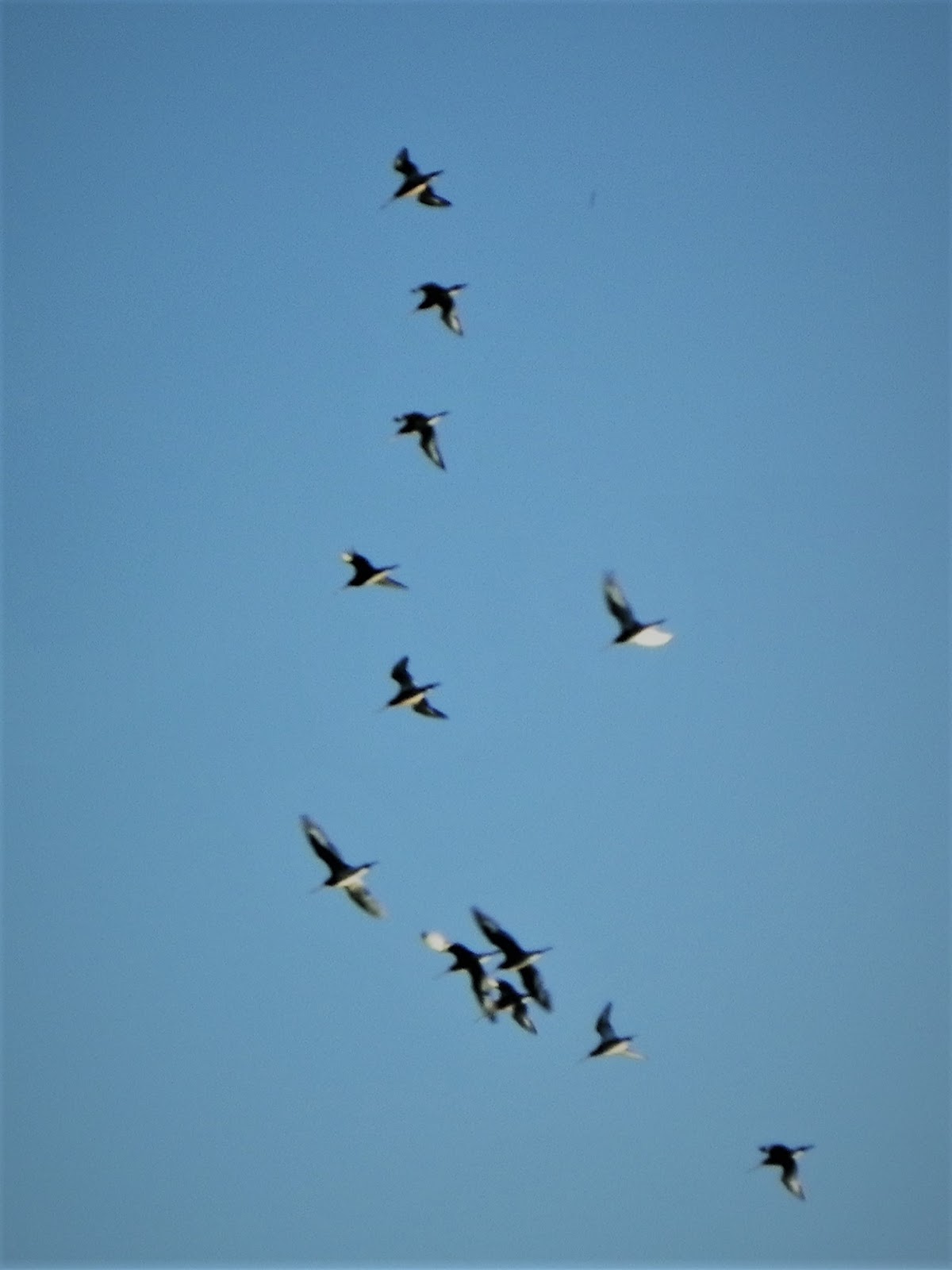
Any autumnal totals for wildfowl/wader migration just won't add up to anything meaningful. To that end, viz mig is a bit of a blow out here; but you can experience it here, and when you do, it's bloomin' wonderful; skeins of Brent, lines of Whimbrel, a rise of terns, all cutting in overland- a real joy.

Black-tails inland at dusk, Windmill Hill, 07/17

Common Terns inland over Gillingham, 08/17

Brent Geese inland over Moor Street, 09/17

Whimbrel inland over Lower Twydall, 08/17

Sunday, 19 November 2017

Visible migration- adjusting your position on it all

Seawatching? No thanks, I'd rather be bushwatching.

Bushwatching? Just turn that chair around to face inland, and watch those birds working through the bushes. Just like many early morning visible migrants are simply making a minor movement, seeking out a feeding spot, many birds can just feed and move, looking to find a safe spot during teh first few hours to allow them to rest up and ready themselves for the next leap home.

------

"Morning flights of migrating birds relate to density of nocturnal migration and direction and speed of nocturnal winds aloft", a nice little study available as an easy-to-absorb chart here:


Their conclusions?

"Coastal morning flight migrants may be correcting for wind drift incurred at night.."

"Stopover habitat selection may also be a factor.."

"General aversion for the ocean is evident.." (substitute 'large estuary' for 'ocean' here)

"Further inland, possibly other functions (involved such as) continued migration.."

"Local topography also exerts bias.."

Yes, yes, yes, yes and yes!

"Future research: increased coverage, more inland locations, spring morning flight.." Oh heck, a spring spent out on Horrid? Let me think about that one.

-----


My favourite place on earth for bushwatching? Point Pelee, Canada. No question.

Favourite place in north Kent? Sadly no longer really exists. Grain Power Station.

A dozen or so football stadium style pylons on site. Lighthouse-style attractions. With permission, several years spent getting a few spindly sallows established among the walkways.

A first flush, walking under the pylon lights just on dawn. Migrants into our mist nets. Then the second round, almost as productive, as birds that had holed up in dark corners move out to try to find good feeding. Finally, a third wave that we called 'the dog walker express pulling into shoreline central'. Over the perimiter fence they came, a flush of warblers that had been happy in habitat outside, but now felt too many threats to rest up. After the first two or three hours, all over. A trip to the western parts of the site, around the human-free scrubby water tank compound, would find a lot of birds.

Happy days.

Here on the South Medway? Horrid Hill? Nope.

Sharps Green. You've got one shot. Limited early morning parking keeps visitor numbers down at first, but there's a few die-hard locals who will be out, even pre-dawn. Most will stick to the paved paths at first, until the light is really good. Find your spot, a little ways in from the shore, where there's a nice hedgerow effect. And wait. On a good day, the waves get pushed through the area. All over after the first hour, but that good day will get you a total of 30, 40, 50 warblers. Less than you'll get elsewhere on the north Kent coast, but more than enough to keep you happy.

Tuesday, 14 November 2017

Visible migration: why bother?

A quite interesting factoid; did you know that the phrase 'visible migration' isn't in Ian Newton's magnificent New Naturalists tome, 'Bird Migration'?

Newton says "..the observer equipped only with binoculars might conclude that these were the very conditions that favoured migration, a view once firmly held by some but counter to reality. Birds also tend to fly low along coasts in these conditions, reluctant to strike out over water. We therefore have to distinguish the influence of weather in promoting migration from its influence in making migration to the casual observer.."

Like me, he knows viz mig can be impressive "..in coastal areas, diurnal migration is often spectacular.."but "..diurnal observations seldom do justice to the scale of the movements. This is because most migration occurs at night, or at altitudes too high to be easily seen by ground-based observers.."

Scuttled off to my fav five migration texts, and, yup, viz mig missing from all five.


I still love it. I get swept up by it. A nice sorbet to all the wader counts. I could rush off to the coast, like many birders do, but when life gives you lemons, you suck on it and pull a bitter face. The question becomes is there much visible migration visible here on the south shore.

So, for the first four autumns back on the Medway, I dipped my toe in the waters, trying various sites. 2013 saw a concerted effort from a private site inland just west of Rainham, 2014 a mix there and south and west towards the Downs, 2015 and a lot of the ridges east of Lower Halstow, 2016, time up on Windmill Hill just east of Otterham. 2017 found my mobility impaired as I awaited an operation for a condition that also impaired my ability to put up/take down nets for ringing. So, time for an all-out viz-mig effort out on Horrid Hill.

This was to be the conclusion to the question 'can you pick up on visible migration here on the south Medway and, if so, can it really provide any objective value?'

Starting late July/early August. Most observations won't be 'viz mig' then as mainly nocturnal migrants, but can some value be added to counts by, say, sticking it out for catching overland migration by waders/terns? September, can you pick up on departing long-distance migrant passerines? Come October, can we start to appreciate the scale and timing of finch arrivals through the south-east from the continent?

Can I convince more birders watching such minor spots is worthwhile? The big push for patch birding has been in place for a few years now, and is likely to have plateau-ed. How to convince others? The old 'Patagonia Picnic Stop' effect. Birding mindset is mainly that the whole of Kent is a valid playing field, and well-watched sites pull the crowds. Somewhere like Grain, at the mouth of the Medway, picks up nothing but bad press in the twittersphere, even though it still has good numbers of birds. Just that it's a big spot and you need to know how to bird it. Time in equals birds out, and most can't apply themselves nowadays- the lure of the biggie down the road on a reserve often wins out. And the southern shore is no Grain. If Grain can't attract regular migrant hunters, what chance the southern shore?

Hopefully, these viz mig posts over the next few days will help answer these questions.

--------------