Showing posts with label Knot. Show all posts

Thursday, 25 July 2019

Arrivals and departures- the early autumn avian hub

(This post is a little different, being a copy of my original speaker notes for an informal talk given today aboard the Jacob Marley, on an estuary cruise in support of Living River Foundation.
Rather than waste the time on the water with a lengthy lecture full of facts/figures, the talk was pared down to be short, general and informal, but with this lengthier blog then available with additional info after the event. Hope the general approach here of interest to some.)

----------


Arrivals and departures- the early autumn avian hub


Introduction


Grey Plovers

Forget the argument for a Boris Island. The north Kent marshes already handle internationally important numbers of flights every year.

The marshes are well known for the high numbers of overwintering wildfowl and waders. Why each of the north Kent hubs, the Thames, the Medway and the Swale, is recognised as internationally important and are internationally protected: Ramsar, SSSI, MPA.

The north Kent marshes also hold significant numbers of important breeding species.

But what about on migration? How many birds use the Medway? And what do they use it for?


Scheduled flights in July/ August
Wader passage starts in mid-June. For several species, the female's work is done by then, as she leaves the male to look after the eggs/young. Failed breeders and immature birds (some do not breed until they are four or five years old) also wander back in small numbers from mid-June onward. A hardened birder might enjoy getting out and finding the few returners, but not really a spectacle- yet.

By the last 10 days of July more people are noticing a build in numbers, as small flocks start to appear- tens, twenties for most, but some species already well into the hundreds. The rest of the breeding adults have started to move now. They will often desert their young, who then only follow on a few more weeks later.


The East Atlantic Flyway

The Medway is one hub within of a large network of refueling stations strung out along the main carrier route between the high Arctic and Africa. As we will see in the individual species accounts, different species have different travel plans for travelling the flyway, and will use the Medway in different ways.


Departures

Sandwich Terns

Birds are also leaving us now. Our breeding seabird species have nearly all left. A simple premise with colonial nesters- as any colony is a magnet for predators, as soon as your young fledge, move away.

Some that are estuary feeders might only move a short distance from colony (e.g. Common Terns, often to adjacent creeks and fleets), while others move their young to more open water elsewhere (Sandwich Terns, which feed more readily in open water, have now moved off to places such as east Kent).

Gull species that feed on the flats might now spend their time on higher mud nearer the shore, rarely visiting the colonies. And most will be back on the water to roost. Mediterranean Gulls are harder to find as, feeding more on insects, tend to move inland en masse (mostly via the North Downs).


Arrivals

Black-tailed Godwits

But there will be more arriving than departing.

Like people-watching the crowds at any hub airport, a little hard to tell who's coming/going by a quick look around the terminal; those same departing Gull/Tern species are also arriving from elsewhere; colony dispersers from elsewhere around the UK coast/ near continent. Why any series of counts of the estuary will never really give an idea of the total number of birds that pass through.

The waders are easier to call as arrivals. There were so few here for the summer for a start. And there can be many. Of course, we concentrate on peak wintering numbers, and some arriving now will indeed stay for the winter. One species known to prefer carrying out post-breeding moult on wintering grounds is the Curlew. July to March, some birds spend more time here each year than anywhere else, but we just think of them as 'wintering'.

But many autumn bird move on.


Connecting flights

Oystercatchers

Inter-continental journeys, from the north American high arctic, or from Siberia, then on to African shores, often have to be made in stages. Too long a journey for a single flight. Stop and refuel, stop and refuel.

Often not as simple as a quick feed-up, often need a few days, weeks, to rebuild reserves. These are their scheduled short-haul flights; many older birds use the same estuaries, even the same small creek on the same estuary, year after year; they enjoyed the facilities before, so they'll use them again.

This is why some species actually have their peak numbers in autumn, rather than winter as many of us are led to believe.

And if you look carefully enough, some wintering species have two distinct peaks, a mid-/late- winter peak and an autumn peak- a gap between the movers and the stayers. Others have numbers departing for warmer climes obscured by arrivals from other continental hubs (continental hubs tend to be much more challenging in winter than those on our mild UK Atlantic coastline). Monthly counts in autumn may look fairly similar to winter, but the individual turnover has been much higher than the numbers show. (Where individual monitoring through methods such as colour-ringing and radio-tagging comes in useful to prove hub usage.)


Stopovers, long and short stays
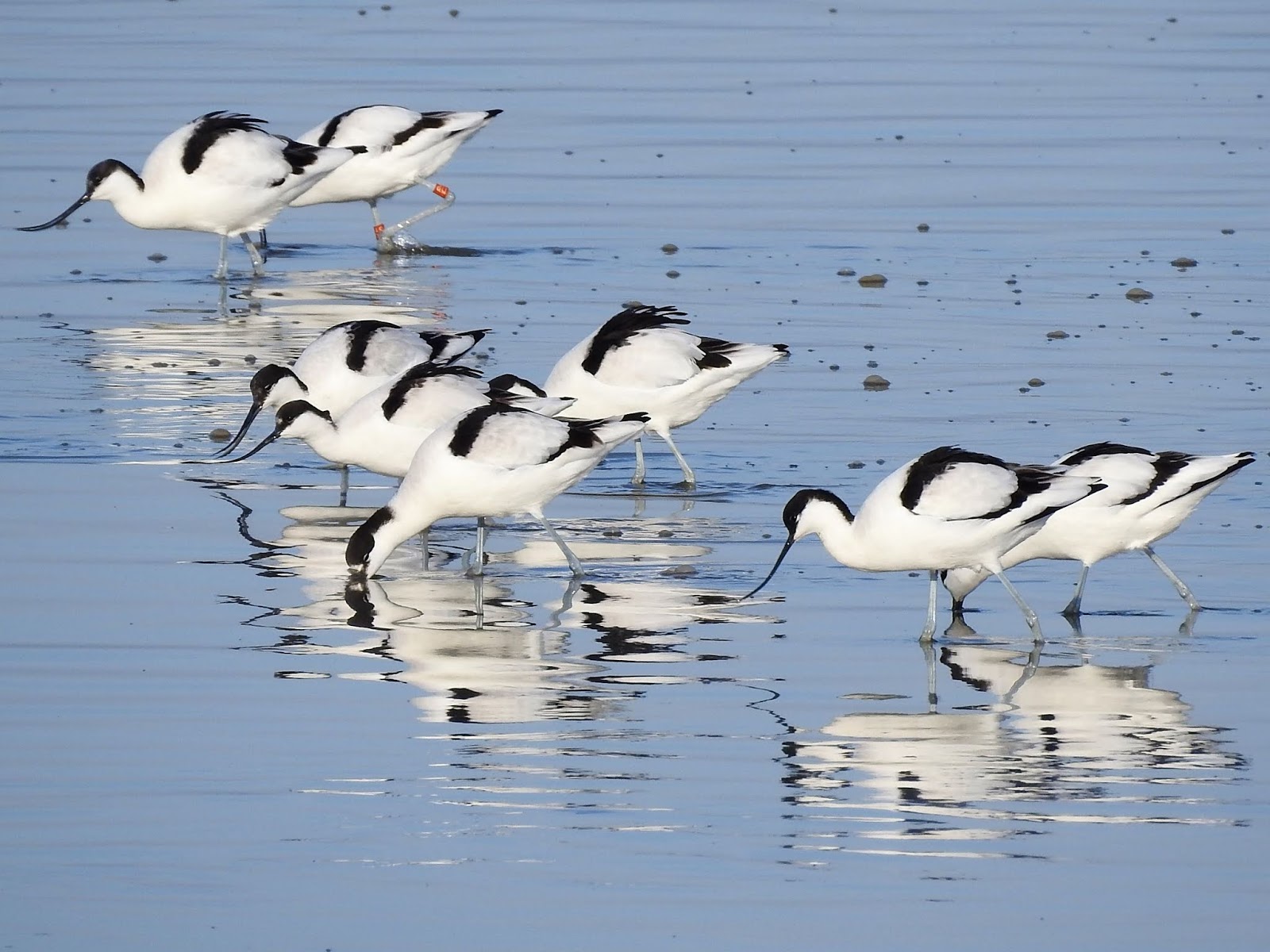
Avocets

Migration isn't cheap. As well as fuel, there's feather wear and tear. All birds have to replace their plumage. This takes more time in larger birds, for most waders around 90 days.

Redshank love the stopover facilities on the Medway. First birds are back on the flats post breeding, late June. Local breeders are joined by birds from the near continent, then later from northern Europe and finally Iceland. The 'continental' birds are most likely to continue south after moulting, on to as far as west Africa for the winter. The Icelandic usually tend to stay on here- they don't mind the cold, being slightly bigger birds. All populations within a species have different degrees of attachment to an area. Redshank overall numbers are smallest in summer, highest on autumn passage, somewhat lower during winter. Why we need to survey through the whole of the year to understand what goes on.

Several species behave similarly but differently, with populations having different strategies; when Grey Plovers arrive, some wil moult and then stay, others simply refuel, then carry on south to moult later.


Diverted air traffic

Black-tailed Godwits

Youngsters have a general idea where they're heading, but are more prone to land at unscheduled sites. Why those rarities that twitchers chase often turn out to be youngsters. If they find a rare adult wader, why twitchers then they have high hopes it might well turn back up same time following year.


Customs on arrival

Turnstones

We've seen it isn't that easy to spot the incoming, what with so many other movements going on during the twice-daily ebb and flow. The Medway, as an 'inland estuary', doesn't really have a coastline, so we don't see birds fly 'in-off'..

So, one of the easier ways to pick out arrivals is on a covering tide. Birds are wary. Even if they know the area, they will still need to check that last autumn's safe roost site is still safe. Juveniles have no idea, they watch and wait out on the flats, often until the tide is up to their bellies, before dashing to a roost; they will have watched local birds leaving long before to settle for the high tide.

Also, the main runway for arrivals appears to usually be mid-estuary. Makes sense, the quietest areas will be central to this 60 square kilometre eastuary. A chance to rest up upon touchdown before exploring. Small flights of 10s, 20s, 30s can often be seen dropping in from height (local/settled birds rarely bother to gain too much height when traversing the area- why waste energy?)

So, the individual species- how do they use the Medway? A short cut-out-and-keep guide follows.

----------

Plain spotting at the hub:

A short guide to the common wader species
found on the Medway 
during late July/early August


Curlew

The following accounts are simplified guides to the commonest waders using the Medway as a hub in July and August, including:
- Points of departure
- Final destinations
- length of stay in the UK
- Reason for visit (their moult strategies whilst on the Medway)
- Passenger number estimates: average maximum figures for July and August are taken from WeBS/KOS reports. There are two sets, illustrative only, as  surveying has often been incomplete since the turn of the century. The first figures, for the 90s, were done partly when the Medway was better surveyed. The 00s counts are now acknowledged as probably unfit for purpose. Finally my comments, which are based on my own nigh-daily visits to the estuary, from 2013 to date.


Oystercatcher


Local breeding population: Most choose not to fly far from the estuary, though a few (mainly their youngsters) head south (to near continent, exceptionally as far as Africa).

Local non-breeding population: stay local all year, augmented by very young Norwegian birds (who from age of two tend to move nearer their natal grounds in summer).

Main winter arrivals are not until October/November. Chiefly Fennoscandian birds, mainly Norwegian. Others from the Low Countries, with small numbers from Iceland e. to Estonia.

Moult (adult)- postbreeding, complete: flight feathers usually changed September- December, may occasionally arrest during passage (technical term- the moult halts then later begins again from the start by changing both new and remaining old flight feathers). Why the bulk of our wintering birds, moulting somewhere else along the flyway nearer to their nesting grounds, do not start to arrive until much later in the year.

Average nos 1990-99 July 616 August 1,008
Average nos 2000-09 July 700 August 670
In recent years more sampling has revealed numbers to still be in four figures from around now, but the picture is complicated by individuals using one estuary (Greater Thames) to feed then roosting in another (Medway), if disturbed or if spring tides reduce carrying capacities- numbers can be tripled over certain tides


Avocet


Chiefly short-distance flights at present, switching between local breeding estuaries (east Anglia southwards) and local moulting grounds (such as the Thames at Cliffe). They then Settle on a choice of estuary for winter, usually within southern UK- but not necessarily the one they bred on.

Moult (adult)- postbreeding, complete. Flight feathers start in July, to October (November). Winter numbers on the Medway do not peak until after this time.

Average nos 1990-99 July 66 August 182
Average nos 2000-09 July 135 August 147
In recent years, due to increasing breeding numbers, July numbers have continued to grow, but most will have left for safer moulting areas by month end- August has similarly low numbers nowadays.


Ringed Plover


A collapse in numbers in recent decades, now almost extinct as a breeding species on the estuary. Any remaining local birds will be joined by birds from northern Europe for the winter, with 'tundrae' (birds from the high north of Scandinavia e. into Siberia) passing through in variable numbers during autumn. A definite early autumn peak in passage numbers, but birds 'short stop' and may only be present for a short period. Counts are often missed.

Moult (adult)- postbreeding, complete. Highly variable sequences, usually starting on breeding grounds, from mid-June to as late as October, most suspending the primary feather moult during peak passage period (August- September). Right now they will have grown a small number of new flight feathers to help their journey south, our breeders perhaps going as far as France/Spain while the Scandinavians 'leap-frog' us to go as far as Africa

Average nos 1990-99 July 124 August 904
Average nos 2000-09 July 12 August 155
In recent years numbers have remained low, just double figures most days, although the odd three-figure count does still get made- just as for breeding, Ringed Plovers find our increased activity and urbanisation have made the Medway less attractive. Any high shoreline fronts (their favoured areas) are too disturbed (or more often flooded by increasingly high spring tides) for hold them for long.


Golden Plover


A small number arrive around now and will remain to overwinter. Origins unknown, possibly British/ near continent.

Varying numbers then arrive in late autumn/early winter. ('last minute bookings' to escape harshest of the winter weather on the continent). Further urbanisation of the green areas surrounding the Medway will reduce the Medway's carrying capacity- birds that spend the day roosting on marshes such as Chetney do need inland fields in which to feed at night.

Moult (adult)- postbreeding, complete. Starts late May- July, often suspends July-August, restarting mid-September- early November. July August is the move from breeding grounds, the flight feathers are pristine at the start of winter ready for 'escape movements' from bad weather.

Average nos 1990-99 July 7 August 40
Average nos 2000-09 July 11 August 97
Numbers on the Funton mudflats have, in recent years, been slightly higher (up to around the 200 mark) and, interestingly, these birds then tend to continue to roost on the flats rather than join the later arrivals in the fields.


Grey Plover


First landings are usually  scheduled for late July, the start of adult passage, with youngsters then not turning up until September.

Moult (adult)- postbreeding, complete. Starts on wintering ground or on specific staging ground. Starts flight feathers between August- early October, but birds starting from September onwards will suspend from mid-October and only restart in spring. ('Suspend' another technical term; stops, then restarts later from point where halted earlier- so, different from 'arrest'.) Birds present on the Medway in early August will either be adults about to either pass through quickly, or here to establish a feeding territory and remain to moult. Why easy to miss the highest counts if only counting a few times each month.

Average nos 1990-99 July 180 August 1,556
Average nos 2000-09 July 7 August 131
Recent numbers still reflect 1990 figures. Most of the larger flocks do tend to favour the less-disturbed flats mid-estuary, perhaps hinting at their being 'short-stayers'.


Lapwing

Small numbers will have been arriving since June, mainly from the near continent. Some return year after year to winter, mainly late Sept-Nov, but the biggest numbers only will only be seen if they need to escape poor bad winter weather. Biggest numbers will always be on the fields rather than the mudflats.

Moult (adult)- postbreeding, complete. May/June- August/September. The species has a very fast moult of outer primaries to aid early autumn movements.

Average nos 1990-99 July 313 August 513
Average nos 2000-09 July 138 August 347
Another species where older records better reflect the present position- incomplete coverage has underplayed the estuary's true numbers. The drier the summer, the more easily detectable out on the mudflats (instead hidden up in the harder-to-view/count fields spread around the marshes).


Knot


Small numbers on autumn passage. Biggest numbers are December-February, made up of wintering wanderers who, having spent first part of winter elsewhere on the east coast, take a short flight to enjoy the Medway cuisine. Fussy eaters, Knot rely on molluscs more than many of the other calidrid species (why they are fixated with only certain muflats here).

Moult (adult)- postbreeding, complete. Might start on breeding grounds, but usually not until in wintering area. Subspecies canutus starts when reaches Mauritania in August-September, subspecies islandica start as soon as arrive in western Europe (July/August) but these stay mainly on recognised moult grounds (e.g. Morecambe Bay, the Wash); 'our' August birds are usually of the race canutus, from western Siberia, heading for Africa.

Average nos 1990-99 July 0 August 171
Average nos 2000-09 July 0 August 50
Recent years very similar, and erratic in number from year to year. A clear example of flight diversions by way of a departure from the scheduled route- here, birds usually relocate after a day or so, probably having overshot the Wash or the Waddenzee (Netherlands).


Dunlin


schinzii- Greenland/Iceland to Norway- small numbers on transit through the early autumn.
alpina- northern Europe to north-west Siberia- these are our overwinterers, not booking in until October/November.

Moult- postbreeding, complete. Just as each race has its own wintering preferences, each has a differing moult strategy. Schinzii moults after migration, alpina may start and then suspend before migrating, often to complete on other specific staging grounds along the flyway before finishing in October (just in time for many to make the final flight to their north Kent wintering grounds). Why many of the small number of adults seen now are likely schinzii, making short stopovers before racing off south.

Average nos 1990-99 July 350 August 1,774
Average nos 2000-09 July 8 August 443
One of the few species where a decline appears to have continued; hard work nowadays for three-figure count at this time of year. Clearly refueling elsewhere. If their main flyway is west to Norway then down through Europe, most will stick to the continental side of the Channel- when they do drift over, they stay more to the south coast than north Kent.


Black-tailed Godwit


Often higher numbers in autumn than in winter. First returnees from Iceland arrive late June, continuing to build through August, to make a moult stopover, with many then moving on to spend the later winter months on the south coast, over in France, or as far south as Portugal.

Moult (adult, islandica)- postbreeding, complete. The flight feather moult takes place after main flight from Iceland, from August to December, when birds may then move on. Birds seen now on the Medway will intend to stay here on the north Kent marshes to see out this important stage of their moult cycle.

Average nos 1990-99 July 232 August 979
Average nos 2000-09 July 298 August 570
Nowadays, four figure counts in August are the norm. (Reflecting the growth in breeding numbers in Iceland).


Whimbrel

Small numbers pass through in early autumn. A species which we see more in the spring than the autumn. The bulk of their population moving through the UK (breeding in Iceland) adjusts their flightline to Africa, sticking to the west via Ireland. The birds we see in the autumn are more likely from Scaninavian/Siberian populations.

Moult (adult)- postbreeding, complete. Usually not started until on wintering grounds in Africa, September/October onwards (a neat aide to separating from moulting Curlew in distant flight at this time of year). Stopovers here are for refueling purposes only.

Average nos not readily available from the old printed annual reports. Partly because they weren't here in any number then. Whimbrel can be fickle and switch refueling sites every few years. Recently a three figure roost has become regular around Nor/Friars/Oakham at this time of year, but only for a matter of a few weeks before continuing on to the wintering grounds to moult.


Curlew


Annual peak numbers are in the autumn, usually September. Safe moulting out around the Medway islands. The drop off in monthly counts later in the winter is probably down to feeding strategies as Curlew, more specifically the shorter-billed males, prefer to feed in fields as winter progresses. Further urbanisation will affect the Medway's carrying capacity.

Moult (adult)- postbreeding, complete. Primary flight feathers start in July/ August, shortly after arriving on wintering grounds. Take 12 weeks to complete.

Average nos 1990-99 July 786 August 1,599
Average nos 2000-09 July 134 August 178
Recent numbers reflect the more methodical counts of the 1990s. In fact, a series of counts will often produce peaks- like Oystercatcher, under certain tidal conditions/ disturbance levels, many of the Thames birds will join the Medway (and Swale) moulters. Another reason why counts should be coordinated not only within the Medway estuary, but on the Thames and Swale as well.


Redshank


Late autumn peak, although moulting numbers are already quite high. Rough and ready rule of thumb, most Icelandics overwinter, quite a few continentals carry on south. And some local movement to the near continent.

Moult (adult)- postbreeding, complete. Flight feathers start in late June to September. Usually remain on moulting grounds throughout, but can still continue on migration before finishedif needs must (a strategy more prevalent in continental birds).

Average nos 1990-99 July 2,294 August 3,523
Average nos 2000-09 July 208 August 404
Numbers moulting within my study area (the southern shoreline) probably reflect an autumn population perhaps only a little under those 1990 figures. Get the count time right (on the rise for birds retiring into the spartina) and single creek roosts here can exceed 700, 800 birds.


Greenshank


Small numbers build to a first peak at the end of July, when the bulk of the breeding adults arrive. A second peak follows two- three weeks later, as the juveniles join them. Very small numbers then remain to overwinter.

Moult (adult)- postbreeding, complete. Moult of flight feathers might start on breeding grounds, then suspend until reach moulting  grounds such as the Medway. Moult takes place July to September (though some may then suspend unifinished moult until they reach their wintering grounds).
Birds here in early autumn are here for safe moulting.

Average nos 1990-99 July 21 August 60
Average nos 2000-09 July 17 August 54
Greenshank behave a lot like their red-shanked cousins, and are often hidden up over the usual WeBS counting period (high tide itself); by counting birds into roost, three figure counts are in truth easily achievable during August.


Turnstone


Fennoscandian population: on transit for south
Greenland/Canada: arriving slightly later, for winter.

Moult (adult)- postbreeding, complete. Birds make a choice of two strategies. #One, starting late-June- August by birds intending to overwinter in northern hemisphere. #Two, for birds overwintering south of the equator, flight feather replacement commences mid-September.

Many of the Turnstone on the Medway in the early autumn peak show no sign of a wing moult, hinting at a short stopover and a long journey ahead.

Average nos 1990-99 July 97 August 726
Average nos 2000-09 July 22 August 43
Again, counts are more usually closer to the 1990s. A species that shows a clear weekend disturbance pattern (more often heading to central estuary roosts rather than the old hulks closer to the shoreline footpaths).

----------

Hopefully this short introduction to the Medway's early autumn bird migrants has helped illustrate the large numbers of waders that will use the estuary during an autumn. It is a complex situation, with every month different; making sense of the way the birds continue to use this estuary is challenging but highly rewarding. Because the estuary needs to be understood if we are to protect it- which brings me neatly back to our hosts tonight, the Living River Foundation- we really do need to know what effect plastic is having on our breeders, our migrants, our overwinterers, on their fuel living in the estuary? I'm sure we all wish them well in their monitoring work- and thank you for coming out and supporting them tonight.


Saturday, 24 February 2018

Weigh heigh! And up she rises?

The Westmoreland was wrecked off of Hoo over on the north shore back in 1973. Another of the many old sailing barges to come a cropper. Her agony has been prolonged. The wreck was taken to Faversham, in the hopes of restoration, but time and money ran out a few years back. The owner of the Edith May then stepped in and bought her and transfered her, on a floating dock, to Halstow Creek, where she has sat out at the end of the old causeway.

-----

Friday, an hour before the tide covers the flats. Halstow creek is busy with Pintail and Brent. Both are up in number, even though numbers have been going down; an internal estuary movement of lowering estuary numbers as the fowl try to gain a little shelter from the increasing easterly wind.

A figure passes me. I look up and see they are carrying a shovel. Curiosity is aroused; the local Parish Council have long-since stopped bait-digging here, but one or two still flout their rules. But a bait-digger uses a fork? And has a bucket to carry the bait in. This chap clearly had a spade and a rather large spray can of compressed air. Curiosity dials up to eleven.

They cut down off the seawall and out onto the old causeway. Now overgrown with weed, and with sections of the brickwork missing, it is not a particularly nice walk. I've done it twice in five years. Both times on an ebbing tide, to follow the waders out, at a distance. I'm in no hurry to try again. On the rise? Wouldn't risk it and besides, there would be an awful lot of birds disturbed.


I think he must be an owner of one of the handful of sailboats kept out there but, no, he keeps going, going, going.. right off the end, knee-deep in the clinging mud, pausing only to retrieve.. a child's plastic sledge. And make for the Westmoreland.


All sorts of alarms go off in my head. During the past five years I'd seen enough wreckers on hulks to know there's money in old metal. Was he planning on dragging some back? I'd planned to be off to Funton by now, but it could wait a little longer. I like the Thames barges, and didn't want anything happening to this one.

He disappears inside the floating dock. Through the 'scope, every now and then I spot his head bob up, then I see I saw a camera. What was happening?

------

Of course, there is absolutely nothing to stop anyone going out on the estuary at Lower Halstow, though I wouldn't advise wading through the soft mud to anyone who's never tried it under guidance from someone with experience. You don't walk as such; lift a leg for a stride and down you go and 'stickfast'. There's a technique to wlaking the mudflats, and I'm not telling you! Instead I'll save your life here by keeping you to the seawall.

Although us birders know Twinney and Halstow creeks are a spectacle, neither are protected from routine usage. Disturbance is to be expected. So, as well as watching the mystery mudskipper, I watched the birds.

It was a rising tide, early afternoon. So, not too many gulls loafing on the causeway. By the last third of February you can usually expect to find the first handful of Mediterranean Gulls back among the Black-heads. There were eight, but they were sheltering alongside Halstow Creek. The Lapwing were in fair number for here though; often resting birds disturbed from the fields overfly, with some coming down to roost safely on the causeway; a three-figure number went up, along with a handful of Oystercatchers and Turnstones.

On the mud itself, many of the larger waders and wildfowl were soon off; they never appreciate a close approach. The smaller, as usual, stayed in more numbers, but I always add a caveat to that rule. The tighter the flock, the quicker they go; all it takes is one flustered bird to set off a flush. And the wildfowl on the water in Halstow Creek near to the Westmoreland? They retreated to the far bank.


------

The 'wrecker' was off ahead of the tide, just, with his sledge laden with.. well.. nothing. And he brought it all the way back to shore. Quickly noting any second phase of flighting (just double figures of Lapwing had been happy enough to land back on the causeway, but now followed the others to Barksore), I moved to a point where I could intercept the chap and strike up a conversation.

Bad news. On Monday, in poor weather, the dry dock had decided to hole; the Westmoreland was no longer afloat. For me, the penny, like the barge, dropped. The can of compressed air was for opening/closing old rusty seals or similar; letting the water out. That's why he had gone out on the rise. To close things up. Open on the drop, close on the rise. And if I had had half a brain, I'd have noted the Westmoreland had shifted when I 'scoped it. Actually, shifted was an understatement. More liked twisted (or as the chap said, 'popped'). The shovel was to clear mud, the sledge perhaps a buoyancy aide to spread weight as the soft mud sucked up water on the incoming tide? Probably still got a bit of all that wrong, but I didn't need to ask.

We chatted for a few minutes. I asked after the Westmoreland's fate, bearing in mind Lottery funding had been turned down. They hasn't given up hope yet. The owners are Lower Halstow through and through, and the Westmoreland is a part of this village's history.

-----

An estuary doesn't just belong to the birds. The Medway is no exception. Lower Halstow, for birders, is one of the gems of the southern shore. But for now I understand we'll be seeing more flighting, more 'necessary' disturbance to the feeding birds- and right at the start of the coldest winter weather here for five years.

Here on the blog I sometimes mention the estuary is protected by Ramsar. The Ramsar Convention on 'Wetlands of International Importance especially as Waterfowl Habitat' is an international treaty for the conservation and sustainable use of wetlands. Recreational use has to avoid a detrimental effect. This was an unfortunate incident.

The Westmoreland had 'popped' on Monday. The end of February usually sees a drop in Knot numbers as they move off to the Waddenzee, but I'd been puzzling all week over why they had so suddenly moved out of the Halstow/Twinney creeks. There were still numbers in Funton still, but Lower Halstow's rising tide flock had gone, seemingly.

But another good excuse to keep going out at the moment. An bit of an impact study of sorts. The counts would be dull, but the more you don't see, the more you understand.

Friday, 10 February 2017

Knot, Tellin: the full story

The other day I had the pleasure of showing someone around the southern Medway. Of course, the only day/time they could visit was when tides were poor for showing off the birds. An already nigh-fully uncovered dropping neap. Ouch. Close up views were going to be at a premium, so it was down to playing with numbers. I decided we could tell a story of inter-tidal movement through a game of 'chase the Knot'.

Kicked off with a  deliberate 'miss' at Funton; no Knot in view. (They would have roosted up Stangate, and more favoured muds were opening up as dawn broke.)

Followed this up with a jaunt to Shoregate and views over Ham Ooze for the win. The Knot were there. Impossible to see with the naked eye. No matter to start with, my visitor had the chance to soak up the atmosphere of bleak Dickensian marshes at their finest, framed by the distant curve of the new Sheppey bridge.

Of course, the distance these Knot were at made them hard to pick up with 'bins. I'd cheated, prior knowledge, I knew they'd start at the higher flats. To ensure they enjoyed the spectacle, the 'scope came out. I set up on the 'rear' of the flock tight by Slayhills saltings, and told my guest to keep scanning along the line towards the river. And keep scanning... keeeep scanning.... keeeeeeeep scanning...

Mission accomplished- suitably impressed with the spectacle (though I noted numbers were down), my visitor left with an impression of the importance of Ham Ooze within this complex estuary complex, not just for the Knot, but for all the other species present.

- - - - - - -


Racing Knots

"Immature Knots visit our Medway mud flats in very small numbers in the autumn; half a dozen is the most I have met with at this time together..."
Prentis, "Notes on the Birds of Rainham including the district between Chatham and Sittingbourne", 1894

We see two races of Knot here in the U.K. Unfortunately these races are assigned mainly on geographical grounds- breeding continents apart, wintering continents apart, having different travel arrangements. And for the ringer the visual differences are, putting it mildly, highly subtle and subjective. Birders have little chance of seeing any difference. Knowing about the differences helps to appreciate them though.

Islandica breed in northern Greenland and the islands of high Arctic Canada. The UK and Ireland support about 70% of their total population in midwinter.

Siberian Knot (specifically, largely from around the Taimyr peninsula), canutus, pass through the Waddenzee en route for their wintering grounds in Africa.


Knot, Funton, February 2014


Migration routes- the flow comes in

"The Knot is one of the species most frequently heard during its migration as it passes over our sea-side towns, attracted by the glare of the lights during dark nights, and is easily recognised by its peculiar croaking cry amongst the babel of cries of the other wading birds..."
Ticehurst, 'A History of the Birds of Kent', 1909.

Islandica leave late summer, short-stopping in Iceland before making directly for their chosen moulting grounds.

Canutus are known to occur, in North Kent, thanks to September ringed birds popping up in Africa in October. Chances are that most early autumn birds are canutus. Most of the canutus ringed in the UK are juveniles on their first migration, mirroring the age of the majority of late summer sightings on the Medway. Adult Knot in brick-coloured summer finery are a red letter day. I have yet to find any hints of islandica adults, birds staying for any length of time, showing signs of moult. There is no staging here.

There are also relatively few oversummering birds in the UK, with Knot returning to breeding grounds in their first summer. The ringing atlas considers this choice to be down to body condition, being individuals simply not fit enough to undertake the flight back.


Staging in the Waddenzee

The huge estuary complex between the Netherlands and Denmark is a safe moulting area. Moult takes about three months, between August and October. Once complete, birds move on to their wintering grounds. Many of 'our' Knot here in the south are presumed to be from the Waddenzee. The nearest U.K. staging post, the Wash, sees a similar redistribution but apparently mostly to the north


Winter adjustments

"Though a few arrive in imd-October, they are seldom abundant until until December, and, when severe conditions set in, individual flocks may total up to a thousand or very occasionally double this number..."
Gillham and Homes, 'The Birds of the North Kent Marshes', 1950.

The Migration Atlas reports that arrival dates of ringed birds shows dispersal from moulting areas to wintering grounds taking place between October and December. Arrivals here are always at the latter end of that timescale.

It also suggests inter-estuary movements occur, as a response to food availability. (Both annual changes and intra-seasonal adjustments).

Ringing evidence now suggests the 'old conclusions' of hard weather adjustments, as supposed by the authors such as Gillham and Homes, are not that important in the scale of things, perhaps not even happening. This seems at odds with their apparent rational thinking, but drops in numbers counted during severe weather at sites like the Waddenzee are now known to be more often down to logistical problems for the counters themselves. (I sympathise. As a soft southerner I find it hard to force myself to stroll out in a drizzle.)

So, birds are known to then make for the UK through the last months of the year, then shuffle about mainly due not to weather but a change from a diet of their favoured bivalves (the Baltic Tellin) to snails (hydrobia)

A Baltic Tellin distribution map here shows the Greater Thames estuary is a stronghold for the favoured food. Medway, not so much. Having been a bit of a budding (bumbling) concologist when working at Sandwich, the shell is a familiar one, and one I do not encounter that often here.

Looking at the month-by-month peaks, the Medway December numbers follow a short arrival period, whilst the Thames overall numbers build from October to December. The Medway December influx happens at the time that food switch is suspected to happen.

Are 'my' birds arrivals from the Waddenzee, or early arrivals repositioning themselves from Essex? Hard to say.

The New Atlas confirms there is routine interchange between nearby sites (estuaries), which can lead to large fluctuations in a season. Checking the WeBS interface, it is interesting to note the Swale peaks in February, the Thames and Medway in December.

Ringed Knot, south Medway, September 2016


Numbers

"...the compact flocks of Knot... move from place to place and keep so much together, that they are usually seen in large numbers or not at all..." Gillham and Homes, 'The Birds of the North Kent Marshes', 1950.

Taylor quotes mean winter peaks of Knot for the Medway as
2,300 1953/54-1960/61
2,000 1961/62- 1968/69
   900 1969/70- 1976/77

A decade on, Holloway in the Birds of Gillingham stated "About 100 or so regularly winter in the estuary and can be seen feeding in very tight flocks on the mud-flats..." Certainly numbers were low until the 1990s when we benefited at the expense of the Waddenzee (the causes are explained later). A simple charting of peak counts from published Kent Bird Reports shows the upsurge in numbers:


The annual WeBS peaks in the winters since I came back to the Medway in late 2012 have been much lower than the true numbers on the estuary, being just:
   2012-13:   75
   2013-14: 200
   2014-15: 100
The WeBS five year average is just 1,306.

In reality, there have been triple that for the south shore alone. Two roost sites on the eastern side of Stangate have been favoured, with switches to Deadman's and, infrequently, to Bishop's.

So, despite the picture given by WeBS, there have been routine nationally important totals present (3,200 being the present threshold) and the international threshold (4,500) has been broken on several occasions (counts by other observers can be found on the county's database ).


Rainham Creek, January 2015


Migration routes- on the March

The routine return is via the Waddenzee. Spring numbers there are much higher than in autumn; many Knot that moulted in the U.K. in the autumn go there in preference to our shores. Most will not leave the Waddenzee until mid-May to stage in either Iceland or in just a couple of fjords in northern Norway prior to hastening to the breeding grounds late May/ early June and getting straight into breeding.

If you are lucky enough to find a Knot sporting a yellow leg flag then this will be a Norwegian stager; a few have been reported from the Medway in recent years.

Squint hard enough and that Knot is wearing a yellow flag; Twinney, February 2014


Population crashes- on the breeding grounds

Knot have some tremendous variances in numbers. They suffered a huge crash in the 1970s, from which there was only a slow recovery. It was thought to have been caused by a series of poor breeding seasons. By mid 80's they were down to a population of around 345,000, from 609,000. There have been good years since, but the species is red-listed by BirdLife International as 'near-threatened' in part because trends and numbers are so unclear.


Population crashes- on the wintering grounds

Between 1996 and 2005 more than 50% of the suitable feeding areas on the Waddenzee were lost, with monitoring confirming Knot numbers dropping by half during that period as well. This was all down to the cockle industry and a government policy which allowed large-scale damage by mechanical dredging. Ringing recoveries have shown some Knot did manage to relocate to sites in Britain and France. Same happened to some degree with the Wash. Woods, writing in 2007 in 'The Birds of Essex' reported that, nationally, numbers had recently decreased by some 15% but, at the same time his county had seen an increase of some 40%.


So, do the Medway birds arrive via Essex or direct from Waddenzee?

Although there will be a turnover of birds masking true numbers using the Thames, generally Essex numbers increase sharply in November to then peak in January. The Medway rise follows later, with the first large arrivals now usually seen in early December.

Sadly, the Migration Atlas highlights the Greater Thames is under-represented in ringing results. Not enough birds ringed, not enough retrapped. The simplest model is of birds arriving on the Essex flats, then dispersing. Usually Medway birds first turn up 'mid-river', out on the Ham Ooze then settling into routines around Twinney, Halstow and Funton. To buck that trend, in one autumn I witnessed first large numbers arriving via the Swale, cutting overland west over both Chetney and then Barksore.

Four winters in, it's fair to say I really don't yet know how the dispersal/displacement operates in this part of the world.

Knot crossing Barksore, December 2014


Taking the high ground

"Mr G.B.Rimes wrote me (31.v.1948) to the effect he had met with small parties at Motney Hill in the winter, but apparently these birds are not much given to straying far from the tidal basins and their immediate inlets and tributaries" Harrison, The Birds of Kent, 1953

Settling arrivals stick close to Funton Creek, close to Bedlams, on the northern edge of Twinney, close to Slayhills. All areas that, often up to this point in the wintering season, have not been favoured by other species in large numbers.

All are wide and open areas, better for accommodating a large flock. They are also what I think of as 'higher ground', and are what I now know to be exactly that being harder, sandier areas. Many other species have not been targetting any Tellin to be found in their sort of habitat. They may well be dining out on favourite food before switching to the hydrobia in the softer mud. All just a theory, but it keeps me guessing...


Taking to the roost


Though the birds can and do turn up all around the estuary, the normal pattern for a rising tide, from low water to covering (yellow), is for the Knot to start out on Ham Ooze. As the tide covers the Ooze from around the 2.5 metre mark, the birds move either to Funton (the edge of the Creek, or Bedlams Bottom, often split between the two) or to Twinney. Both flightpaths take Millfordhope Creek, and avoid cutting over the islands.

The main roost has been at Chetney Hill (red), but will also roost further north along Stangate Creek or along Deadman's island.

Less frequently (yellow circles) birds will use Bishop Ooze at low water and then sometimes feed around Rainham Creek. When remaining in this western basin for several days, the roost may move to Bishop Saltings (red square).


Taking cnout

"Deducing the overall migration system requires a flyway-scale analysis of Knot ring-recoveries." Davidson, in 'The Migration Atlas; movements of the birds of Britain and Ireland', 2002.

Similarly, efforts to find out more on Knot numbers in the greater Thames require a co-ordinated effort. The possibility is there for the wader counters of both Kent and Essex to get heads together and ensure the Thames counts are co-ordinated. A logistical nightmare for sure, but the birds would benefit.

One day...

Yes, I know some regular readers will now be banging their heads off of keyboards muttering "he's off on the hobby horse again". Perhaps I should now mention that person I was showing around the other day had already been looking at existing published counts in a professional capacity, and finding them nowhere near as useful as they could be if they were being carried out correctly.

One day...

In the meantime, if anyone feels the urge they can help by having a go at counting/estimating numbers ofany flocks they encounter.

Monday, 12 December 2016

Off the shelves

Following my recent pelagic post, just how deep is the deep water in the Medway?

The deepest waters are at the mouth; to the east of the Isle of Grain, the aptly named Sheerness Harbour Reach (starting in the north-east corner of the picture below) is 21 metres deep in places. That's 21 metres below the chart datum low water mark, which equates to the lowest astronomical tide. So, 21 metres is the minimum depth you'll encounter; on the highest tides you'd have a water depth of a little under 28 metres, give or take a choppy wave/trough. That would sort out most diving birds save the auks. To the south of Grain, Saltpan Reach runs for most of its length at around 13 metres deep.


At the eastern end of Saltpan Reach the deep water navigation channel, marked by the familiar red and green buoys, shallows out at seven metres, with just an incredibly narrow eleven metre channel (marked in blue on the map). To the north of this channel lays the Stoke Shelf, with a depth of just some three and a half metres below the chart datum low water mark, the similarly shallow Stoke Shoal just to the south and west (yellow circles).

South and east of the eleven metre channel is the extensive Sharpness Shelf, just two to four metres in places.

Small wonder the local tugs are kept busy piloting the large Liquefied Natural Gas tankers. The main water body alongside port facilities is dredged routinely to a depth of around 15 metres for these tankers and container ships, but for much of the southern edge the deep water lays some distance out from the shore.

No wonder the birding is hard. How important is a deep water channel for the birds? Feeding? This is a large open area of water where prey can be widespread. There is a more important navigation theory. Most seabirds can easily detect such channels, and stick over them. Theoretically, any seabird silly enough to take the dog-leg into the Medway from the Greater Thames will stay closer to the northern shore- and to date my own observations have shown this to often be the case, especially with Skuas. (This is a well known phenomenon on the Thames- the Channel runs close to the Essex shore and they get close views- but lousy lighting. Kent birders, with the sun behind them, get distant but clear views.)

The next interesting question is whether that narrow, dog-leg eleven metre deep channel at the end of Saltpan Reach is so small as to deter some birds from venturing further up estuary.

The shallower channel opens again to become Kethole Reach, running down to just south of Oakham island. The maximum depth has now dropped to seven metres. Often storm-blown seabirds just circle Kethole, especially when poor weather obscures exit routes. They either
 - (i) head back out past Grain,
 - (ii) gain height and go overland (seabirds often to the Thames, gulls and terns often south over the Medway towns), or
 - (iii) risk following the main channel further west (especially during high water).

Seabirds really don't seem to like the inner estuary. The outer estuary may be poor for seawatching, but the inner is much the poorer in comparison.

This analogy works for transiting sea duck too- by comparison, the mouth of Stangate Creek, a favoured hang-out for sea duck, is some 13 metres deep. If birds settle and take up residence, this rule goes out the window- they settle down around the best feeding areas.

I've also had idle thoughts about whether this puts some waders off routine crossings. One of the things I have noticed over last four years is that waders do not cross the main water body with any regularity; narfsiders roost on the north, sarfsiders the south.

I haven't often seen birds switching between the northern Stoke Saltings and the island complex. If they do, they more often than not switch indirectly moving about covering mud flats in the shallower parts of the estuary and using the central  mudflats such as Bishop Ooze as their stop-off crossing point. Obviously this is probably not a direct choice, the birds just make the most of available feeding time. Perusing W.G.Hale's 'New Naturalists' volume 'Waders', there are maps of wader flightlines around Morecambe/Ribble/Dee that, for the main, do similar.

But rules get broken, and yesterday was one such day when you could see waders crossing the deep water channel direct- over that narrowest point.

-------

First light, Queenborough, tide on the rise, already covered. Knot have been building in numbers the past couple of weeks, bang on schedule. On Deadman's Island a small group were trying to sit out the rise at Swale Ness. With the Oystercatchers occupying the drier heights, they were eventually pushed off, first south into the Swale, to West Point for a short while before turning round and out to head for Deadman's northern beaches.

In the distance, more Knot wheeled up off Stoke Saltings. With plenty of roost sites on offer there, I expected them to circle and land, but they set out south-east over Stoke Ooze. Over the next half hour another three flocks, all made for the south side. All went shortest route, shallowest water, to congregate on a dry part of the old seawall on Burntwick (blue flightlines).


These Knot may well have overflown the shelves by happy coincidence to reach a safe roost, but the Stoke Avocets went further. Narfside Avocets normally keep themselves to themselves, usually only commuting to and from Oakham, especially on higher tides. I had never seen them cross the deep water channel in four years (and I had been looking), but today they came south. They kept on a straight line over the Sharpness Shelf to turn hard south down Stangate Creek, lost to sight (but perhaps going to join the main southern roost in Funton?) These Avocets also did not cross as one flock, but three, spread out over a 40 minute spell, all on that same flightline (yellow), It was interesting to note how they stayed close to the Burntwick shoreline. They could have saved themselves some flight time by going high overland, or have entered mid-Creek to avoid potential dangers (they are not to know the wildfowlers wouldn't be aiming at them). Essentially they took shallow water for much of the route.

I was uncertain as to why any had crossed in the first place. It was not a particularly high tide, nor too strong a wind. The movement did not happen until after their original high tide roosts had settled, so it might have simply been down to disturbance; wildfowlers perhaps, or just the slow maneuvering of that oil tanker and attendant tugs close by Elphinstone Point?

Whatever the reason, all I know is I really want to watch it happen again.

Thursday, 5 May 2016

Up and down the Stangate Strip

During the winter months a rising spring tide from the Chetney sea wall provides one of the best wader spectacles on the estuary. Make the walk out from Raspberry Hill to close where the path cuts east over the Peninsula, and watch towards Slaughterhouse Point. As the waters keep rising to cover the neap roost sites, more and more lines of birds head past you towards Barksore saltings. At first, small groups of Grey Plovers, Godwits, Curlews- then a procession, chains of waders large and small coming off of Greenborough, Burntwick and the Chetney saltings. As the tide tops, large flights of Oystercatcher and Curlew may take to the sky just north of you, joined by big numbers of Lapwing, sometimes pulling the Golden Plover up with them. From then until the safer roosts uncover, wheeling flights of aerial roosters keep tripping overhead. All the excitement of the Stangate Creek complex- without actually viewing very much of Stangate Creek.

Historically, for the birdwatcher Stangate has always been difficult to view from land. Certainly there's a distant sight-line from the right lay-by at Funton, while further away, the panorama from up on the Saxon Shore Way, but as most birders are not content with counting specks these days, few bother (40 months back, still not bumped into a birder up on Tiptree Hill). Searching the various local birding guides very few authors have touched on the importance of the creek.


Starting from the mouth, working clockwise, the eastern flats opposite Burntwick, Sharfleet Creek and the north-east corner of Greenborough run into an unnamed (on the charts I have seen at least) large serpentine creek (A) that cuts into Chetney marshes for nearly a kilometre from low mark to seawall. For my purposes I've called it Chetney Creek (but if anyone can put me right...).

From the angles available up on Tiptree Hill the Creek appears to be a pool. It certainly has a good deal of standing water nearby in the form of dykes and reed-fringed fleets. Flights of duck are up and about as the raptors pass over.

On low waters, many resting wildfowl mainly line these flats, while the majority of the 'local' waders will have moved just north and east along the main channel by Blackstakes (B). Come the rise a number, of these waders move into Chetney Creek, more with any northern/eastern element to the wind. Many Shelduck and geese (wild and feral) will be either side of the wall here throughout the tidal cycle.

As you continue south south relatively little mud is exposed until you reach (the impressively named) Chetney Hill, The old Blackstump Creek (C) is still in good shape and is used by many birds over the tide, even though the sea wall has cut the creek off. Some excellent habitat around the Creek has been further improved with a pool/scrape, sadly obscured from the Chetney footpath (yellow) but is viewable, distantly, from the Saxon Shore way on Tiptree Hill.

The low mound of Chetney Hill is made into a round island by the Chetney canal that surrounds it. To the south and east the canal holds few birds at roost (due in part to the proximity of the public footpath and farm buildings), but the west and north are relatively undisturbed over the tide. The western edge is the site of the Oystercatcher roost birders can scan from the lay-by on the Funton road. Loafing Brent often use the roost (with birds still using it now in Mid-May). The late winter Knot flock, which more usually favour Greenborough or Chetney Creek, sometimes crams itself on here; this past winter the Knot actually usurped the Oystercatchers for a while, who retreated en masse to the old dock by the footpath.

(For any local historians, there is also the interesting story of the Chetney Hill Lazaret.)

Stangate Creek now has a dog-leg to the west. This borders the eastern end of Barksore (G), which has a remnant area of saltings now mainly covered by spartina; larger waders like Curlew can retreat here during a spring tide, and many Little Egret and Grey Heron will also gather, but the biggest numbers are now found at the end of Stangate; on our clockwise journey we now swing north onto Greenborough at the three-way junction with Millfordhope and Halstow Creeks (H) a substantial pre-roost gathering of waders and wildfowl builds, which can hold out spread along the old sea wall as far as Slaughterhouse point on a neap. This is an important shelter when certain winds, or disturbance, hit the Funton complex, and is where some/all of the 'Funton' Avocets will usually be found when reported as 'missing' from their main roost.

For the remaining journey back north out of Stangate Creek the western sea walls are covered by gulleries in the summer months. In winter, many waders are spread along the same walls. On the low tide these birds move, in the main, west to the larger flats such as Ham Ooze. As far up as Sharfleet Creek (I) resting duck and especially Geese will be sat on the western mudflats. The Greenborough shoreline is the more routinely fowled, when the birds drop east to Chetney. It is a similar usage picture for Sharfleet Saltings (J) and on up to the mouth at Stangate Spit (K).

That is Stangate circumvented; within that outline, the waters of the creek keep a good depth over the low tide period, and can be a magnet for birds. In winters when a local notable such as, say, a Long-tailed Duck or Common Scoter take up residence, over the high tide they try to keep to a good feeding depth of water, so move into Funton or Halstow with the tide, but then back out into Stangate on the drop. Any number of Goldeneyes and Mergansers present will follow the same routine, as do the smaller Grebes and the odd Diver. Stangate is a safer haven than the wide open waters of the main river channel along Saltpan Reach.

The distant waters of Stangate Creek at mid-tide
(foreground Barksore and the flats of Funton Creek).


(An aside. I still deliberately remain on land for my birding; the various boat excursions for bird/seal watching nearly always end up in Stangate Creek, invariably turning up a good record or two around there. The birders that travel out on them swear by them. Whilst I can't personally vouch for any, a trawl around Queenborough quayside, Riverside Country Park {and even the 'floating tea room' at Lower Halstow} will find details of several different owners offering sailings.)

So, that's birds around Stangate, birds on Stangate, and now birds over Stangate. The mouth of the Stangate is the preferred arrival/departure for many of the breeding Terns that, in the main, prefer to head out to the open waters of the Greater Thames to fish. The southern end of the creek is directly below the flight-paths from Millfordhope/Halstow for waders/wildfowl en route to safe roosts. All the time birds are switching east to west to east over the rest of the creek. When breeding, the gulls routinely follow Stangate out south for feeding, or simply 'hop over' onto the Chetney fields to loaf/feed. The Marshes here are also used, pre-breeding, as gathering sites for returning birds, a time when counts of Mediterranean Gulls can reach three figures just inside the Creek.

Meds 'n' Black-heads, Chetney, April 2015

Human usage is, in the main, as an overnight mooring for small craft during the summer months, mainly along the western edge of the deep water channel. More than a dozen boats can be anchored at a busy weekend, in the main seen as little threat by the roosters/nesters (it is the smaller craft, sailing close to colonies on the high tide, that cause most disturbance (landings are mainly limited to the unsigned Burntwick island, but most going ashore soon realise not to go near the colonies).

Of course, this guide is for the benefit of anyone seeing the seaplane playing on the 'runway' designated by Peel Ports; it is easy to appreciate the disturbance caused when on the strip, but disturbance to birds alongside, beyond the seawall as the plane banks low will be apparent to any observer.

One lives in hope Peel Ports may yet see the problems for this internationally protected and internationally important area.


Coming into land in south-west Stangate, over Chetney Hill, July 2015

Monday, 29 February 2016

A picture post, from February 2015

Ice on the Bloors pools

Wigeon

Dusk, Berengrave


Red-breasted Mergansers

Knot, Funton

The pink fluffy cloud factories, Grain

Black-tailed Godwits

'Togger, Rainham Dock

Wigeon


Funton

On the rocks, Nor

Dunlin, Rainham Creek