 |
| "Look above you, Fallout Boy- Geese!" "Forget them Radioactive Man, Godwits back in the Creek" |
Fallout- not a phrase that trips off the tongue this side of the pond, but a well-known phenomenon nonetheless- we tend to say a fall.
The fun is birds don't just do it as a response to hitting bad weather; they can use it as a landing tactic. For sure, many descend like an aeroplane, losing altitude as they approach their destination, but if they are flying over and see a habitat below that seems suitable, they can just drop. Our mindset may be visible migration and those diurnal migrants late in the season, but plenty are higher than we can spot, and plenty will drop in, night or day.
Works same way for long-distance migratory flights. Waders setting off from Africa, heading for the Waddenzee, often waste no time rising to a height of around three kilometres cruising height. All why if you tot up all those waders zooming up-Channel in spring, both sides of the water, you'll get nowhere near the true figure passing. Plenty will still be a kilometre or so up, only carrying out a fallout manoeuvre over their favourite bit of mudflat (radar studies have shown incoming heights in northern Germany at around the 900 metre mark).
Flight height. South coast ringers know some of the biggest day totals happen in conditions viz-migging birders give up on; clear skies, a slight sou'westerly. Migrants striking out for the continent, having travelled overnight from, say, the north of England, face choices at dawn. Can they see really good habitat for refuelling, or are they up for striking out for the continent? Fallout, from twilight's first gleaming. Why a reedbed might be full at dawn, why ringers' catches are best in the first few net rounds.
The 'dawn ascent'. Coastal ringers know second round is as good, sometimes better than the first. Birds are still arriving. Often at night migrating birds drop low over water. Some think they can take advantage of the wind conditions where waves of water and air meet. Some think they'd stay low in such circumstances in daylight, but rise to avoid predators (bloomin' seagulls again).
Makes viz-migging diurnal migrants over an estuary fun. You can say there's nothing moving, when in fact there could be plenty just that little bit too high. When it comes to thinking about waders and wildfowl, you start to have a whole new set of problems, especially once you're mid-season and birds are already in; what is inter-tidal movement, what is inter-staging area migration?
A whole new level of interpretation.
Some things help here on the Medway. The first movements of Brent Geese each autumn, birds bound for the south coast and beyond. Similarly a duck like Wigeon. For waders, first arrivals of adult breeding Grey Plovers is a good one. You are never going to get it 100% right, and you might be more than 50% wrong if truth were known, but a good understanding of flight behaviour will get you asking questions at the right time.
So, ducks and geese. High arrivals. Higher than flights for creek to creek tidal re-positioning. Why waste energy heading up when soon coming down? Escape flights- often lower than migration mode (wildfowlers would have hung up their guns by now if birds had evolved to equate height with fright). A longer flight, from one side of the estuary to the other? Well, these don't happen unless needed, so not a regular occurrence, but when they do, they can start to have central height- fun is to learn to spot the take-off.
Birds at a cruising altitude of a hundred feet or more (so good views of the estuary environs) following the deep water channel, falling out on 'safe landing zone' (more on this below) should ring alarm bells. Of course, birds could already have dropped low to the water out in the greater Thames; birds entering the Medway past Sheerness can be really low. You are never going to be able to tell for sure- but you can get a feel.
Waders? Play the same game with their inter-tidal movements, watch which birds favour which heights, and look for differences. Settled waders often do not travel long stretches of the main deep water channel. Incomers do, and often head mid-estuary for the 'safe landing zone'
Booze buoy- where fallouts happen
Yes, you might well pick up your first dates from shore in the well-known bays, the Rainham Saltings and the Funtons. But often this can be tide two back, or more, for returnees. They hit mid-estuary first. The flats of Ham Ooze, or Bishop Ooze, give them a chance to weigh up the situation. Even once the season is well under way, many birds remain as far from shore as they can. Why take unnecessary risks?
 |
| The BOOZE buoy- marking the western end of Bishop Ooze |
So, watching from Horrid, no choice but to grit your teeth and look out into the sun early in the season. Look to the distant cranes, take the left hand end, that's roughly the start of the main Channel's drift down Kethole Reach; birds coming in straight towards you along that line, they're quite possibly movers.
 |
| From Horrid to Booze Buoy, a measly 3.6 km. Just like grown up seawatching |
Of course, a lot of that could be totally misinterpreted. Go back 30 years and I can remember the often heated exchanges at local birder gatherings between the returners and the exiteers (Thames/Lower Hope- seabirds return back out east, they don't go overland- seabirds go east, at height). It all comes down to which school of thought your mind works under. Try to be open, and try to remember any type of movement is on a spectrum- some birds will do it one way, others of the same species another, and individuals might well change tactic under different conditions.
Any autumnal totals for wildfowl/wader migration just won't add up to anything meaningful. To that end, viz mig is a bit of a blow out here; but you can experience it here, and when you do, it's bloomin' wonderful; skeins of Brent, lines of Whimbrel, a rise of terns, all cutting in overland- a real joy.
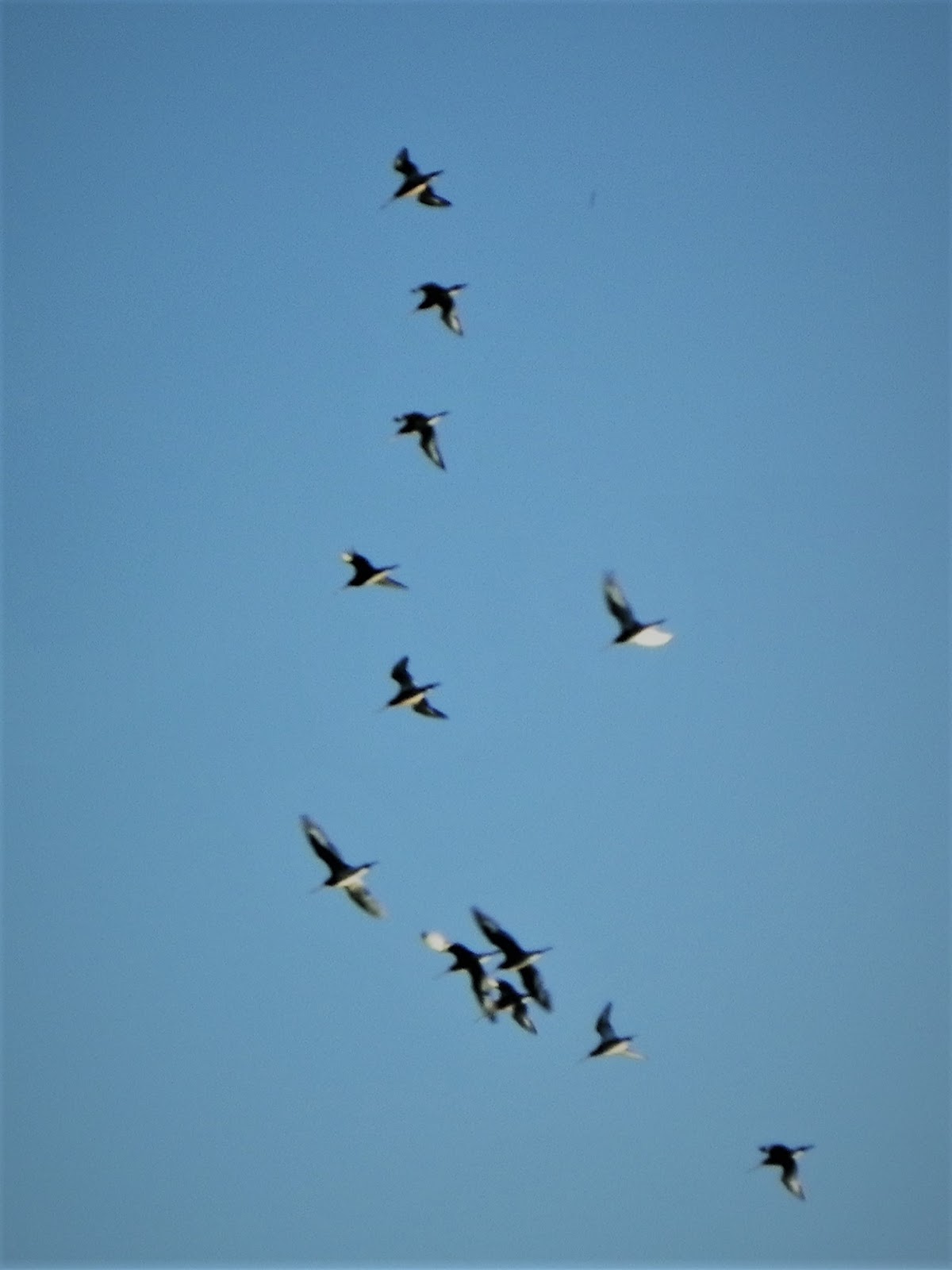 |
| Black-tails inland at dusk, Windmill Hill, 07/17 |
 |
| Common Terns inland over Gillingham, 08/17 |
 |
| Brent Geese inland over Moor Street, 09/17 |
 |
| Whimbrel inland over Lower Twydall, 08/17 |


