This is just one small relatively insignificant, often overlooked, reserve. But look hard enough and there's enough question to keep a birder (even a bed-ridden post-op one) happy.
The remainder of the most common roosting passerines
Jay
I'll spend this entry apologising for going on about Magpies so much. For not charting Rook, who only chose to roost here for one winter, for not charting Crow, as several often pre-assemble here but then move further south-southwest, and for not charting Jackdaw, infuriatingly intermittent in their drop ins. Even this chart is duller than it looks; only about half this number fly in; the other half are calling birds dossing around the pit.

Always a joy to see, always pleased when numbers remain close to the previous count as always sure they're too frail to hold out all winter. How many are migrants, not sure; possibly not many. The numbers of breeding tetrads along the southern Medway is well up on the last Atlas, with eight additional tetrads holding at least one pair each year since 2013.

This is a perfect example of why I say I don't count for a number, I count to understand. I have a precise methodology for exact timings. Limited viewing means I can never see the whole area. Yet I often get asked how many 'X' are there. I really have no idea! And if I say a figure for any species, some leave ignoring any such caveat, to horsetrade the counts. Squinting to see I've counted up to 19 birds isn't the point of that graph- stop it, stop it right now, and look at those beautiful curves.
Going back to the late eighties, and an invite from a local ringer to see what really goes on. One short net up, hoping for a handful of winter thrushes. A golden rule of ringing is never overstretch yourself, and this chap, effectively working alone (I hadn't started training at this point) was prepared for the Parus express* to pull into Berengrave central. Rush hour. So. Many. Birds. More than I could ever hope to count. Tit flocks enter that chalk pit low. This sort of study could never hope to produce a realistic figure. But a representation of what happens? Probably getting that right.
(*Yes, I'm fully aware that train franchise no long runs. The operators are now Cyanistes South-east.)

Great Tit
Seriously, did you not just read Blue Tit? Go back, re-read. Then start to ask why the curve isn't really appearing in this graph. Fun, isn't it? I keep saying I'm no scientist, nor am I a statistician. I keep coming up with alien abduction for this one. See if you can do any better..

Oh the shame. I can never resist pishing LoTTis if they come close enough. Those peaks really shouldn't be quite as high, but they're soooo cute, and I love it when they look at me from eighteen inches. Please imagine a smoother lower early curve, dropping to those breeding numbers, and you'll be there. I'm sorry.

Really? Checking winter roosts into April? Well, yes, part of confirming that main roost I watch, the Magpie, is well and truly finished. That early spring peak is probably more indicative of arrivals than winterers showing more. The most disappointing thing is not to have a higher count- yet.
(Really? Not checking your winter roosts from post-breeding dispersal? Have you seen how dense the canopy is in the chalk-pit at that time?)

I blame Wilkos and their ilk. Just up the road, selling their cheap and tasty fat balls at low, low prices. Most Berengrave sightings are fence-hoppers. There's one spot along the chalk pit boundary footpath where, if you strain on tippy-toes, you'll find Blackcap on the fat balls. But that's outside the recording area, and bearing in mind the good people of Chalky Bank Road actually have decent-sized gardens, these central Europeans living on hand-outs can just doss down among the ornamentals.
(Up in the north-east corner of Berengrave, several allotmenteers run feeding stations. My own allotment is here, and while I have breeding Berengrave Blackcap on my boundary, I've yet to see a Blackcap in the allotments at this time of year. Go figure.)

Wren
I rather like this one. If I produce similar for one of my reed-bed sites, then the late autumn peak dispersal is even more pronounced, with a nice wintering curve. These birds in the Berengrave might well end up half a mile away along the Motney ditches, coming back to check for nest site availability in the early spring.

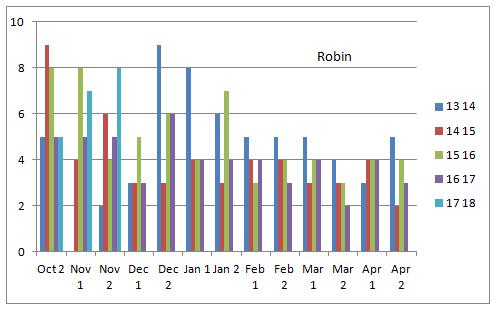
Robin
Individual territories during the winter. Pretty straightforward. The only thing I'll add at this stage is it also reflects the findings of the Migration Atlas, in turn just a repeat of the BWP narrative; we *don't* have birds come here from the continent to overwinter (at least not in big numbers). The vast majority that arrive in autumn are passage migrants, continuing down the continent. Even though I've known that for years now, I still find it hard not to trot out the idea we're joined by hordes from Europe each winter. Most adult Robins don't move very far to adopt winter territories, their offspring usually move less than a kilometre as well. The urban myth that will not die.
Dunnock
My uber-favourite (where the monicker DunnoKev comes from, after all). A pretty perfect representation of a sedentary species.

But the humble Dunnock still a part of this sum of all parts. Berengrave is a small outpost in an infilling urban sprawl. Already, some letters appear in local publications bemoaning the lack of recreational resources there. Until that happens, until the concrete sprawl turns it into an ecological sinkhole, then I'll make the most of it.


