Showing posts with label Brambling. Show all posts

Monday, 30 April 2018

The procure of Bramblings

Second half of April I gambled, and won. I had worried I wouldn't turn up any Brambling on my final Magpie roost count for the 2017-18 season, but about ten minutes before sunset a small group bounded into view. That view was through the 'scope, naturally; distant white rumps flashing among the branches and, unlike in true 'winter mode', when they would sit for long periods up in the tops to act as attractants to others, this late in the season, pre-migration, it was once around the block then down into cover.

And that's the birdy news over for this post. You can leave now if you want. The blog post is more about Berengrave LNR itself, and changes since the boardwalk closed.

Imagine the quarry paths as a (very rough) triangle. In the good old days (when I moved back in 2013), coming in from the estuary, you had two routes down either side to choose from to reach the third southern edge. To the west, an undulating walk along the quarry edge, with very few views down into the pit. To the east, a wonderful roller coaster of a boardwalk, rising and falling into the quarry depths until a final steep climb out of what one birder described as the nearest thing on planet earth to Dagobah. Colour me green and call me Yoda. Easy to guess which way I always chose.

In those days, the boardwalk was in good condition, but time was running out. The construction and repair work had, over the years, been carried out mainly by a support group, the Friends of Berengrave. Long story short, politics crept in and the rot set in; repairs were not allowed and the boardwalk was eventually closed off to the public by the Council.

What this meant was that any circular route around the reserve was no longer available. The number of visitors plummeted. Thankfully I could still get to my Magpie count spot and while I couldn't explore as much as in the past I was now keen to see what happened with the birds. Ever since the Foot and Mouth outbreak in 2001 and the 'closure of the countryside' I'd supported what was found by many back then; you stop the public from wandering the countryside and birds do better.

So, first thought had been 'this is going to be good'. The main users of this tiny local nature reserve were recreational dog walkers. A known disturbance. Here though, dogs had always been mainly on leads (there are some steep drops around the quarry), so not as much uncontrolled disturbance as elsewhere. Noise disturbance? Sure the odd yappy (and by that I mean the shouty owner), but usually fairly quiet. The main effect noticed in the past had been flighting. A noisy visitor would put up early roosters, with Woodpigeon and Magpie the most noticeable. About two thirds of the time, they would circle and resettle, otherwise they would move off, normally towards cover nearby (beyond the Berengrave Nurseries and towards the Bloors Community Woodland). The Magpies would then often work back, the Woodpigeon not so much. Harder to note the effects on smaller passerines, but small groups of finches would put up, and again, some species more prone to leaving Berengrave and not returning that evening; Goldfinches often appeared the most reluctant to stay, and they never roosted deep in the quarry anyway, preferring the edgelands; roost quality obviously played a part in any flight decision.

There were sometimes noisier human visitors of course. The reserve appealed to the younger element. The rising boardwalk was a good climbing frame, the paths, despite the no cycling signs, a nice little off-road workout.

I think during those first few years I met fewer than a dozen naturalists. And that would have been one botanist and eleven birders- we were never great users. A hard to work site, with minimal facilities? Birders were always likely to amble elsewhere.

Now?

Following the boardwalk closure local dog walkers still take the eastern route to and from the main Country Park, but in much smaller numbers. Many dogs don't get long walks in Medway. Fewer still dog walkers bother with the dead end of a  southern edge now it leads nowhere. During the 90 minutes of a count I see less than a quarter of the number of park walkers I had before. This southern edge is where my viewpoint is and it is certainly true contacts are up. Though for most common species my roost numbers are fairly similar, birds seem more likely to loiter along this top edge rather than hurry down in.

Fewer adventurous youth now as well. The boardwalk still does appeal though, being a big ol' scary climbing frame now. But the routine flushings of the pre-roost gatherings of Magpies and Woodpigeons are a thing of the past now.

All in all, I'd say the birds are enjoying the lower disturbance levels.

But there has been a growth in another area of human activity. Fewer recreational public, more recreational drug users.

Good and bad birders. Good and bad dog walkers. Good and bad potheads. The nice ones are really pleasant. They come to sit on one of the three benches along the southern edge, smoke their weed, take in the view and chill out. And they're pretty chilled about me if I turn up at the first bench to count. I explain what I'm about, and they go 'whoooah', have a look through the 'scope and then wander off to one of the other benches. I'm sure one of their number was behind the 'save the bees' graffiti that appeared on the barrier.


Good 'uns usually arrive in pairs. Stumble in upon a hazy cloud made up of more than half-a-dozen, and you know to tread carefully. Usually no more than a bit of verbal if you set up shop, normally never more than a loud verbal, especially if they're at the second bench just about five metres away.
I just think of the abuse being rather like adolescent chimps flinging faeces. Same old sh*t we've all had to put up with over the years. And they never actually threaten actual violence. T'was ever so.

But you know on the evenings you don't show, they're the ones setting the small fires, breaking the barriers. Throwing their beer cans down the bank. T'was ever so.

The third bench, the far bench? Well, that's another few hundred metres on, and only the most adventurous dog walkers venture that far. You have to want to be going there. So this spot appeals to those who like tablets a little stronger, the ones that come in teeny plastic bags with cheery little logos printed on them.

------

What the heck do the owners, the local council, do with an 'asset' like Berengrave? We nature lovers don't show the love enough enough, yet we expect our Councils to uphold our LNRs. Should they spend loads on replacing the boardwalk when it is so little used? Should they pull it down as it is no longer fit for purpose? Or do they close off all access as they did for a short time prior to my move back?

Never mind the human politics, what would the birds say?

Well, it is one of the few overgrown areas left locally. Roosts opportunities abound. For common 'town' species, the noisy humans never really had an effect on numbers in the past, and neither have their roosting numbers increased since it has become quieter. Too soon to say if the more 'sensitive' species have increased. Their numbers, like these Brambling I've watched this past winter, are up and down for other reasons. A lot of these species are usually the last into roost anyway, chances are they've always missed the noisier people by dropping in at last light.

Of course, summer and breeding are a whole different study but Berengrave remains a safe winter haven. Long may it stay so. With the amount of housing going up close by, the importance grows.

Me, personally? Well, I hope they never feel the need to completely close off again because of purely selfish reasons; I've loved my five winters of Magpie roost counting.

Who would want to be a Council employee/ Councillor responsible for making best decisions for all users of a site like this?

There's a price to pay for hanging on to sites like these, one that fewer birders seem willing to pay. We don't shop for our sightings at the Mom'n'Pop old style sites. We don't even go and browse at the out-of-town birding megastores so much. We browse the internet for good stuff, and buy in to what we're told are the must-haves this season.

Me? I've just resolved to make a few more visits than usual this breeding season, before the 'everything must go' signs appear..

-----

For more information on this LNR do check out the now sadly dormant 'Friends of Berengrave' website.

Berengrave present:
Sections of the boardwalk are closed off by simple planks..

..the adventurous just climb beside them..

..viewpoint barriers tend to disappear during school hols..

Bench three

Berengrave past: Views from the boardwalk


Monday, 9 April 2018

The lure of Bramblings

In 1951/52, attempts were made to count a winter roost of Bramblings in Switzerland. One stream into the roost was estimated to hold around 36 million birds. To quote from Newton's 'NN 'Finches', "..however, only about half the birds could be seen from the observation points, so the total number was probably at least 70 million.."

That is a lot of Bramblings. To a soft Kent birder, a three figure count would be impressive. This winter, I have been more than happy with a number going to roost somewhat under that. Of course, I knew, like the Swiss, I probably wasn't counting the whole flock from my viewpoint, but it was fun to dream it could have been millions. Or a hundred. I'd have settled for counting a hundred.


Berengrave Chalk Pit

Go back to the 1980s, a regular spot for Brambling in the run of hard winters back then. I still have fond memories of trudging through the snow to see them, standing under the ivy covered trunks watching birds sneaking in.

Since I moved back from East Sussex, I have been counting the Magpie roost at Berengrave. As mega-exciting as that sounds, I decided from the start to count everything that roosts (a series of links at the end of the blog will take you to past summaries for most of the more common species including Brambling). This year autumn passage on the estuary hinted at a small but slightly higher than usual passage and, sure enough, after a run of nigh-blank winters, I finally had some Brambling to look at. Not 70 million, not even 70, but it would do.

I must be one of the few birders who routinely takes a telescope into an overgrown quarry. Simple fact of the matter, the birds were always at the northern end, the only decent viewpoint at the southern.


Pre-roost assembly and roosting

The Magpie count period has always been a set timed count from 60 minutes pre-sunset to 30 after. The finches often start arriving before that so, on arrival, a scan of the distant tree line would often find a mix of species up on display. When I say mix, there tended to be a general clumping of one species over another. Chaffinch, in the largest numbers, were all through the higher trees but the Goldfinches and Bramblings would be in tens, twenties, both having favourite trees and both able to flight without taking any of the other flocks with them.

Unlike the Magpies, the finch show would be over by sunset. Usually roughly twenty minutes before when the various groups would drop into lower branches. Mainly without any fuss, only sometimes, especially later in the season, making a few circuits of the Pit before piling in. Another interesting difference was that during the coldest part of the year perching in the tree tops would still happen, but for much, much shorter periods. Any urge to advertise the roost to newbies was overridden by an urge to secure a good spot.

Arrival was almost always from the north, and mainly the north-east. This put the majority on a flightpath back to what I discovered to be their favourite local food source.


Bramblings along the Medway


Taking winter as December 1st to February 28th, sightings were clustered around the main early season food source before spreading to a later winter support system of gardens. The initial attraction was not, as the field guides would have it, beech mast, but brassica, in game cover crops. Looking at 'BWP', brassica is a source many switch to when the mast runs out. There was clearly enough good feeding on these local farms, with safe roosting nearby, to keep a few birds present all winter.

Sadly, I was hampered by my early December operation and did not get to search the eastern end of the shore as often as I would have liked; Brambling arriving at the other more easterly roost I did visit tended to fly from the north-west and north-east, so were also no doubt also taking advantage of local cover crops; another local farmer more to the east always has them in his cover crops when they are in the county. Another site for me to check up on in the next good winter.


The second coming

Many texts hint at late winter hard weather movements. My set counts might very well hint at such a thing, but I can't say for sure. I found myself asking another question instead.

Go back to that monster Swiss roost. The actual count was never the number of birds present. That had to be estimated. In no way do I think my counts were the true number present. Just a nice comparison of relative numbers throughout the winter. But because my site is a b*gg*r to view, and with birds dropping down much more quickly during the coldest periods, could it be I missed more birds in the cold than the mild? My primary reason for counting here is, after all, the Magpies, so I never kept my eyes glued to the finches' favoured pre-roost perches. Did more sneak in past me at this time? Was the drop as strong as suggested by the graph?

Which had me thinking on other aspects of Brambling wintering behaviour and movement where the texts tend to differ a little.

Unlike other finches, Brambling are not, in the main, diurnal migrants; many birds, some texts suggest the vast majority, actually move at night. (BWP makes an intriguing statement that most diurnal movement takes place overland, while more nocturnal movements are over large water bodies. Years later the Migration Atlas states '..Brambling movements are often nocturnal and may leave exhausted stragglers grounded at the coast during the day..') The best bet is that we often just pick up on early morning stragglers or daytime adjusting movements; why, on  a good autumn morning, we never have more than a handful in comparison to Chaffinches.

Those late winter second pushes into the U.K. from the continent; how much evidence actually exists? Why couldn't late winter peaks be birds adjusting from, say, already within the U.K.? Again, the Migration Atlas "..weather conditions may bring new arrivals from the Continent in mid-winter, often in substantial numbers.." referencing the Birds of Norfolk, but intra-seasonal ringing controls that back this up are lacking somewhat, plus, on reading that referenced species account the mid-winter flight directions are mentioned, but none suggest an 'in-off'; movements south through that county could just as easily be birds already in the U.K.

The probability is good, but there is still much to confirm.


Spring departure and some real experiments rather than my guessing games


A direct comparison of Chaffinch vs. Brambling shows a typical Chaffinch curve, albeit steeper than usual thanks to higher numbers. A continued rise into December as the migrants find the better roosts/feeding areas, a decrease after New Year as winter bites, then a drop from March onwards as the locals move out to set up territories and the winterers start to feel migratory restlessness setting in; Chaffinch move a few weeks before Brambling. Makes sense, Brambling being the more northerly breeder, no need to move off quite as quickly; those breeding in, say, northern Finland, can't really get started there until warm enough in mid-, late- May. Their diet becomes more insectivorous, why risk getting back there and finding everything still frozen if there's still food available further south? Why some texts hint at their peak departures from here being mid-April, a fortnight or so after the Chaffinch peaks.

Having a trawl around the internet, I found a couple of interesting papers on work on migratory cues for Bramblings.

In one experiment, birds were kept under artificial light set to short (winter) daylengths. These lights were switched abruptly to 14.5 hours. It was like turning the dial up to eleven. Within three days, the birds had developed migratory restlessness. Zugunruhe. Fat deposits grew. So, effectively by mid- to late-April, migratory condition in Bramblings should be well advanced. Doesn't mean they all move at once, the texts say they stay in some number throughout the month.So why do we see less and less? Migration Atlas hints at an answer. Large flocks may have short-hopped to the continent, or they may have dispersed. Diet again. Stalling an early arrival on snowy breeding grounds again.

A second, more technical experiment, supported the hypothesis that "changes in the amplitude and level of the daily melatonin cycle are involved in regulating migratory restlessness, by either allowing or inhibiting nocturnal activity.." "Nocturnal activity"- now that made me sit up. Despite those more recent texts hinting diurnal migration might well be as strong as nocturnal, this species has true nocturnal urges. Puts me in the camp standing by the theory we only ever see a fraction of the true numbers of Brambling in our viz mig efforts. All the guesses that there's probably a lot more Brambling mixed in a high-flying Chaffinch flock than we can pick out? Nah, there's probably just a similar percentage to those we pick out in the lower flocks; a handful in the hundreds. The majority arrived earlier. (Be interesting to see if I eat these words in the coming years as more birders take up 'noc mig'..)

So, we might not be able to see them go. Do we know when they really do leave?


Borderline differences

Newton, in New Nats, stated British winterers move early March to April. What have our county avifaunas said?

Norfolk (Taylor): "..April records are now not at all unusual and large flocks can occur.. can still be present in good numbers into early April.. most tend to have slipped away by the middle of April.. coastal passage in the spring is much less noticeable than in the autumn.."

Suffolk (Piotrowski): "..pre-emigrating flocks.. ..feeding flocks are frequently reported until early May.."

Essex (Wood): "..the status of those birds occurring in the county from March onwards is unclear. Many are probably wintering birds, but it is likely that from the end of March there is an increasing number of returning migrants involved..

London (Self): "..several influxes during the middle of winter.."

Surrey (Wheatley): "..some evidence of passage March and larger arrivals in January.."

Kent (Taylor) "..small, but often noticeable spring passage, usually indicated by the presence of temporary flocks, during March-April.."

Sussex (James): "..a small spring passage is evident from mid-February onwards.."
(Thomas): "..spring passage is much less noticeable than in autumn.."

Where specific, not exactly any consensus among the local counties then.

Nationally, the Migration Atlas goes for "..large wintering flocks have typically dispersed or returned to the continent by mid-April.." so, they may or may not have left. It also asks if late April/early May birds on the coast are late leavers or passage birds heading up from south-west Europe.

We really still don't know as much as we like to think we do.

Among the county avifaunas, as always, for me, Wood stands out (fnarr). It makes plain we don't really know, and hints at what might be going on. Why when anyone asks me what's the best text on birds for Kent, I always say 'Birds of Essex'. I've always stated outstanding for esturine birds, but it also really works for a lot more species as well.

Not much left for me to do now this season. Just the one Magpie count left, in second half of April, but I'm already geared up for a nil return on Brambling, if only because my allotment backs onto the northern edge of their assembly area, and this past week I've not been hearing any in the late afternoons- or will they prove me wrong? Who would guess forecasting negative data for a common species could be so much fun?


-----

Links to other Berengrave roost posts:
- Introduction
- Finches
- Thrushes
- Non-passerines
- Other passerines

Tuesday, 12 December 2017

The sum of all parts of the quarry (2): finches

This December, the two roost counts at Berengrave are going to be rather far apart. First half of month was nice and early but, thanks to an operation, second half count will be nice and late. In the meantime, a chance to muse on what else, in addition to all those Magpies and Woodpigeon I keep going on about, gets counted. Yup, OCD muppet that I am, I try to count everything.

Results? All 'normal', but all fascinating, and helping to refine my personal views on the local populations.

How the reserve was promoted 32 years ago. Now? No school visits,
no fieldwork- mind you, no Borough Council, no Police Station.

The Finches
Brambling
Still a close-your-eyes-and-you're-back-there species for me; Berengrave, 1986, more than 200 coming into roost at the southern end around the chalk washing ponds. Snow everywhere, flurries coming down, calling to the left, right and centre of me. Birds staring back at me through the gloom. Wonderful.

Of course, those cold winters were the exception rather than a norm even back then and, although locals always go on about how the regular roosts there have disappeared, were they ever regular?

Certainly a struggle nowadays, in line with sightings for much of the western half of the southern shore- slightly higher around the remaining orchards in the east of the estuary, but a double figure at roost would be something to celebrate. Of course, I now count from the south-west corner of the quarry, so far I've been able to resist checking numbers from the ground in the north-east.


Chaffinch
Those early years of birding (I didn't start until in my twenties) had hundreds of Chaffinch roosting at the southern end of the pit. Today, birds still favour that end, and many arrive from the north and west; a scan of the treeline in the last half-hour of daylight will find numbers perched out, advertising the roost; in the minutes before sunset, they all drop in together; few are late to roost. Small numbers arrive from the south and west of the viewpoint; there are, of course, other local roost sites for townie finks.

The general trend is for fair numbers pre- year-end being followed by a peak at the start of the winter; mid-winters influxes have not been seen the past four winters. By February numbers are dropping off- dead, driven on by weather/food shortages, or when mild, perhaps even heading back toward the continent; by early March it seems to be just a few, most likely local breeders, left.


Goldfinch
All highly irregular. Even in the better years they lead any observer a merry dance, jingling in to the quarry only to jingle out ten minutes later. The deep dip in mid-winter perhaps reflects onward passage during the coldest part of the year. One species for me to watch in the coming years.


Greenfinch
Sadly, I have no recollection of a Greenfinch roost from all those years ago. I have yet to look up roost preferences (got to save some things for the years to come) and can only presume this reflects the population crash in recent years (what, BTO? No 'Birdtrends' webpage for Grefi? I was looking to make a link to there..) Based on ringing, we never see many into the UK each year so that 'monster' count of 16 this autumn may not actually be reflecting passage birds. The biggest hope for local trends is a slow year-on-year increase in numbers. Another good reason to keep dragging myself down twice a month 13 times a year..

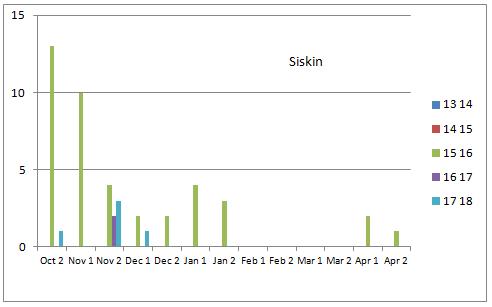
Siskin
Finally for the common finches (a species only gets a chart when I've seen it a dozen times to date)
a species that I remember more from the springs than the autumns. A trend not seen now, but as this is an irregular irrupter, why should they? The habitat is just not right, even though they (and Lesser Redpolls) used to like the north-east corner in the days before the birches and alders were routinely removed.


Wednesday, 15 November 2017

Visible migration; Horrid results for the finches

The question- is visible migration worth studying along the south Medway? The results from this year's early morning counts at the point of Horrid Hill (plus, from early October, a second spell on the Mound at the base) have provided some useful support to findings made at other sites on the south Medway since autumn 2013.

The opening quotes for each species are from John Holoway's 'Birds of Gillingham', and then Dave Davenport's chapter on migration from Oliver's 'Bird watching on the North Kent Marshes'. The graphs are this years Horrid Hill figures, whilst the maps, unless otherwise stated, are based on cumulative observations for the whole southern shoreline over the past five autumns.


Chaffinch

Holloway (1985): "..flocks are often seen along the river and on farmland in autumn and winter.."
Davenport (in Oliver, 1991): "..last three weeks of October and first two weeks of November produce the main westerly passage.."

Chaffinch has been an eye-opener for me for many years since first bumbling into the factoid that the majority of 'finks overwintering in the U.K. enter via the south-east (unlike Bramblings that mainly come in further north).


It is certainly a great example of east-west visible migration here. Previous autumns, east and south-east of Horrid, have shown just how strong that movement can be. Often the biggest counts happen the day after east coast sites such as Pegwell have their big arrivals, as if they are putting down within an hour or so of crossing the Channel.


Brambling

Holloway (1985): "..occasionally seen with Chaffinches in the winter months.."
Davenport (in Oliver, 1991): "as Chaffinch.. accompanied by smaller numbers.. main arrivals equally likely to occur in early November.. frequently associated with hard winters.. when.. takes to feeding on the saltings or along the sea walls.."

A species that never regularly turns up in numbers in the autumn, one that is more prone to see cold weather movements later in the year. Whether these later movements are from birds already in the UK, from the north, or further immigration from the near continent, is difficult to say. The autumn birds here are tied in with the onshore Chaffinch pulses and should be considered as 'fellow travellers', as the majority of Brambling arrivals come in over the northern North Sea.


Greenfinch

Holloway (1985): "..widespread.."
Davenport (in Oliver, 1991): not mentioned.


Another species many believe comes over in numbers, but one that ringing evidence says 'no'. Certainly these grounded birds were only coming out to the Point on Horrid to feed; stay long enough and you would see them return to the same spot on the 'mainland' most days. Any peak could just as likely be down to local dispersal.


Goldfinch

Holloway (1985): "..fairly common.."
Davenport (in Oliver, 1991): "..increasing numbers (in October).."


Although the past few years have picked up a definite 'southerly' feel to autumn flights, perhaps indicating a larger element of emigration rather than immigration, the local topography creates a south-west movement inland. Goldfinches at the Point are more likely to be coming in from a northerly vector than most finch species reviewed here.


In previous decades wintering numbers were much lower, so picking up movement late in the season was easier, but there are now several areas where Goldfinches remain in fair numbers throughout the autumn; local ringing has shown some local breeders to be sedentary. To that end, daily roost flights have to be considered when considering possible viz mig; these roosts grow in size from early September onwards.


Linnet

Holloway (1985): "..can be seen along the Medway at any time of the year.."
Davenport (in Oliver, 1991): "..on some October days.. southerly movements of Linnets.."


Very similar general comments to Goldfinch, with a nice southerly trend to flights. However, many more feeding flights to the island saltings, so difficult to pick out viz mig; roosting habitat preferences, such as dense bramble, are not found on many of the islands and the short duration of the main southerly pulse points towards an ability to pick up on viz mig.


Siskin

Holloway (1985): "..very uncommon migrant but in October 1983 there was a large passage.. flocks of 20 or so could be seen flying west.."
Davenport (in Oliver, 1991): "..last three weeks of October and first two weeks of November.. season for (large visible movements) accompanied by smaller numbers of.. Siskins.."


No shocks with this graph; not a Siskin autumn. This species (and the following) have a large element of irruptive nomadism to their seasonal movements. Irruptive, because they work from local food source to local food source- there is no promise of food at the end of a long migration to the same spot as the previous winter; why, for example, Scandinavian breeders might first move south then possibly move west, or east, later into the winter.


Lesser Redpoll

Holloway (1985): "..occasionally seen with other finches in winter.."
Davenport (in Oliver, 1991): Not mentioned.


Siskin and Redpoll could almost be lumped for viz mig comments. Again, feeding further north must have been good at the start of the autumn (ringing has shown that many birds in the south-east in autumn have come from within the UK).

------

In conclusion, diurnal movements of finches, although nowhere near as strong as along the Thames, itself nowhere no as strong as further east in the county, is observable on the estuary, and regular watches can turn up the odd 'big day'. Even if these results don't fill you with any urge to rush to the Medway, bear in mind the Thames is woefully under-watched these days; despite the adverse comments places like Grain seem to receive on an annual basis on social media, the birds are still passing there. Lower Hope Point at Cliffe, Allhallows, Sheerness on the island, all spots where viz mig awaits to be recorded fully again.