Showing posts with label Oakham Island. Show all posts

Tuesday, 3 October 2017

Horrid autumn- 3/10/17

A short while after coming back from Sussex I gave up owning a car, and took to the pushbike, or walked. Actually, I gave up owning a 4x4 truck, the beast had been brilliant offroad over the farmland in the Brede Valley, but was a bit too OTT for the Rainham estates.

It wasn't all about saving the world, it was about saving money. Besides, from time to time I could borrow a car, so I wasn't that green to turn down the chance. Because, like every dear reader, I'm dying. Very slowly, since my twenties, just like you.

Back then I believed 'coughs and sneezes spread diseases' and didn't really appreciate what disease is; a disorder of structure or disfunction in the body. We bring some upon ourselves (if you don't know what 'The Western disease' is, look it up. I'm busy putting lots of people off Maccy D and the likes nowadays) others happen when we think our slowly reducing muscle mass can still operate as well as 30 years ago, and then things just pop out.. We're all diseased, we're all going to fall apart. Get out and bird now. Retirement won't be what you think for a lot of you. Long and the short of it, I'm walking with a stick until I have an operation to sort out some worn parts.

So, choosing Horrid seemed like a good idea for days when I could borrow transport. A tad worse on other days, which could find me walking in, then diverting to Twydall for a lift back at least. Some mornings, to get to Horrid for Dawn, I just had to grit my teeth for an hour's limp.


You can always tell the days I walk. There's a bloomin' big BHG number in the notebook. Today? 5,220 Black-headed Gulls, south to the Downs in the half-hour it took to walk the edge of the Park. These are counts that can be really messy, but more fun watching for odd behaviour- sometimes not many leaving that early (they know when the ground is frozen, covered), or big numbers arriving early (no guess, sometimes perhaps a movement, sometimes just really good early feeding or a lot of disturbance down on the farms?


I was really tempted by a tired Woodpigeon as I arrived at Horrid, one I could have picked up and stroked; migration? A man can dream.. (Answer- no. Just, well, no.)


So, what was there?

06:45-09:45
Viz mig: Brent Goose 47 (+89 offshore), Peregrine 2, Kestrel, Sparrowhawk, Sandwich Tern 13, Common Tern, Swallow 4, Sand Martin 2, Skylark 8, Meadow Pipit 104, Pied Wagtail 2, Lesser Redpoll, Linnet 27, Chaffinch 2, Goldfinch 2.

Point: Chiffchaff 4, Linnet 14, Reed Bunting 2.

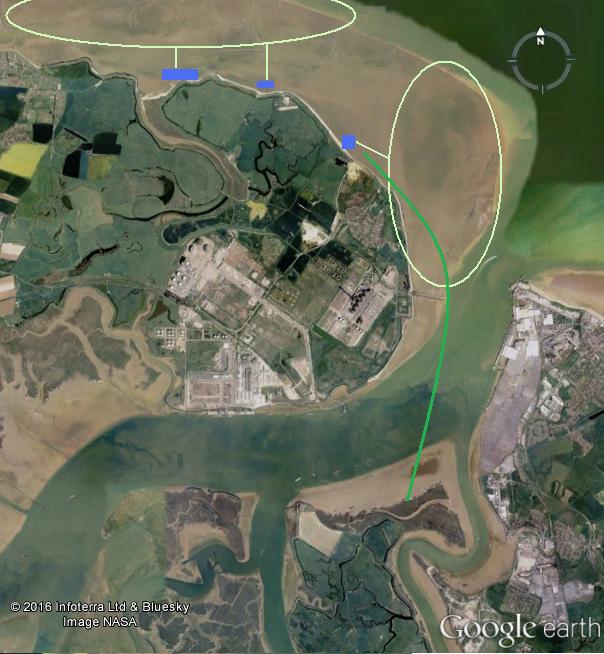
Watched the Curlews for a bit. Last few days, flightline to roost were settled (red). Today? West basin birds behaving, but eastern lot having none of it around Friars (yellow). Gave it a wide berth and instead formed two large groups over on Oakham. Haven't heard anything of late on the ongoing ownership questions. WAGBI, Wildfowlers Association of GB and Ireland, long-term loaned it to the CEGB, Central Electricity Generating Board. Both gone through name changes, affiliations, both present regenerations having trouble locating their copies of the paperwork.

Saturday, 2 September 2017

Horrid autumn- 2/9/17

Distant odd goings on with the Grey Herons- seven at the tip of Ham Green struck out north, twice, only to give up and turn back.


Nearer odd 'goings off'- the Friars Curlew had given up and moved to Oakham, perhaps down to the opening of the wildfowling season the previous day. It was interesting to watch birds arriving from Ham Green (usually roosting Greenborough), only to skirt Friars and circle Oakham before finally setting down.


-----------
02/09/17

Pt- Whitethroat 2, Willow Warbler, Chiffchaff, Blackcap 2, Lesser Whitethroat 2.

vm- Yellow Wagtail 4 west, Greenshank 1 high west, Golden Plover 6 west, Meadow Pipit 3 west.

Offshore- One Peregrine hunting the Rainham mudflats, last seen heading off over Otterham. Common Tern 5, Sandwich Tern 2.

Friday, 25 November 2016

A ring from middle estuary: #1306348

Although I now restrict myself to the southern shore I trained as a ringer under my good friend Bill Jones out on Oakham Island, which is frustratingly mid-estuary, just north of the main channel. I hope no-one objects to my publishing an occasional map from some of his ringing recoveries over the years here on this blog for interest


Grey Plover Ring no. 1306348
Ringed as an adult female, 26th May 1996, Castricum, Nord-Holland, The Netherlands.
Retrapped: 8th September 2002, Oakham.
Found 2296 days after ringing, 303 kilometres south-west of ringing site.

This time I haven't joined the two sites with a line. With the number of years between ringing and recapture, the fact the bird was an adult when ringed, and ringing was en route to breeding grounds and recapture en route for winter, the chances are that in any statistical analysis of all records, this would be weighted towards choosing a route close to the continental mainland on the way back racing back from a wintering ground much further south. This was the seventh inbound trip later, so one would hope she knew what she was doing. The autumn choice of route is influenced by the need to find somewhere to undertake a partial moult of flight feathers safely- stopping for a short period on the Medway had probably been a good choice for this bird down the years.

This sort of record always has me wondering if these birds ever take a short cut overland, say, from the Medway to the south coast. A good probability. After all, GPS studies on other migration routes have confirmed them not to be deterred by a little bit of ground, say, most of mainland Russia and China...

Saturday, 2 July 2016

Catching on

An early morning visit to Motney, a late evening visit to Ham Green, mostly thinking about Oystercatchers. I've mentioned  Oystercatcher movements within the inner basin in general terms already, so a little more explanation of what goes on in the outer basin might be appropriate now. 

At the lowest point of the tidal cycle many Oycs will be feeding on the large oyster beds found in the Ham Ooze area. As the tide covers this stretch early the birds retreat mainly via Millfordhope Creek, sometimes heading straight to the Chetney Hill roost, often detouring into Twinney and Halstow creeks to take advantage of the additional feeding time. Eventually all these birds also move off to Chetney Hill, where they are joined by Funton feeders. On higher springs the roost might move to the old dock below the hill, but if disturbed by walkers then inland to the fields. Sometimes a small roost can sometime be found inside Barksore as well.


Then there's the Deadmans Island roost. This picks up local birds, but is also a refuge for Thames Oycs under certain conditions. On spring tides their usual Grain beach roost site can go under. At other times it suffers disturbance (at present there is no official footpath there, but walkers and fishermen often visit) when Sometimes these birds might head for Yantlet or another nearby beach, but more often they head south-east and south into the Medway to Deadmans. Back in the early nineties Grain was my 'patch', and in the 25-odd years since their dependency on Deadmans has grown. Simple fact is Yantlet can be one of the more disturbed roost sites. East of Grain, The Flats and Grain Spit are excellent feeding areas, and viewable from Deadmans. The flight might be longer, but it is a good, safe choice.


Right now it's time for Oystercatcher numbers to increase. Certainly most immigrants from the continent arrive in August and September, A rough and ready guide to numbers using these three core areas outside the 'wintering' months?

In the 1990s four-figure counts for the whole of the estuary in May, June and July were usual, but by the turn of the century counts had become erratic and incomplete. Of course, it does not help that birds change roosts (and rivers) but since returning in 2013 my counts in each ten-day period are pointing towards the present usage being more in line with the good old days. The graphic includes the Thames birds in blue, so as to give an idea of numbers feeding in the southern Medway. If you were then to add in the known main roosts on the northern shore (the Kingsnorth Power Station sea wall under certain conditions, and more routinely Oakham Marsh) then four figure on co-ordinated counts for the whole estuary should be achievable.


The casual birding visitor might miss out on all this; it has taken me a few seasons to catch on fully. With the main oyster beds being some distance from shore, and Oystercatchers prone to being one of the first species to go to roost, a birder might pick up on the thin spread of birds, sometimes in pairs, close in to the sea walls. Some will be breeding pairs, but there are not as many as one might at first think; sexually mature from around three, but possibly not breeding until four, five or later, places like Horrid Hill are a 'back of the bike sheds' for some Oystercatchers. Optimal breeding habitat is thin on the ground, and pairs are often found on the brownfield areas. Mid-river, the concrete jetty out to (and beyond) Oakham used to have a number of nest trays, lovingly re-shingled each year by the Power Station Environmental Officer after he discovered the birds would try and nest among torn lagging on the pipework. The photograph is from 2012- whether they are still in use in 2016, who knows?


Thursday, 26 May 2016

A ring from middle estuary- #GC34920

Although I restrict myself to the southern shore I trained as a ringer under my good friend Bill Jones out on Oakham Island, which is frustratingly mid-estuary, just north of the main channel. I hope no-one objects to my publishing an occasional map from some of his ringing recoveries over the years here on this blog for interest.

A May recovery date for this record, and just a very short-distance:

Little Egret Ring no. GC34920
Ringed as an adult, 31st December, 2009, Oakham.
Found dead: 18th May 2012, Hoo Marina (finder's comment- "drowned, in the Medway".
Found 869 days after ringing, 3 kilometres west of ringing site.

Although many local Little Egrets do go a little south in winter, a small number hang on. When operational, the old Kingsnorth Power Station outflow had kept the waters near Oakham some three degrees warmer than the surrounding area- why Damhead Creek was such a pull for feeding Egrets and the odd Spoonbill, and why this bird was out and about on Oakham on a New Year's Eve.

Bill devised a method of supplementing their diet. The station's intake screens often trapped a number of fish, and these were usually just disposed of (have you ever seen Little Egrets in a skip? I have!). But a daily bucket, transported out to Oakham, proved a draw for the Damhead birds in the cold days of winter. So much of a draw, they not only got to recognise Bill and his bucket, they could pick out his E.On van as he drove out onto the island, and fly along after him.

Of course, Bill had an ulterior motive, there's no such thing as a free lunch and all that. In return for those fish, it would be good to get some rings on the birds. By placing the freebie feast in the mouth of his large static funnel trap, there was a chance to trap and ring an unwary bird by walking into the trap. This normally meant a second ringer had to being hidden up in a small blind near the mouth of the trap some time before the birds arrived- they knew what Bill was up to, and would not settle until he left.

So this bird found at Hoo had been one that stayed on the estuary for the winter, using Bill's 'bird table'.


The funnel trap was quite a size, positioned over and along the hedge Bill had grown beside the access road. It had a large holding cage, big enough for even the odd Harrier or Owl, which was partitioned by a large mesh wall to filter the passerinessafely through into a smaller holding area. Google earth shows the frame is still in place (fractionally below centre); sadly, when the site closed for the demolition of the Power Station, the trap had to be secured to a state of permanently open.

At the mouth of the trap, autumn 2012. Complete with drinking trough drip-feeding a
small pond (just out of shot to right). The strimmed area became waterlogged in
winter and was where the offering of small fish was placed.

Inside, looking back through the baffles

The 'walk in' catching box.


For the ringers, a question- 'what's the difference between a funnel trap and a Heligoland trap?'. Answer- a funnel trap is always straight, a Heligoland always has at least one 'bend'. This acts as an additional baffle to help deter birds from doubling back round and straight out of the trap.


Thursday, 10 March 2016

A ring from middle estuary- #JN69442

Although I restrict myself to the southern shore I trained as a ringer under my good friend Bill Jones out on Oakham Island, which is frustratingly mid-estuary, just north of the main channel. I hope no-one objects to my publishing an occasional map from some of his ringing recoveries over the years here on this blog for interest. As I've now made them my species of the month, this story has to be of a...

Dunlin Ring no. JN69442
Ringed as a pulli, 15th July 1994, Yabari, Sabetta, Yamal Peninsula, Yamalo-Nenets, Russia.
Found: 18th February 1998, Oakham.
Found 1,314 days after ringing, 4,285 kilometres from nest site.


1998 was an interesting year for the Dunlin of the Yamal Peninsula- a paper was published in International Wader Studies confirming Siberian Dunlins calidris alpina migrate to Europe; first evidence from ringing Unfortunately JN69442 was just a little too late to feature in the article, but it surely would have made print for the rarity value of the finding circumstances:

Dead- taken by predatory bird- ring found in owl pellet


Bill has dined out on this story over the years. His then assistant, Andy, had picked up the pellet and joked that there might be a ring in it. Bill laughed and told Andy he'd checked hundreds and hundreds of pellets over the years without any luck so, if there was, Andy could keep it. The rest is history. (Bill is off to Wales to see Andy next week- I'll have to get him to ask if he still has the ring.)

For any pedant ringers/historians reading this (I cannot be the only one, surely?) the BTO notification paperwork quoted USSR:


Of course, The Union of Soviet Socialist Republics had actually been dissolved in 1991, some three years before it was ringed. With typical socialist efficiency, this bird was documented as coming from somewhere that didn't exist(!).

Of course, bird rings often avoid quoting the country name, choosing instead somewhere that might intrigue a finder: British Museum, Moscow (Paris, Oslo, Madrid, etc). Makes sense in a strange way- after all, the birds don't recognise our own silly boundaries.

Only the final odd twist in this tale was the actual address quoted on this particular ring- Gdansk. It turned out Polish ringers had mounted the expedition, and used their own scheme's rings (with permission) so as to help ensure prompt news of any birds found (avoiding that Socialist efficency). Of course, since then co-operation between schemes has got a lot better, thanks to bodies such as Euring, and results can come through quite promptly. Not yet perfect, but getting there.

More details of interesting Dunlin ringing recoveries can be found on the BTO website. (And lovers of displaced migrants, when checking the map there don't miss the single record on the extreme left, nine o'clock...)

Friday, 29 January 2016

A ring from middle estuary- #DB97190

I trained as a ringer under my good friend Bill Jones, often out on Oakham Island. Although I now limit myself to the southern shore, and Oakham is frustratingly mid-estuary, just north of the main channel, I hope publishing an occasional map from some of his ringing recoveries over the years here on this blog will be of interest.

Greenshank Ring no.DB97190
Ringed: 9th August 2003
Found: 13th July 2005, Homledal, Hole, Buskerud, Norway.
Leg and ring found near Peregrine nest.
Found 704 days after ringing, 1,129 kilometres from Oakham.

This particular bird was an adult when ringed.Scandinavian Greenshank often pass through the south and east of the UK on their way to winter in south-west Europe and Africa. It is known these birds are highly site-faithful to particular staging areas whilst on migration, so highly likely to have visited the Medway before (and then after) the ringing date.

The recovery site and date could refer to it being back local to its breeding site, or possibly still en route to breeding grounds, when it met its end.

More details on Greenshanks (plus a map of international movements) can be found c/o the link on the BTO Birdfacts page here.

Sunday, 10 January 2016

A ring from middle estuary- #1293502

I trained as a ringer under my good friend Bill Jones, often on Oakham Island. Although I now limit myself to the southern shore and Oakham is frustratingly just north of the main channel, mid-estuary, I hope publishing an occasional map from some of his ringing recoveries over the years here on this blog will be of interest.

Grey Heron Ring no.1293502
Ringed: 12th February 2003
Found: 16th May 2008, Töcksfors, Varmland, Sweden.
Freshly dead- found in a fishing net.
Found 1,920 days after ringing, 1,143 kilometres from Oakham.


To date, this is the only British-ringed Grey Heron to have been recovered in Sweden. The bird was most likely not actually British, as foreign-ring recoveries have shown birds from north and east Europe routinely overwinter in the UK.

More details of Grey Heron ring recoveries (plus a map of international movements) can be found c/o the BTO website here.