Deja vu. Posted on this a couple of years back, now have a bit more knowledge of Turnstone to-ings and fro-ings.
First off, I didn't emphasise that you can't get away with counting from just one angle. This google earth pic shows the hulks at high tide:

If viewing from the east, on Horrid, you can miss birds on the boats behind. If viewing from the south, you miss the birds low on the waterline on the main hulk. But if you leave off looking from the west, from Eastcourt Meadows, you'll not pick up any birds 'in' the boats. (And today, for good measure, a couple of dozen were on the remains of the small pleasure craft in the saltings.)


This meant Rainham Saltings wasn't under at the start, and would be able to hold some birds over the tide if undisturbed. Of course, this is half-term week, the kids are all off, and the Country Park was packed.
So I was expecting numbers to change. I actually thought the main roost wouldn't last, still all-too-often flushed by dogs getting sent into the saltings to chase balls and sticks. It didn't happen; I think it was either the Brent Goose effect, the cold owner effect, or the little kid effect. The firstis based on the 150+ Brent which try to ride the tide out in the Bay, so they can continue feeding around the saltings. Some dog owners pick up on this and appreciate quite a few of the public enjoy seeing them up close and personal. The second is the owners, wrapped up warm and often jacketing their their pets as well, think the dogs won't want to be in the water "stay out, it's cold, COME HERE!". Finally, a lot more dogs are on leads when young children are about. Of course, there will always be those owners who don't care about such things but today the Turnstone were about to get away with a lack of canine concerns.
By the second count, numbers were coming off of Rainham Saltings. Again, thankfully, no real flush. Most public were walking briskly alongside, their youngsters not wanting to mess around by the water's edge (not when there were so many puddles on the path). And another of the main causes of disturbance to the RS roost, the stop-and-stare birder, was missing. The person admitting to being a birder today didn't have their bins with them. Made the effort to tell me he never bothers birding here, everything too far out, I should go to Sheppey instead, there's plenty of good birds there.. I smiled, and mentioned yesterday's Spoonbill on the sightings board at the Visitor Centre..

I digress. The roost increase had come about in dribs and drabs as some Turnstones got their feet wet. (You know they've flushed when they arrive as a lump.)
And the increase to the actual high tide figure was lumpless as well, the majority coming in off the Saltings or from Motney Saltings where the Avocet were restless and quite a few Plover were moving off for some peace. Others came in from Nor and Friars, but none from the direction of the Gillingham Marshes roost. Perhaps they'd got away with it? (This year both this and Sharps Green were often in simultaneous use.)
The disturbance, when it did come, wasn't human. Bird of Prey. Might not have put the Turnstone up at first, but it did put up the Geese, who took the waders with them. And even though the tide had barely dropped, enough wet rocks were showing for Turnstone to disperse to try starting to feed. They didn't bother coming back.
How many are there on the southern Medway at the moment?
Well, quite possible around a three figure count at Gillingham Marshes. Just as often as they've flushed to Sharp's this winter they've been equally happy to flush to Nor or Darnet, where 20 or 30 are not uncommon. Next, the Rainham Saltings roost now has to be on the saltings themselves; whereas in autumn/early winter they would most likely use the deck of the hulk PAS1511 off of Bloors, the large gulls have already started to reclaim that for breeding. Another 20 or so regular around the top of Motney/Otterham, sometimes using the caisson on a tide of today's height. So, if you went out of your way to get a high score, and actually got lucky enough to find them all, you'd have around 500 in the western basin.
The eastern basin is a little more problematic, as feeders there often come out of Ham Ooze west to become part of that 500-ish total, but Lower Halstow through Millfordhope will often have 30-50, but hard to count, either scattered in among the small groups of waders on the saltings or spread along the concrete debris of the Barksore shoreline. A similar number attempt the same around the Funton 'triangle', coming together on higher tides on the concrete barges on the Barksore side, perhaps some up around the Shade. Throw in another 20 or so off of Queenborough around Deadman's. These can be joined by flights from the Thames, from off of Grain or Sheppey; a conservative total for these commuters might be 100 on a good day. So, a hypothetical count of 650 for the south shore? Of course, this is based on good days, and I can be out every day. Bad days you won't find them. But for the estuary as a whole. adding in the north shore, where birds roost on the apron wall of Kingsnorth alongside the Oystercatchers, or the beaches of southern Grain, you could, if you set out on a mission on the covering tide, aim for 750. You wouldn't always get it. You certainly won't get near it on a multi-observer un-coordinated high tide count due to disturbance patterns. And of course, this is just my perception, my considered opinion, I could still be well out!
 |
| Seek, and ye shall find- a part of this week's Funton Turnstones, roosting at Bedlams |
But it all goes some way to confirming the long-held fears the WeBS totals are under-reporting the true figures on the estuary: the Sharp's Green roost alone often passes the WeBS annual estuary peak. But the problem is those birds will often end up out around the estuary islands at weekends which have been counted during the week in recent years.
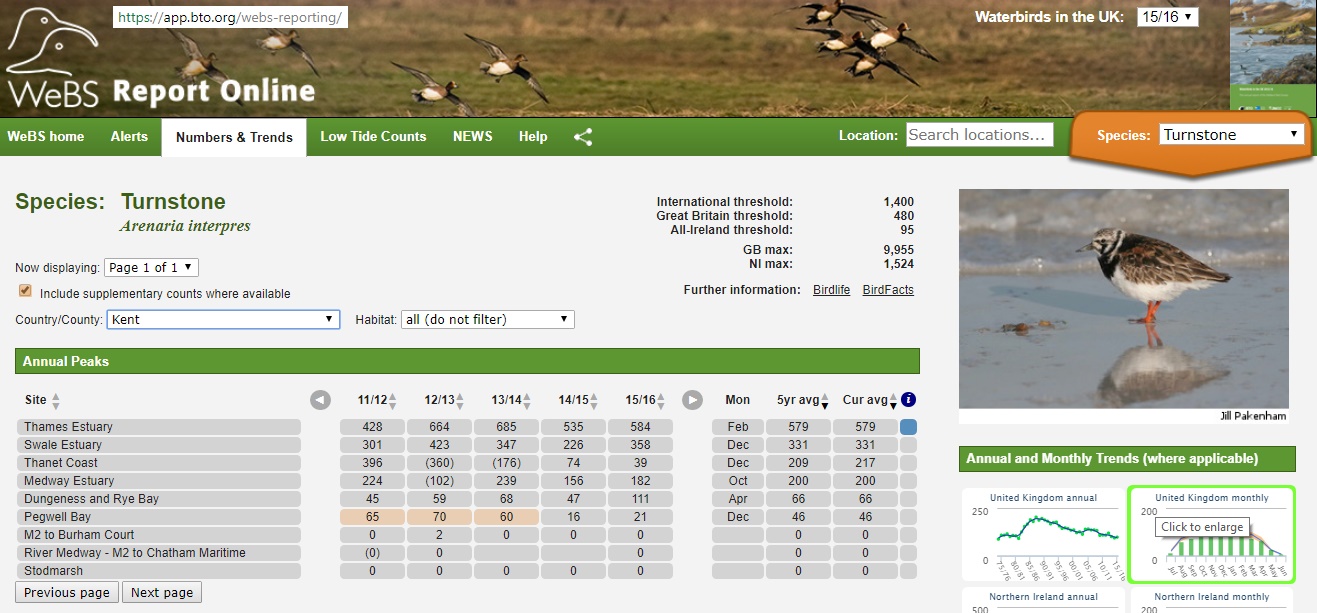
If correct, then the Medway holds nationally important numbers in winter. It also holds nationally important numbers during the autumn, but that season has not been covered fully by WeBS in recent years.

Looking back to the golden years of WeBS for the Medway, 500 often routine in the winter months. Note also count coverage was better in autumn. Recently counters have more often been out for just the core period, October to February. Yet the highest numbers on the estuary were (and are) still on passage- hovering around internationally important totals. Similarly, a spring peak evident then (and still now to a casual observer); although present for shorter periods, even the once a month official survey often detected the passage increase. (And there are, of course, several other species with similar high passage numbers not being reflected in such surveys.)
Another species where any informal counts can prove useful, especially outside of those winter months.
-----
Oh, and nearly forgot today's stand-out bird; in the Sharps Green roost, flitting around deep among the metal hulls, a Wren. Stupid Wren? Well, they certainly feed out on the saltings a lot outside the breeding season. Perhaps this one found it easier to spend a couple of hours over the top of the tide on the rust-buckets than going ashore and facing off with winter territory holders. Clever Wren? Perhaps, if it works. I must watch out for him again.

Another species where any informal counts can prove useful, especially outside of those winter months.
-----
Oh, and nearly forgot today's stand-out bird; in the Sharps Green roost, flitting around deep among the metal hulls, a Wren. Stupid Wren? Well, they certainly feed out on the saltings a lot outside the breeding season. Perhaps this one found it easier to spend a couple of hours over the top of the tide on the rust-buckets than going ashore and facing off with winter territory holders. Clever Wren? Perhaps, if it works. I must watch out for him again.