Showing posts with label Greenfinch. Show all posts

Tuesday, 12 December 2017

The sum of all parts of the quarry (2): finches

This December, the two roost counts at Berengrave are going to be rather far apart. First half of month was nice and early but, thanks to an operation, second half count will be nice and late. In the meantime, a chance to muse on what else, in addition to all those Magpies and Woodpigeon I keep going on about, gets counted. Yup, OCD muppet that I am, I try to count everything.

Results? All 'normal', but all fascinating, and helping to refine my personal views on the local populations.

How the reserve was promoted 32 years ago. Now? No school visits,
no fieldwork- mind you, no Borough Council, no Police Station.

The Finches
Brambling
Still a close-your-eyes-and-you're-back-there species for me; Berengrave, 1986, more than 200 coming into roost at the southern end around the chalk washing ponds. Snow everywhere, flurries coming down, calling to the left, right and centre of me. Birds staring back at me through the gloom. Wonderful.

Of course, those cold winters were the exception rather than a norm even back then and, although locals always go on about how the regular roosts there have disappeared, were they ever regular?

Certainly a struggle nowadays, in line with sightings for much of the western half of the southern shore- slightly higher around the remaining orchards in the east of the estuary, but a double figure at roost would be something to celebrate. Of course, I now count from the south-west corner of the quarry, so far I've been able to resist checking numbers from the ground in the north-east.


Chaffinch
Those early years of birding (I didn't start until in my twenties) had hundreds of Chaffinch roosting at the southern end of the pit. Today, birds still favour that end, and many arrive from the north and west; a scan of the treeline in the last half-hour of daylight will find numbers perched out, advertising the roost; in the minutes before sunset, they all drop in together; few are late to roost. Small numbers arrive from the south and west of the viewpoint; there are, of course, other local roost sites for townie finks.

The general trend is for fair numbers pre- year-end being followed by a peak at the start of the winter; mid-winters influxes have not been seen the past four winters. By February numbers are dropping off- dead, driven on by weather/food shortages, or when mild, perhaps even heading back toward the continent; by early March it seems to be just a few, most likely local breeders, left.


Goldfinch
All highly irregular. Even in the better years they lead any observer a merry dance, jingling in to the quarry only to jingle out ten minutes later. The deep dip in mid-winter perhaps reflects onward passage during the coldest part of the year. One species for me to watch in the coming years.


Greenfinch
Sadly, I have no recollection of a Greenfinch roost from all those years ago. I have yet to look up roost preferences (got to save some things for the years to come) and can only presume this reflects the population crash in recent years (what, BTO? No 'Birdtrends' webpage for Grefi? I was looking to make a link to there..) Based on ringing, we never see many into the UK each year so that 'monster' count of 16 this autumn may not actually be reflecting passage birds. The biggest hope for local trends is a slow year-on-year increase in numbers. Another good reason to keep dragging myself down twice a month 13 times a year..

Siskin
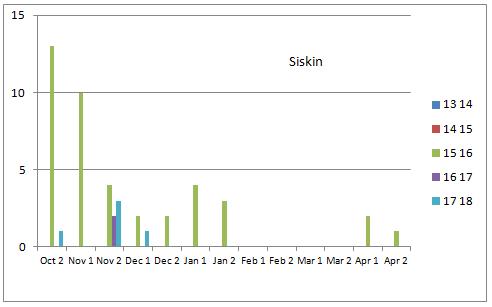
Finally for the common finches (a species only gets a chart when I've seen it a dozen times to date)
a species that I remember more from the springs than the autumns. A trend not seen now, but as this is an irregular irrupter, why should they? The habitat is just not right, even though they (and Lesser Redpolls) used to like the north-east corner in the days before the birches and alders were routinely removed.


Wednesday, 15 November 2017

Visible migration; Horrid results for the finches

The question- is visible migration worth studying along the south Medway? The results from this year's early morning counts at the point of Horrid Hill (plus, from early October, a second spell on the Mound at the base) have provided some useful support to findings made at other sites on the south Medway since autumn 2013.

The opening quotes for each species are from John Holoway's 'Birds of Gillingham', and then Dave Davenport's chapter on migration from Oliver's 'Bird watching on the North Kent Marshes'. The graphs are this years Horrid Hill figures, whilst the maps, unless otherwise stated, are based on cumulative observations for the whole southern shoreline over the past five autumns.


Chaffinch

Holloway (1985): "..flocks are often seen along the river and on farmland in autumn and winter.."
Davenport (in Oliver, 1991): "..last three weeks of October and first two weeks of November produce the main westerly passage.."

Chaffinch has been an eye-opener for me for many years since first bumbling into the factoid that the majority of 'finks overwintering in the U.K. enter via the south-east (unlike Bramblings that mainly come in further north).


It is certainly a great example of east-west visible migration here. Previous autumns, east and south-east of Horrid, have shown just how strong that movement can be. Often the biggest counts happen the day after east coast sites such as Pegwell have their big arrivals, as if they are putting down within an hour or so of crossing the Channel.


Brambling

Holloway (1985): "..occasionally seen with Chaffinches in the winter months.."
Davenport (in Oliver, 1991): "as Chaffinch.. accompanied by smaller numbers.. main arrivals equally likely to occur in early November.. frequently associated with hard winters.. when.. takes to feeding on the saltings or along the sea walls.."

A species that never regularly turns up in numbers in the autumn, one that is more prone to see cold weather movements later in the year. Whether these later movements are from birds already in the UK, from the north, or further immigration from the near continent, is difficult to say. The autumn birds here are tied in with the onshore Chaffinch pulses and should be considered as 'fellow travellers', as the majority of Brambling arrivals come in over the northern North Sea.


Greenfinch

Holloway (1985): "..widespread.."
Davenport (in Oliver, 1991): not mentioned.


Another species many believe comes over in numbers, but one that ringing evidence says 'no'. Certainly these grounded birds were only coming out to the Point on Horrid to feed; stay long enough and you would see them return to the same spot on the 'mainland' most days. Any peak could just as likely be down to local dispersal.


Goldfinch

Holloway (1985): "..fairly common.."
Davenport (in Oliver, 1991): "..increasing numbers (in October).."


Although the past few years have picked up a definite 'southerly' feel to autumn flights, perhaps indicating a larger element of emigration rather than immigration, the local topography creates a south-west movement inland. Goldfinches at the Point are more likely to be coming in from a northerly vector than most finch species reviewed here.


In previous decades wintering numbers were much lower, so picking up movement late in the season was easier, but there are now several areas where Goldfinches remain in fair numbers throughout the autumn; local ringing has shown some local breeders to be sedentary. To that end, daily roost flights have to be considered when considering possible viz mig; these roosts grow in size from early September onwards.


Linnet

Holloway (1985): "..can be seen along the Medway at any time of the year.."
Davenport (in Oliver, 1991): "..on some October days.. southerly movements of Linnets.."


Very similar general comments to Goldfinch, with a nice southerly trend to flights. However, many more feeding flights to the island saltings, so difficult to pick out viz mig; roosting habitat preferences, such as dense bramble, are not found on many of the islands and the short duration of the main southerly pulse points towards an ability to pick up on viz mig.


Siskin

Holloway (1985): "..very uncommon migrant but in October 1983 there was a large passage.. flocks of 20 or so could be seen flying west.."
Davenport (in Oliver, 1991): "..last three weeks of October and first two weeks of November.. season for (large visible movements) accompanied by smaller numbers of.. Siskins.."


No shocks with this graph; not a Siskin autumn. This species (and the following) have a large element of irruptive nomadism to their seasonal movements. Irruptive, because they work from local food source to local food source- there is no promise of food at the end of a long migration to the same spot as the previous winter; why, for example, Scandinavian breeders might first move south then possibly move west, or east, later into the winter.


Lesser Redpoll

Holloway (1985): "..occasionally seen with other finches in winter.."
Davenport (in Oliver, 1991): Not mentioned.


Siskin and Redpoll could almost be lumped for viz mig comments. Again, feeding further north must have been good at the start of the autumn (ringing has shown that many birds in the south-east in autumn have come from within the UK).

------

In conclusion, diurnal movements of finches, although nowhere near as strong as along the Thames, itself nowhere no as strong as further east in the county, is observable on the estuary, and regular watches can turn up the odd 'big day'. Even if these results don't fill you with any urge to rush to the Medway, bear in mind the Thames is woefully under-watched these days; despite the adverse comments places like Grain seem to receive on an annual basis on social media, the birds are still passing there. Lower Hope Point at Cliffe, Allhallows, Sheerness on the island, all spots where viz mig awaits to be recorded fully again.

Wednesday, 1 November 2017

Horrid autumn- 1/11/17


Point: 3 Goldcrest, 14 Chaffinch, 8 Reed Bunting, 2 Song Thrush, 16 Greenfinch.

Viz mig: 2 Song Thrush, 2 Chaffinch, Pied Wagtail.

Mound: Chaffinch 25, Goldfinch 14, Redwing 8, Fieldfare 5, Siskin 2, Skylark 1 (no Starlings).
Offshore: 2 Red-breasted Merganser, 58 Great Crested Grebe, 650 Shelduck, 209 Brent Goose.


Another fireworks display overnight. The result? No Brent Geese in Sharps Green Bay, all in the lea of Friars Saltings for the first hour and a half after dawn, only venturing back in small groups as the tide rose.


The Greenfinch are running out of food at the Point, and, possibly, in the Country Park; not long after arriving today, most left- but not for the usual southern shore. Instead 14 set off for the south-west corner of Nor (the remaining two setting off, but then turning back half way over Bartlett). The flock was lost to sight just over the seawall. Needs must.