Showing posts with label Lapwing. Show all posts

Thursday, 25 July 2019

Arrivals and departures- the early autumn avian hub

(This post is a little different, being a copy of my original speaker notes for an informal talk given today aboard the Jacob Marley, on an estuary cruise in support of Living River Foundation.
Rather than waste the time on the water with a lengthy lecture full of facts/figures, the talk was pared down to be short, general and informal, but with this lengthier blog then available with additional info after the event. Hope the general approach here of interest to some.)

----------


Arrivals and departures- the early autumn avian hub


Introduction


Grey Plovers

Forget the argument for a Boris Island. The north Kent marshes already handle internationally important numbers of flights every year.

The marshes are well known for the high numbers of overwintering wildfowl and waders. Why each of the north Kent hubs, the Thames, the Medway and the Swale, is recognised as internationally important and are internationally protected: Ramsar, SSSI, MPA.

The north Kent marshes also hold significant numbers of important breeding species.

But what about on migration? How many birds use the Medway? And what do they use it for?


Scheduled flights in July/ August
Wader passage starts in mid-June. For several species, the female's work is done by then, as she leaves the male to look after the eggs/young. Failed breeders and immature birds (some do not breed until they are four or five years old) also wander back in small numbers from mid-June onward. A hardened birder might enjoy getting out and finding the few returners, but not really a spectacle- yet.

By the last 10 days of July more people are noticing a build in numbers, as small flocks start to appear- tens, twenties for most, but some species already well into the hundreds. The rest of the breeding adults have started to move now. They will often desert their young, who then only follow on a few more weeks later.


The East Atlantic Flyway

The Medway is one hub within of a large network of refueling stations strung out along the main carrier route between the high Arctic and Africa. As we will see in the individual species accounts, different species have different travel plans for travelling the flyway, and will use the Medway in different ways.


Departures

Sandwich Terns

Birds are also leaving us now. Our breeding seabird species have nearly all left. A simple premise with colonial nesters- as any colony is a magnet for predators, as soon as your young fledge, move away.

Some that are estuary feeders might only move a short distance from colony (e.g. Common Terns, often to adjacent creeks and fleets), while others move their young to more open water elsewhere (Sandwich Terns, which feed more readily in open water, have now moved off to places such as east Kent).

Gull species that feed on the flats might now spend their time on higher mud nearer the shore, rarely visiting the colonies. And most will be back on the water to roost. Mediterranean Gulls are harder to find as, feeding more on insects, tend to move inland en masse (mostly via the North Downs).


Arrivals

Black-tailed Godwits

But there will be more arriving than departing.

Like people-watching the crowds at any hub airport, a little hard to tell who's coming/going by a quick look around the terminal; those same departing Gull/Tern species are also arriving from elsewhere; colony dispersers from elsewhere around the UK coast/ near continent. Why any series of counts of the estuary will never really give an idea of the total number of birds that pass through.

The waders are easier to call as arrivals. There were so few here for the summer for a start. And there can be many. Of course, we concentrate on peak wintering numbers, and some arriving now will indeed stay for the winter. One species known to prefer carrying out post-breeding moult on wintering grounds is the Curlew. July to March, some birds spend more time here each year than anywhere else, but we just think of them as 'wintering'.

But many autumn bird move on.


Connecting flights

Oystercatchers

Inter-continental journeys, from the north American high arctic, or from Siberia, then on to African shores, often have to be made in stages. Too long a journey for a single flight. Stop and refuel, stop and refuel.

Often not as simple as a quick feed-up, often need a few days, weeks, to rebuild reserves. These are their scheduled short-haul flights; many older birds use the same estuaries, even the same small creek on the same estuary, year after year; they enjoyed the facilities before, so they'll use them again.

This is why some species actually have their peak numbers in autumn, rather than winter as many of us are led to believe.

And if you look carefully enough, some wintering species have two distinct peaks, a mid-/late- winter peak and an autumn peak- a gap between the movers and the stayers. Others have numbers departing for warmer climes obscured by arrivals from other continental hubs (continental hubs tend to be much more challenging in winter than those on our mild UK Atlantic coastline). Monthly counts in autumn may look fairly similar to winter, but the individual turnover has been much higher than the numbers show. (Where individual monitoring through methods such as colour-ringing and radio-tagging comes in useful to prove hub usage.)


Stopovers, long and short stays
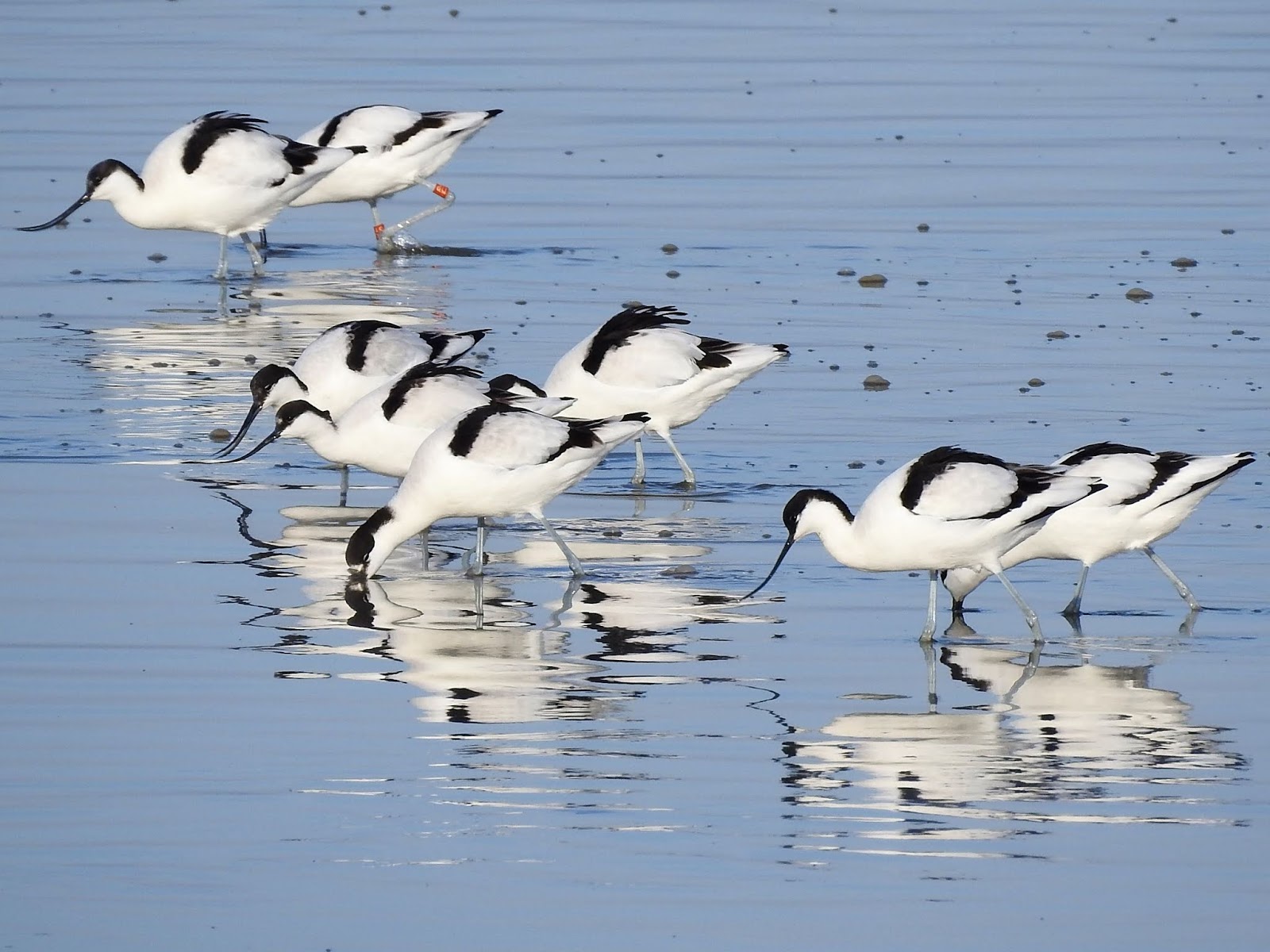
Avocets

Migration isn't cheap. As well as fuel, there's feather wear and tear. All birds have to replace their plumage. This takes more time in larger birds, for most waders around 90 days.

Redshank love the stopover facilities on the Medway. First birds are back on the flats post breeding, late June. Local breeders are joined by birds from the near continent, then later from northern Europe and finally Iceland. The 'continental' birds are most likely to continue south after moulting, on to as far as west Africa for the winter. The Icelandic usually tend to stay on here- they don't mind the cold, being slightly bigger birds. All populations within a species have different degrees of attachment to an area. Redshank overall numbers are smallest in summer, highest on autumn passage, somewhat lower during winter. Why we need to survey through the whole of the year to understand what goes on.

Several species behave similarly but differently, with populations having different strategies; when Grey Plovers arrive, some wil moult and then stay, others simply refuel, then carry on south to moult later.


Diverted air traffic

Black-tailed Godwits

Youngsters have a general idea where they're heading, but are more prone to land at unscheduled sites. Why those rarities that twitchers chase often turn out to be youngsters. If they find a rare adult wader, why twitchers then they have high hopes it might well turn back up same time following year.


Customs on arrival

Turnstones

We've seen it isn't that easy to spot the incoming, what with so many other movements going on during the twice-daily ebb and flow. The Medway, as an 'inland estuary', doesn't really have a coastline, so we don't see birds fly 'in-off'..

So, one of the easier ways to pick out arrivals is on a covering tide. Birds are wary. Even if they know the area, they will still need to check that last autumn's safe roost site is still safe. Juveniles have no idea, they watch and wait out on the flats, often until the tide is up to their bellies, before dashing to a roost; they will have watched local birds leaving long before to settle for the high tide.

Also, the main runway for arrivals appears to usually be mid-estuary. Makes sense, the quietest areas will be central to this 60 square kilometre eastuary. A chance to rest up upon touchdown before exploring. Small flights of 10s, 20s, 30s can often be seen dropping in from height (local/settled birds rarely bother to gain too much height when traversing the area- why waste energy?)

So, the individual species- how do they use the Medway? A short cut-out-and-keep guide follows.

----------

Plain spotting at the hub:

A short guide to the common wader species
found on the Medway 
during late July/early August


Curlew

The following accounts are simplified guides to the commonest waders using the Medway as a hub in July and August, including:
- Points of departure
- Final destinations
- length of stay in the UK
- Reason for visit (their moult strategies whilst on the Medway)
- Passenger number estimates: average maximum figures for July and August are taken from WeBS/KOS reports. There are two sets, illustrative only, as  surveying has often been incomplete since the turn of the century. The first figures, for the 90s, were done partly when the Medway was better surveyed. The 00s counts are now acknowledged as probably unfit for purpose. Finally my comments, which are based on my own nigh-daily visits to the estuary, from 2013 to date.


Oystercatcher


Local breeding population: Most choose not to fly far from the estuary, though a few (mainly their youngsters) head south (to near continent, exceptionally as far as Africa).

Local non-breeding population: stay local all year, augmented by very young Norwegian birds (who from age of two tend to move nearer their natal grounds in summer).

Main winter arrivals are not until October/November. Chiefly Fennoscandian birds, mainly Norwegian. Others from the Low Countries, with small numbers from Iceland e. to Estonia.

Moult (adult)- postbreeding, complete: flight feathers usually changed September- December, may occasionally arrest during passage (technical term- the moult halts then later begins again from the start by changing both new and remaining old flight feathers). Why the bulk of our wintering birds, moulting somewhere else along the flyway nearer to their nesting grounds, do not start to arrive until much later in the year.

Average nos 1990-99 July 616 August 1,008
Average nos 2000-09 July 700 August 670
In recent years more sampling has revealed numbers to still be in four figures from around now, but the picture is complicated by individuals using one estuary (Greater Thames) to feed then roosting in another (Medway), if disturbed or if spring tides reduce carrying capacities- numbers can be tripled over certain tides


Avocet


Chiefly short-distance flights at present, switching between local breeding estuaries (east Anglia southwards) and local moulting grounds (such as the Thames at Cliffe). They then Settle on a choice of estuary for winter, usually within southern UK- but not necessarily the one they bred on.

Moult (adult)- postbreeding, complete. Flight feathers start in July, to October (November). Winter numbers on the Medway do not peak until after this time.

Average nos 1990-99 July 66 August 182
Average nos 2000-09 July 135 August 147
In recent years, due to increasing breeding numbers, July numbers have continued to grow, but most will have left for safer moulting areas by month end- August has similarly low numbers nowadays.


Ringed Plover


A collapse in numbers in recent decades, now almost extinct as a breeding species on the estuary. Any remaining local birds will be joined by birds from northern Europe for the winter, with 'tundrae' (birds from the high north of Scandinavia e. into Siberia) passing through in variable numbers during autumn. A definite early autumn peak in passage numbers, but birds 'short stop' and may only be present for a short period. Counts are often missed.

Moult (adult)- postbreeding, complete. Highly variable sequences, usually starting on breeding grounds, from mid-June to as late as October, most suspending the primary feather moult during peak passage period (August- September). Right now they will have grown a small number of new flight feathers to help their journey south, our breeders perhaps going as far as France/Spain while the Scandinavians 'leap-frog' us to go as far as Africa

Average nos 1990-99 July 124 August 904
Average nos 2000-09 July 12 August 155
In recent years numbers have remained low, just double figures most days, although the odd three-figure count does still get made- just as for breeding, Ringed Plovers find our increased activity and urbanisation have made the Medway less attractive. Any high shoreline fronts (their favoured areas) are too disturbed (or more often flooded by increasingly high spring tides) for hold them for long.


Golden Plover


A small number arrive around now and will remain to overwinter. Origins unknown, possibly British/ near continent.

Varying numbers then arrive in late autumn/early winter. ('last minute bookings' to escape harshest of the winter weather on the continent). Further urbanisation of the green areas surrounding the Medway will reduce the Medway's carrying capacity- birds that spend the day roosting on marshes such as Chetney do need inland fields in which to feed at night.

Moult (adult)- postbreeding, complete. Starts late May- July, often suspends July-August, restarting mid-September- early November. July August is the move from breeding grounds, the flight feathers are pristine at the start of winter ready for 'escape movements' from bad weather.

Average nos 1990-99 July 7 August 40
Average nos 2000-09 July 11 August 97
Numbers on the Funton mudflats have, in recent years, been slightly higher (up to around the 200 mark) and, interestingly, these birds then tend to continue to roost on the flats rather than join the later arrivals in the fields.


Grey Plover


First landings are usually  scheduled for late July, the start of adult passage, with youngsters then not turning up until September.

Moult (adult)- postbreeding, complete. Starts on wintering ground or on specific staging ground. Starts flight feathers between August- early October, but birds starting from September onwards will suspend from mid-October and only restart in spring. ('Suspend' another technical term; stops, then restarts later from point where halted earlier- so, different from 'arrest'.) Birds present on the Medway in early August will either be adults about to either pass through quickly, or here to establish a feeding territory and remain to moult. Why easy to miss the highest counts if only counting a few times each month.

Average nos 1990-99 July 180 August 1,556
Average nos 2000-09 July 7 August 131
Recent numbers still reflect 1990 figures. Most of the larger flocks do tend to favour the less-disturbed flats mid-estuary, perhaps hinting at their being 'short-stayers'.


Lapwing

Small numbers will have been arriving since June, mainly from the near continent. Some return year after year to winter, mainly late Sept-Nov, but the biggest numbers only will only be seen if they need to escape poor bad winter weather. Biggest numbers will always be on the fields rather than the mudflats.

Moult (adult)- postbreeding, complete. May/June- August/September. The species has a very fast moult of outer primaries to aid early autumn movements.

Average nos 1990-99 July 313 August 513
Average nos 2000-09 July 138 August 347
Another species where older records better reflect the present position- incomplete coverage has underplayed the estuary's true numbers. The drier the summer, the more easily detectable out on the mudflats (instead hidden up in the harder-to-view/count fields spread around the marshes).


Knot


Small numbers on autumn passage. Biggest numbers are December-February, made up of wintering wanderers who, having spent first part of winter elsewhere on the east coast, take a short flight to enjoy the Medway cuisine. Fussy eaters, Knot rely on molluscs more than many of the other calidrid species (why they are fixated with only certain muflats here).

Moult (adult)- postbreeding, complete. Might start on breeding grounds, but usually not until in wintering area. Subspecies canutus starts when reaches Mauritania in August-September, subspecies islandica start as soon as arrive in western Europe (July/August) but these stay mainly on recognised moult grounds (e.g. Morecambe Bay, the Wash); 'our' August birds are usually of the race canutus, from western Siberia, heading for Africa.

Average nos 1990-99 July 0 August 171
Average nos 2000-09 July 0 August 50
Recent years very similar, and erratic in number from year to year. A clear example of flight diversions by way of a departure from the scheduled route- here, birds usually relocate after a day or so, probably having overshot the Wash or the Waddenzee (Netherlands).


Dunlin


schinzii- Greenland/Iceland to Norway- small numbers on transit through the early autumn.
alpina- northern Europe to north-west Siberia- these are our overwinterers, not booking in until October/November.

Moult- postbreeding, complete. Just as each race has its own wintering preferences, each has a differing moult strategy. Schinzii moults after migration, alpina may start and then suspend before migrating, often to complete on other specific staging grounds along the flyway before finishing in October (just in time for many to make the final flight to their north Kent wintering grounds). Why many of the small number of adults seen now are likely schinzii, making short stopovers before racing off south.

Average nos 1990-99 July 350 August 1,774
Average nos 2000-09 July 8 August 443
One of the few species where a decline appears to have continued; hard work nowadays for three-figure count at this time of year. Clearly refueling elsewhere. If their main flyway is west to Norway then down through Europe, most will stick to the continental side of the Channel- when they do drift over, they stay more to the south coast than north Kent.


Black-tailed Godwit


Often higher numbers in autumn than in winter. First returnees from Iceland arrive late June, continuing to build through August, to make a moult stopover, with many then moving on to spend the later winter months on the south coast, over in France, or as far south as Portugal.

Moult (adult, islandica)- postbreeding, complete. The flight feather moult takes place after main flight from Iceland, from August to December, when birds may then move on. Birds seen now on the Medway will intend to stay here on the north Kent marshes to see out this important stage of their moult cycle.

Average nos 1990-99 July 232 August 979
Average nos 2000-09 July 298 August 570
Nowadays, four figure counts in August are the norm. (Reflecting the growth in breeding numbers in Iceland).


Whimbrel

Small numbers pass through in early autumn. A species which we see more in the spring than the autumn. The bulk of their population moving through the UK (breeding in Iceland) adjusts their flightline to Africa, sticking to the west via Ireland. The birds we see in the autumn are more likely from Scaninavian/Siberian populations.

Moult (adult)- postbreeding, complete. Usually not started until on wintering grounds in Africa, September/October onwards (a neat aide to separating from moulting Curlew in distant flight at this time of year). Stopovers here are for refueling purposes only.

Average nos not readily available from the old printed annual reports. Partly because they weren't here in any number then. Whimbrel can be fickle and switch refueling sites every few years. Recently a three figure roost has become regular around Nor/Friars/Oakham at this time of year, but only for a matter of a few weeks before continuing on to the wintering grounds to moult.


Curlew


Annual peak numbers are in the autumn, usually September. Safe moulting out around the Medway islands. The drop off in monthly counts later in the winter is probably down to feeding strategies as Curlew, more specifically the shorter-billed males, prefer to feed in fields as winter progresses. Further urbanisation will affect the Medway's carrying capacity.

Moult (adult)- postbreeding, complete. Primary flight feathers start in July/ August, shortly after arriving on wintering grounds. Take 12 weeks to complete.

Average nos 1990-99 July 786 August 1,599
Average nos 2000-09 July 134 August 178
Recent numbers reflect the more methodical counts of the 1990s. In fact, a series of counts will often produce peaks- like Oystercatcher, under certain tidal conditions/ disturbance levels, many of the Thames birds will join the Medway (and Swale) moulters. Another reason why counts should be coordinated not only within the Medway estuary, but on the Thames and Swale as well.


Redshank


Late autumn peak, although moulting numbers are already quite high. Rough and ready rule of thumb, most Icelandics overwinter, quite a few continentals carry on south. And some local movement to the near continent.

Moult (adult)- postbreeding, complete. Flight feathers start in late June to September. Usually remain on moulting grounds throughout, but can still continue on migration before finishedif needs must (a strategy more prevalent in continental birds).

Average nos 1990-99 July 2,294 August 3,523
Average nos 2000-09 July 208 August 404
Numbers moulting within my study area (the southern shoreline) probably reflect an autumn population perhaps only a little under those 1990 figures. Get the count time right (on the rise for birds retiring into the spartina) and single creek roosts here can exceed 700, 800 birds.


Greenshank


Small numbers build to a first peak at the end of July, when the bulk of the breeding adults arrive. A second peak follows two- three weeks later, as the juveniles join them. Very small numbers then remain to overwinter.

Moult (adult)- postbreeding, complete. Moult of flight feathers might start on breeding grounds, then suspend until reach moulting  grounds such as the Medway. Moult takes place July to September (though some may then suspend unifinished moult until they reach their wintering grounds).
Birds here in early autumn are here for safe moulting.

Average nos 1990-99 July 21 August 60
Average nos 2000-09 July 17 August 54
Greenshank behave a lot like their red-shanked cousins, and are often hidden up over the usual WeBS counting period (high tide itself); by counting birds into roost, three figure counts are in truth easily achievable during August.


Turnstone


Fennoscandian population: on transit for south
Greenland/Canada: arriving slightly later, for winter.

Moult (adult)- postbreeding, complete. Birds make a choice of two strategies. #One, starting late-June- August by birds intending to overwinter in northern hemisphere. #Two, for birds overwintering south of the equator, flight feather replacement commences mid-September.

Many of the Turnstone on the Medway in the early autumn peak show no sign of a wing moult, hinting at a short stopover and a long journey ahead.

Average nos 1990-99 July 97 August 726
Average nos 2000-09 July 22 August 43
Again, counts are more usually closer to the 1990s. A species that shows a clear weekend disturbance pattern (more often heading to central estuary roosts rather than the old hulks closer to the shoreline footpaths).

----------

Hopefully this short introduction to the Medway's early autumn bird migrants has helped illustrate the large numbers of waders that will use the estuary during an autumn. It is a complex situation, with every month different; making sense of the way the birds continue to use this estuary is challenging but highly rewarding. Because the estuary needs to be understood if we are to protect it- which brings me neatly back to our hosts tonight, the Living River Foundation- we really do need to know what effect plastic is having on our breeders, our migrants, our overwinterers, on their fuel living in the estuary? I'm sure we all wish them well in their monitoring work- and thank you for coming out and supporting them tonight.


Monday, 23 April 2018

Points of views

The morning had started out as a Shelduck chase. Following a few twitter exchanges about the territories they use (which is a blog in itself) I decided a good morning to count some of the non-breeding flocks in the eastern basin.

Working back from the Swale station, I soon found myself up on Raspberry hill. Here, and Tiptree hill have long been known as the best viewpoints for the estuary islands by both birders and non-birders alike. In Helm's 'Where to watch birds in Kent, Surrey and Sussex', Don Taylor had long sung the praises of the viewpoints for 'scoping the distant creeks. They provide some of the best birding on the estuary (probably why I chose Chetney for my first blogpost here). Both viewpoints even have seats of sorts nowadays; the owners have put in a superb huge beam of a bench up on Raspberry hill, while broken chunks of concrete from one of the old wartime buildings have been piled up around the base of the telegraph pole on Tiptree. This is the busier of the two viewpoints, as the path here is one of the highest points of the Saxon Shore Way long distance footpath, although I am usually joined by walkers rather than birders. With my caveat that general birding remains much better on reserves, I've promoted both often enough in the past, but the distant birds views only appeal to obsessive birders (with my cakky old Bridge camera I never get a decent image, but they're fine for record shots of flock sizes, behaviour, etc., besides, heat haze for both 'scope and camera can be a pig). Walking from either Lower Halstow or Iwade appeals to few (leaving a vehicle anywhere at Funton can be problematic; break-ins are, sadly, routine). But they are worth the effort.

Taylor, Wheatley, James, 4th ed., 2003 Don't trust the 'P',
some footpaths are missing, but that Tiptree star is spot on
While I've tweeted and blogged plenty of pics from up there these past five years, another reason I haven't banged on about them these past couple of years because of the ongoing Coast Path discussions. Some stretches of new footpath are likely to arrive in the area, and during this time I'd been asked for information, mainly concerning on both roosts and general disturbance levels. Just a couple of months back I was contacted about one roost near here, when I heard that publication of the route through the estuary is looking likely to be in September (which will raise a few blogposts at that time). So, we're getting close enough not to have to worry about any impact from publicising the viewpoints to birders a little more on here (heck, the other month I was even tweeting the county Recorder saying it'd be worth while getting up and having a scan over Chetney). To date I've only published the first part of the shoreline site guide for the same reason; the remaining sections will come online shortly.

Today that Chetney viewpoint did me proud, and Shelduck numbers were high, higher than expected. (Numbers along the whole of south shore this spring are par; somewhere around the levels that used to get picked up on WeBS in the 90s, nothing that would excite anyone other than a local.)

Rather than take footpath along the ridge I followed the road west down to Bedlam's Bottom and then along to Funton Creek. I was soon distracted by Rooks. They were feeding manically among the saltings and cord-grass beds.

I cursed myself- another pet subject was playing out, and I had nearly missed it. The mini-heatwave we had just enjoyed meant the ground surface was solid in many fields nearby, making difficult feeding for corvids. You can often see three figure counts of Crows on the flats during the year, they have adapted to estuary feeding, but Rooks (and, to a lesser extent, Jackdaws) only join them in big numbers when feeding is tough. Only the day before I'd been impressed by how much like concrete my allotment beds had already become, but I hadn't sussed it was Rook time. Nearly a Rookie mistake.


Some local landowners control corvids, just as some North Kent nature reserves do. You can have a big debate on the merits of that, but what interests me is why some landowners spare Rooks, others cull. The texts are clear; Rooks will take both game bird eggs and wader eggs. But to what extent? 'Birds of the Western Palearctic' states the young are fed almost exclusively on insects, but that these are hard to obtain when fields are dry. So, perfect conditions for looking at a question I'd been interested in for years.

I took the bridlepath up Tiptree. I went to count my Shelduck flocks first, and found they were nearly all missing (explaining in part the raised Chetney numbers). Then I noticed the local Lapwings were agitated. Not just territorial interaction going on, but real agitation, birds even gathering in a 'mini-flock' sitting out in the middle of one of the pasture fields. Others were flight-distracting. These behaviour continued during all the time I was up there, and it was not going unnoticed by others; numbers of Rooks, as well as Crows, were coming off of the saltings and into the fields.

Now the land below Tiptree is no nature reserve. The land is worked, and workers are often out and about. But I then saw someone strolling slowly down the central counter wall and wandering through the centre of the small peninsula below me. Paperwork and behaviour gave away as a bird surveyor, and clearly noting the Lapwings.

Now of course there's an appeal to wandering fields, but any good surveyor should know better than most just how disturbance can happen during a survey. Whilst the published survey methods are clear about checking every field, at the same time they also stress disturbance must be kept to a minimum:

"Extensive open areas should be checked from roads tracks and footpaths without disturbing nesting birds. If birds are flushed, retreat as quickly as possible.. counts are most accurate when birds are undisturbed.. an observer walking through a field, or a crow flying over, will usually cause all the lapwings to fly up..'

All probably why the methodology states a telescope is the essential piece of kit for Lapwing surveys. This surveyor was diligently noting each bird that overflew them, or that they picked up in their binoculars. They just didn't appear to be noting what was happening behind them. From nearly a kilometre and a half off. I just had to sit and watch it happen. Easy for Lapwings to keep one or two Crows away, much harder to target a couple of dozen Crows among a hundred Rooks. And corvids are just as good as us at mapping out territories. They were watching.

That person could well try to justify, and you can justify any action. Justifications hold more weight when countering criticism, but the feedback was pure. In this instance the Lapwings were clearly disturbed, known predators were clearly gathering and published methodologies were not being employed. Why it is best to try to appreciate why the RSPB's Bird Monitoring Methods ask you to do certain things, and then apply.

Especially if in plain sight of any observer who happens to be up on what is acknowledged as one of the county's premier birding viewpoints, on one of the county's busier footpaths. Without fieldcraft, you will be seen. And local birders are already on the lookout for problems.

A couple of years back, after discussions with RSPB Investigations, I highlighted the plight of our gull colonies; reports of unauthorised landings were on the rise, and some satellite colonies within the island complex had deserted, some witnesses allegeding watching a gang of egg thieves out on the islands (taking the eggs for either for the restaurant trade, or for selling locally, private or otherwise. Sadly, with so much wildlife crime still happening, priorities have to be made and gull colonies come lower than birds of prey. So it has to be local birders who 'recognise, record, report' (the tagline of BAWC). The county ornithological society even kindly published some links to my pleas in here and in other county birding facebook pages.

As it is coming up for that time of year again, here's the link to my original 2016 appeal.

Of course, viewpoints out to these colonies are Godsends. 'Scopes and cameras necessary tools.

I'm told by some there are mobile phones with better cameras than I own. Don't doubt it (but still don't ever want to own a mobile). No-one should be naive enough to think they aren't able to be viewed on the marshes, and their actions, whether disturbance or criminal, recognised, recorded and reported. I know I'm often photographed or filmed by some landowners, and I'm more than happy with that.

We birders are being asked to set high standards to the general public when alongside our SPAs nowadays, as legally required initiatives to reduce disturbance, such as Birdwise, come into play. Studies have already proven birders to be one of the main disturbances to wintering wildfowl and waders. Often inadvertently, but disturbance all the same. Birders' egos bruise easily when called out on such things, but it really is time to put such sensitivities aside and for us all, birders and birdwatchers, professionals and 'citizen scientists', to acknowledge such feedback and keep raising standards in the field- because we know additional big pressures on our estuaries are coming, and we need to get the public, not just ourselves, 'birdwise'.

Finally, whether we like it or not, pics of poor birding behaviour appear nigh daily in our birding timelines, often with calls for outright 'naming and shaming'. My harsh tweet that day was deliberately general in details, and non-illustrated. The chair of the county's Conservation and Surveys Committee did reply pretty quickly asking for details, so I did provide clues needed by giving him enough to work out details and appreciate problem (which he did, even though I'd ensured the cropped pic I'd attached for positioning the incident had a nice anonymising blob added over much of the highly pixellated person).

Being on the receiving end of feedback can be painful, but we all have to face up to it from time to time. If we don't want to face up to it, we fall back on logical fallacies; appeal to emotion, claim false cause, personal incredulity or 'the strawman'. Or we can take on board, and improve. And that 'we' is why I've posted this; if a few birders think more about such things, then worth it.

A final thought. I normally veer away talking about Schedule one birds during the breeding season, but as the county's rep on the Rare Breeding Bird Panel recently talked about the estuary in an open Facebook group, I'll make the following point. If you were surveying an area with Schedule One nesting birds, are you committing 'reckless disturbance' (the legalese) if you fail to act in accordance with that species' proscribed methodologies once those methodologies have been pointed out to you? Tricky; why best to try to stick to the published methods in the first place.


-----


I'll say it again; if you can put up with a lot of the birds on show being specks, and you haven't yet been to either of these viewpoints, do go. On a rising tide, or over a full tide (especially a spring) at this time of year. On a winter's afternoon, any time of tide. You really won't be disappointed. Just remember to take your 'scope.

From Tiptree hill:


From Raspberry hill:


Friday, 2 March 2018

Get the facultative movement outta here

“It is well for us to recollect that even in our own law-abiding, not to say virtuous cases, the only barrier between us and anarchy is the last nine meals we've had”
A.H.Lewis, 1896

The arrival of the Beast


Obligate movements. Obliged to do it; inbuilt. The urge, for some, to migrate, at the correct season, at the correct time.

Facultative movements. There is a choice. Stay or flee. (Strict biological definition? 'capable of but not restricted to a particular function or mode of life'.)


As I plot this blog out, it's 06:00 and the Queenborough weather site is showing minus one, with a minus ten windchill. North-easterly wind, averaging 35 m.p.h., gusting to 46 m.p.h. The 'Beast from the East' continues to hit. Do I go out at dawn, or stay in? My choice. I wanna bird, but I also want to stay warm. If this blog gets posted before nine o'clock, you'll know what I chose. That decision is based more on the weather, because I've got a kitchen full of food to keep me going and I've already had my porridge.

But we're all only nine meals from anarchy. Birds? Some are nine meals away. Some, just a couple. Individuals of different species make decisions to move at slightly different times.


-----

Someone told me the Lapwings are migrating away at the moment. Well, strictly, no, they're not. Their annual obligatory migration routes between core breeding areas and overwintering areas are long-established. Within their wintering range, there can be movements during that non-breeding part of the year. Radar studies have shown movements can happen almost daily throughout a winter, in variable numbers. There is a continual readjustment, a refinement, as birds make choices.

These are movements, not a migration.

In the past I've heard it said this is a cold weather movement. That would be nice if it was, because temperature is measurable, and we could soon say what isotherm triggers the movement, just as we have an understanding of how temperature correlates with migration, but cold isn't the main drive.

All-too often you hear hard weather movement. Nice term, but what does it mean? Define hard weather. I've yet to hear someone call a drought 'hard weather', but in that circumstance, waterbirds often make a choice to move, often northwards. Our influxes of, say, Glossy Ibises, have yet to be called hard weather movements. Or autumn pressure systems bringing 'Yanks' to Europe being themselves hard weather- if that's not hard weather, I don't know what is. You could say 'weather-related' I guess, but many scientific texts avoid the phrase.

They tend to call it an escape movement.


-----

The hard weather we're having on the Medway at the moment - mainly deep snow cover, freezing temperatures, chilling winds - puts pressure on a number of the birds here. At an individual level.

Take sheltering. There is a limited amount of decent shelter from the chilling winds. Watch a clump of cord grass and you might not immediately realise how many birds are in there; scanning a birdless edge of saltings a couple of days ago, a cord grass clump called like an alarming Redshank. The next clump over answered, then the next, and then the next.. Yesterday, one flighting Redshank crashed into a clump and put out twelve. They all moved to another nearby clump where, finding no room at the inn, they gathered on the sheltered side and huddled.

Take food. Those Redshanks, their preferred meals haven't migrated, but they're moving - downwards. the colder the mud surface, the deeper the critters burrow. And the surface has been cold of late. Two nights ago, snow arrived during the low tide cycle. Usually snow on mud melts, but it was cold enough for the snow to form a thin sheet of ice over much of the estuary. The birds could not get at their food. Some could. Often the edges of a creek or tideway do not ice up; gravity plays a part in keeping water flowing, so the mud remains, well, muddy ,and there is some feeding available. Squabbles ensue. Some individual birds chose to move. They chose to try to escape starvation. 


Yesterday, the only birds sitting out on the more open flats were the Brent Geese and the Shelduck. The bigger waterbirds. They can play hunger games for a longer period than their smaller cousins, the ducks. These geese may not move for three or four days of snow cover, the ducks might move after a couple, but never usually all of them so long as some feeding remains available. Weighing up when to go is a balancing act.


------

Back to those Redshank. Like quite a few wader species, once they have chosen an estuary in their first winter, they then stick with their choice in future winters. Makes sense. They know it well. For most of the winter, they will not carry big food reserves. Carrying additional fuel outside of migratory periods means slower day-to-day flighting from ever-present predators. Much better to be a mean, lean, flighting machine and hope any poor feeding period only lasts a short while, because they won't have the reserves to make a big distance movement without having an impact on their survival odds. If the extreme weather lasts is long lasting, many will die. They run the risk. The strongest, the fittest, those that can hang on to a feeding spot, survive.

-----

Right now in the belly of 'the Beast from the East', birders are reporting the 'usual suspects'.

Plovers on the move. Plovers rely more on eyesight to locate prey. The species that feed more in fields than mud flats, Lapwing and Golden Plover, have real problems with snow cover. They escape early.  Haven't been in huge flocks here, birds are making the decision individually; twos, threes overflying aren't that exciting (but add up the local day total and the movement is clear).

The field-feeding thrushes, Fieldfare and Redwing, are escaping in a similar manner. Numbers break off from one large-scale gathering and wander. Take how garden birders might report one or two in the back yard one morning becoming a half-dozen later in the day, then a dozen, then two.. Snow cover in south-east England is patchy, many are trying to avoid costly flight, but some birds in the snow need to move. The total involved is fluid.

Transfer that thought process to small calidrid waders and you begin to understand why inland patch workers are getting one or two Dunlin or an odd Knot flying by. Some are choosing to make a short switch to another estuary (perhaps the Thames and Swale for Medway birds; our sister estuaries are that little bit different, with fewer sheltered waters that are freezing out from the shore), not really a full-on escape movement between estuary complexes (we're all the Greater Thames around here) but others may chance finding an unfrozen estuary (remember, they may not have visited sites south of us before) by fleeing overland.

The county avifaunas often refer to the largest movements in the worst winters, and we birders sometimes head out hoping to see hundreds and thousands of bird racing past us, to experience the escape movement. More likely we'll only pick up on a few dozen, or perhaps break three figures for a couple of species. Escape movements are nowhere near as predictable as viz mig during an obligate migration period.


-----

Some are waiting to see wildfowl on the move. Probably won't get seen, because most will still choose to move at night, often overland. We'll see changes in day-to-day local totals. But these might be very short movements, flights to nearest open areas rather than huge jumps. Now mix in the obligate. This time of year, some birds are starting to respond to their obligate drives and are wanting to start to move toward breeding areas. Looking at a satellite image for yesterday, it was clear that most of the low countries were free of snow. Feeding possible. We've only got so much thanks to the North Sea providing moisture. Is there any reason for any duck there to want to 'escape'? Move further on when their urges are saying otherwise? It might be bloomin' cold, but if they can feed..


-----

Escape movements. Yes, they correlate to the weather, and some may move early on sensing weather systems, but for many it comes down to food. Passerines may go early in comparison to larger non-passerines. Can't go as long being cut off from feeding. Juveniles may go early, being routinely pushed down pecking orders (eg think Woodpigeons).

We humans are nine meals from anarchy. Some birds are one or two from death. Calling it a hard weather movement helps hide the life-or-death decisions being taken. Not simply a happy switch between sites, often this is escaping. At the moment, all too often we birders will get excited by the rare garden bird, the patch tick, the hard weather movement day total because it's what these bird species do, but fail to appreciate these individual birds are appearing because they're in trouble..

-----

Hang on, it's 07:30 already. Time to stop. Think I'll leave going out for an hour or so, tide's not until 10:00. Ohhh, time enough for a second breakfast, lucky ol' me (!)


-----

Saturday, 24 February 2018

Weigh heigh! And up she rises?

The Westmoreland was wrecked off of Hoo over on the north shore back in 1973. Another of the many old sailing barges to come a cropper. Her agony has been prolonged. The wreck was taken to Faversham, in the hopes of restoration, but time and money ran out a few years back. The owner of the Edith May then stepped in and bought her and transfered her, on a floating dock, to Halstow Creek, where she has sat out at the end of the old causeway.

-----

Friday, an hour before the tide covers the flats. Halstow creek is busy with Pintail and Brent. Both are up in number, even though numbers have been going down; an internal estuary movement of lowering estuary numbers as the fowl try to gain a little shelter from the increasing easterly wind.

A figure passes me. I look up and see they are carrying a shovel. Curiosity is aroused; the local Parish Council have long-since stopped bait-digging here, but one or two still flout their rules. But a bait-digger uses a fork? And has a bucket to carry the bait in. This chap clearly had a spade and a rather large spray can of compressed air. Curiosity dials up to eleven.

They cut down off the seawall and out onto the old causeway. Now overgrown with weed, and with sections of the brickwork missing, it is not a particularly nice walk. I've done it twice in five years. Both times on an ebbing tide, to follow the waders out, at a distance. I'm in no hurry to try again. On the rise? Wouldn't risk it and besides, there would be an awful lot of birds disturbed.


I think he must be an owner of one of the handful of sailboats kept out there but, no, he keeps going, going, going.. right off the end, knee-deep in the clinging mud, pausing only to retrieve.. a child's plastic sledge. And make for the Westmoreland.


All sorts of alarms go off in my head. During the past five years I'd seen enough wreckers on hulks to know there's money in old metal. Was he planning on dragging some back? I'd planned to be off to Funton by now, but it could wait a little longer. I like the Thames barges, and didn't want anything happening to this one.

He disappears inside the floating dock. Through the 'scope, every now and then I spot his head bob up, then I see I saw a camera. What was happening?

------

Of course, there is absolutely nothing to stop anyone going out on the estuary at Lower Halstow, though I wouldn't advise wading through the soft mud to anyone who's never tried it under guidance from someone with experience. You don't walk as such; lift a leg for a stride and down you go and 'stickfast'. There's a technique to wlaking the mudflats, and I'm not telling you! Instead I'll save your life here by keeping you to the seawall.

Although us birders know Twinney and Halstow creeks are a spectacle, neither are protected from routine usage. Disturbance is to be expected. So, as well as watching the mystery mudskipper, I watched the birds.

It was a rising tide, early afternoon. So, not too many gulls loafing on the causeway. By the last third of February you can usually expect to find the first handful of Mediterranean Gulls back among the Black-heads. There were eight, but they were sheltering alongside Halstow Creek. The Lapwing were in fair number for here though; often resting birds disturbed from the fields overfly, with some coming down to roost safely on the causeway; a three-figure number went up, along with a handful of Oystercatchers and Turnstones.

On the mud itself, many of the larger waders and wildfowl were soon off; they never appreciate a close approach. The smaller, as usual, stayed in more numbers, but I always add a caveat to that rule. The tighter the flock, the quicker they go; all it takes is one flustered bird to set off a flush. And the wildfowl on the water in Halstow Creek near to the Westmoreland? They retreated to the far bank.


------

The 'wrecker' was off ahead of the tide, just, with his sledge laden with.. well.. nothing. And he brought it all the way back to shore. Quickly noting any second phase of flighting (just double figures of Lapwing had been happy enough to land back on the causeway, but now followed the others to Barksore), I moved to a point where I could intercept the chap and strike up a conversation.

Bad news. On Monday, in poor weather, the dry dock had decided to hole; the Westmoreland was no longer afloat. For me, the penny, like the barge, dropped. The can of compressed air was for opening/closing old rusty seals or similar; letting the water out. That's why he had gone out on the rise. To close things up. Open on the drop, close on the rise. And if I had had half a brain, I'd have noted the Westmoreland had shifted when I 'scoped it. Actually, shifted was an understatement. More liked twisted (or as the chap said, 'popped'). The shovel was to clear mud, the sledge perhaps a buoyancy aide to spread weight as the soft mud sucked up water on the incoming tide? Probably still got a bit of all that wrong, but I didn't need to ask.

We chatted for a few minutes. I asked after the Westmoreland's fate, bearing in mind Lottery funding had been turned down. They hasn't given up hope yet. The owners are Lower Halstow through and through, and the Westmoreland is a part of this village's history.

-----

An estuary doesn't just belong to the birds. The Medway is no exception. Lower Halstow, for birders, is one of the gems of the southern shore. But for now I understand we'll be seeing more flighting, more 'necessary' disturbance to the feeding birds- and right at the start of the coldest winter weather here for five years.

Here on the blog I sometimes mention the estuary is protected by Ramsar. The Ramsar Convention on 'Wetlands of International Importance especially as Waterfowl Habitat' is an international treaty for the conservation and sustainable use of wetlands. Recreational use has to avoid a detrimental effect. This was an unfortunate incident.

The Westmoreland had 'popped' on Monday. The end of February usually sees a drop in Knot numbers as they move off to the Waddenzee, but I'd been puzzling all week over why they had so suddenly moved out of the Halstow/Twinney creeks. There were still numbers in Funton still, but Lower Halstow's rising tide flock had gone, seemingly.

But another good excuse to keep going out at the moment. An bit of an impact study of sorts. The counts would be dull, but the more you don't see, the more you understand.

Tuesday, 20 December 2016

Goldie flocks

"In the Thames, and perhaps to a lesser extent the Medway, the first arrivals after a brief spell about the marshes and saltings pass on to the upland fields, whereas along the Swale they not only spend the whole winter in the marshes but regularly visit the saltings and mud-flats. This latter habit is certainly not confined merely to newly-arrived birds, but is noticeable with some of the winter population...
...Dr. J.M.Harrison, writing in the South-Eastern Bird Report for 1937, considered that the visits of the Golden Plover to the saltings and mud-flats of the north Kent coast were rare and limited to odd birds. We agree in general this is correct, but it does not apply to the same extent when they first arrive or during their stay along the Swale and a certain portion of the Medway..."
The Birds of the North Kent Marshes
E.H.Gillham & R.C.Homes, 1950

A sixty-six year old conundrum, which some texts point to now being solved. And a behaviour which certainly still happens on a 'certain portion' of the Medway.

On the mudflats

The first Goldies usually turn up late July/early August, almost always found on the undulating hard flats just south of the remaining saltings on the edge of Bedlams Bottom. The first birds are mostly adults, already showing body moult. Over the next few weeks these numbers build to just around the 200 mark, and remain about this level until the expected early winter influx. This pattern mirrors similar small arrivals at more westerly sites around the eastern Swale.

First returning birds, July 2016

What are their most probable origins? 'BWP' stated British birds to be 'partial migrants' with part of the population wintering in lowlands close to their breeding sites. The Icelandic population moves through Ireland and western Britain. The most likely source for Kent Goldies at this time is Fenno-Scandinavia/Russia, in line with the results from more extensive ringing efforts just over the Channel in the Low Countries. A bird ringed in September 1967 on the North Kent Marshes was shot whilst wintering in Spain in February 1969. The Dutch ringing scheme has a large number of Norwegian records from this time of year.

Will they continue south eventually? Well, the numbers remain level on the flats for the next couple of months, but the chances are we are seeing staging birds, small numbers staying for a few weeks then moving on. The moult strategy for flight feathers is attuned to this; a start before autumn migration, a suspension for several weeks during migration, only completing on arrival at the wintering grounds.

During these first weeks back on the Medway the birds will try to see out high tide on those small islands; if there are spring tides, they go under, so the birds make for Chetney. Otherwise they stay close to the flats. When on the mud, the birds are loafing for 95% of the time. Often it is like counting Meerkats- heads pop up from behind the mounds, and back down quickly again. The distance means they can be missed without a telescope. The rising tide, from around the 2.75 mark, does tend to force them out into view for a short while. The move to roost is more usually as one flock, but they can break into two/three groups to a pre-roost assembly on the flats just north of the islands for a short period.

Part of the flats loafing flock, viewed distantly from Raspberry Hill, November 2016

Feeding activity on the flats is just about non-existent, suggesting the mud is being used just as a safe loafing ground. After working that out slowly for myself, was pleased to see the excellent Poyser monograph quotes studies that have reached the same conclusion. Birds on the mud during the day are thought to be well-fed. It also quotes studies saying juveniles more often use mudflats, but that has not been the case with first arrivals at Bedlams in the last few years. Many species have higher mortality rates in first winter birds, but checking Golden Plover on BTO Birdfacts this is one area for which we still have insufficient data from which to draw results.

The general trend for Goldies in s-e England is for an increase in numbers after moult, often coinciding with the onset of colder winter weather. Further hard weather influxes may occur, but in recent years numbers are generally plateauing from late November.

On the fields

By this time the Medway counts are into four figures. These larger numbers stick, for the main, to the permanent grasslands of Chetney Marsh, where they also feed as well as loaf during the day. They will sometimes partly/wholly move west to the ploughed fields on north-east Barksore. Interestingly, counts of birds on the mud at low tide remain fairly consistent at between 2-300 birds, but on one date this month over the full moon period I counted just over 700.

The Chetney loafing site remains constant, west of the pylon line, with feeding there and through the grassy fields west to Stangate creek. The loafing flock is, for the main, single species; when feeding the birds are mixed in with the much larger numbers of Lapwing. The birds do not suffer close approach, and generally remain a field or so north of the Saxon shore way footpath.


The loafing flock, January 2014

Feedin
g at night


Perhaps there is enough feeding close to these areas- Chetney marshes are now deliberately grazed by horses to ensure a less tight sward. But it likely these birds, as elsewhere, might well have a much larger feeding area. Whilst some of the more suitable fields just inland to the south have been lost to solar farming of late, talking with some local landowners, numbers do use fields south of Funton at night. They all agree numbers in recent years have been much lower than in earlier decades.

It is easy to first speculate the Bedlams Bottom birds are birds that feed south at night, whilst the main numbers can get by quite well on Chetney feeding day and night. But peaks of birds on the mud suggest otherwise.

One important factor that affects nocturnal feeding is the state of the moon; more Lapwing and Golden Plover feed at night under a full moon than a new. the additional light aids their searching. Theoretically, the 'flats' birds might need to feed more in daylight hours, but I have not noticed any change in numbers tied to the lunar cycle. Better night feeding around the full moon might cause a few more birds to switch to the safer(?) flats to day roost.

For several years I was lucky enough to live on a farm among fields perfect for Lapwing. Birds would arrive an hour or so after the end of twilight, but often largest numbers would only be present for a couple of hours; I suspected that if feeding was good they would be in and out and back to safe loafing areas as soon as possible. Darkest nights saw lowest numbers, and birds staying longer.

Both Golden Plover and Lapwing can become active more than 50 minutes before dawn. About 20 minutes before dawn they gather together, then on dawn they disperse to continue feeding if needs be. Here, watches during twilight/dawn have confirmed large movements of Lapwing flighting back to Chetney/Barksore from farmland to the south. Goldies have featured, but never in large groups.

The more you learn, the more there is to find out.

The future


It is clear that the larger scale urbanisation/development further west along the southern estuary have removed nearly all the suitable feeding habitat; continued loss/changes in use of the farmland between the Medway Towns and Sittingbourne could well have an impact on the carrying capacity of the Estuary for both these species (plus Curlew and Snipe). In recent times changes in field usage alongside the Thames led to the decline of the Cliffe birds (that would loaf out on the Higham Bight mudflats). Just this week, between the drafting and posting of this blog I have seen twitter feeds making reference to a need for more work on nocturnal core areas in consultancy surveys, which is a heartening development.

Around the estuary

So, from data Chetney and Funton would appear to have been Gillham and Homes' 'certain portion of the Medway' more than sixty years ago. For Rainham, Prentis, in the 1880's commented that 'November is the month for the Golden Plover, their arrival is most uncertain, some years they are tolerably plentiful, others very scarce. They frequent the plough fields, fly together in company of an evening over the low hedges, where they may be intercepted and shot...'  A century later and Holloway conclusions for the Gillingham district were 'a few birds are seen on migration each year particularly in autumn but the species is surprisingly scarce during the winter when a few may be seen during hard weather...'

Looking at the published county records up until my return to Medway, Golden Plover may have been a less regular visitor until the grazing on Chetney changed to a more Plover-friendly regime. This main roost area is on a game shoot. The are still legal quarry in the UK, but it is not known if Plovers are taken regularly there- a recent article in the Shooting Times stated they are shot rarely in the UK nowadays.


Records further up the estuary remain quite scarce- the odd bird or two in autumn passing south overhead, or perhaps a displaced traveler during harder weather is really about all a watcher in the Medway Towns can hope for. Much better to get to Chetney and enjoy the distant spectacle.

Part of the Chetney flock, December 2014