Showing posts with label Oystercatcher. Show all posts

Thursday, 25 July 2019

Arrivals and departures- the early autumn avian hub

(This post is a little different, being a copy of my original speaker notes for an informal talk given today aboard the Jacob Marley, on an estuary cruise in support of Living River Foundation.
Rather than waste the time on the water with a lengthy lecture full of facts/figures, the talk was pared down to be short, general and informal, but with this lengthier blog then available with additional info after the event. Hope the general approach here of interest to some.)

----------


Arrivals and departures- the early autumn avian hub


Introduction


Grey Plovers

Forget the argument for a Boris Island. The north Kent marshes already handle internationally important numbers of flights every year.

The marshes are well known for the high numbers of overwintering wildfowl and waders. Why each of the north Kent hubs, the Thames, the Medway and the Swale, is recognised as internationally important and are internationally protected: Ramsar, SSSI, MPA.

The north Kent marshes also hold significant numbers of important breeding species.

But what about on migration? How many birds use the Medway? And what do they use it for?


Scheduled flights in July/ August
Wader passage starts in mid-June. For several species, the female's work is done by then, as she leaves the male to look after the eggs/young. Failed breeders and immature birds (some do not breed until they are four or five years old) also wander back in small numbers from mid-June onward. A hardened birder might enjoy getting out and finding the few returners, but not really a spectacle- yet.

By the last 10 days of July more people are noticing a build in numbers, as small flocks start to appear- tens, twenties for most, but some species already well into the hundreds. The rest of the breeding adults have started to move now. They will often desert their young, who then only follow on a few more weeks later.


The East Atlantic Flyway

The Medway is one hub within of a large network of refueling stations strung out along the main carrier route between the high Arctic and Africa. As we will see in the individual species accounts, different species have different travel plans for travelling the flyway, and will use the Medway in different ways.


Departures

Sandwich Terns

Birds are also leaving us now. Our breeding seabird species have nearly all left. A simple premise with colonial nesters- as any colony is a magnet for predators, as soon as your young fledge, move away.

Some that are estuary feeders might only move a short distance from colony (e.g. Common Terns, often to adjacent creeks and fleets), while others move their young to more open water elsewhere (Sandwich Terns, which feed more readily in open water, have now moved off to places such as east Kent).

Gull species that feed on the flats might now spend their time on higher mud nearer the shore, rarely visiting the colonies. And most will be back on the water to roost. Mediterranean Gulls are harder to find as, feeding more on insects, tend to move inland en masse (mostly via the North Downs).


Arrivals

Black-tailed Godwits

But there will be more arriving than departing.

Like people-watching the crowds at any hub airport, a little hard to tell who's coming/going by a quick look around the terminal; those same departing Gull/Tern species are also arriving from elsewhere; colony dispersers from elsewhere around the UK coast/ near continent. Why any series of counts of the estuary will never really give an idea of the total number of birds that pass through.

The waders are easier to call as arrivals. There were so few here for the summer for a start. And there can be many. Of course, we concentrate on peak wintering numbers, and some arriving now will indeed stay for the winter. One species known to prefer carrying out post-breeding moult on wintering grounds is the Curlew. July to March, some birds spend more time here each year than anywhere else, but we just think of them as 'wintering'.

But many autumn bird move on.


Connecting flights

Oystercatchers

Inter-continental journeys, from the north American high arctic, or from Siberia, then on to African shores, often have to be made in stages. Too long a journey for a single flight. Stop and refuel, stop and refuel.

Often not as simple as a quick feed-up, often need a few days, weeks, to rebuild reserves. These are their scheduled short-haul flights; many older birds use the same estuaries, even the same small creek on the same estuary, year after year; they enjoyed the facilities before, so they'll use them again.

This is why some species actually have their peak numbers in autumn, rather than winter as many of us are led to believe.

And if you look carefully enough, some wintering species have two distinct peaks, a mid-/late- winter peak and an autumn peak- a gap between the movers and the stayers. Others have numbers departing for warmer climes obscured by arrivals from other continental hubs (continental hubs tend to be much more challenging in winter than those on our mild UK Atlantic coastline). Monthly counts in autumn may look fairly similar to winter, but the individual turnover has been much higher than the numbers show. (Where individual monitoring through methods such as colour-ringing and radio-tagging comes in useful to prove hub usage.)


Stopovers, long and short stays
Avocets

Migration isn't cheap. As well as fuel, there's feather wear and tear. All birds have to replace their plumage. This takes more time in larger birds, for most waders around 90 days.

Redshank love the stopover facilities on the Medway. First birds are back on the flats post breeding, late June. Local breeders are joined by birds from the near continent, then later from northern Europe and finally Iceland. The 'continental' birds are most likely to continue south after moulting, on to as far as west Africa for the winter. The Icelandic usually tend to stay on here- they don't mind the cold, being slightly bigger birds. All populations within a species have different degrees of attachment to an area. Redshank overall numbers are smallest in summer, highest on autumn passage, somewhat lower during winter. Why we need to survey through the whole of the year to understand what goes on.

Several species behave similarly but differently, with populations having different strategies; when Grey Plovers arrive, some wil moult and then stay, others simply refuel, then carry on south to moult later.


Diverted air traffic

Black-tailed Godwits

Youngsters have a general idea where they're heading, but are more prone to land at unscheduled sites. Why those rarities that twitchers chase often turn out to be youngsters. If they find a rare adult wader, why twitchers then they have high hopes it might well turn back up same time following year.


Customs on arrival

Turnstones

We've seen it isn't that easy to spot the incoming, what with so many other movements going on during the twice-daily ebb and flow. The Medway, as an 'inland estuary', doesn't really have a coastline, so we don't see birds fly 'in-off'..

So, one of the easier ways to pick out arrivals is on a covering tide. Birds are wary. Even if they know the area, they will still need to check that last autumn's safe roost site is still safe. Juveniles have no idea, they watch and wait out on the flats, often until the tide is up to their bellies, before dashing to a roost; they will have watched local birds leaving long before to settle for the high tide.

Also, the main runway for arrivals appears to usually be mid-estuary. Makes sense, the quietest areas will be central to this 60 square kilometre eastuary. A chance to rest up upon touchdown before exploring. Small flights of 10s, 20s, 30s can often be seen dropping in from height (local/settled birds rarely bother to gain too much height when traversing the area- why waste energy?)

So, the individual species- how do they use the Medway? A short cut-out-and-keep guide follows.

----------

Plain spotting at the hub:

A short guide to the common wader species
found on the Medway 
during late July/early August


Curlew

The following accounts are simplified guides to the commonest waders using the Medway as a hub in July and August, including:
- Points of departure
- Final destinations
- length of stay in the UK
- Reason for visit (their moult strategies whilst on the Medway)
- Passenger number estimates: average maximum figures for July and August are taken from WeBS/KOS reports. There are two sets, illustrative only, as  surveying has often been incomplete since the turn of the century. The first figures, for the 90s, were done partly when the Medway was better surveyed. The 00s counts are now acknowledged as probably unfit for purpose. Finally my comments, which are based on my own nigh-daily visits to the estuary, from 2013 to date.


Oystercatcher


Local breeding population: Most choose not to fly far from the estuary, though a few (mainly their youngsters) head south (to near continent, exceptionally as far as Africa).

Local non-breeding population: stay local all year, augmented by very young Norwegian birds (who from age of two tend to move nearer their natal grounds in summer).

Main winter arrivals are not until October/November. Chiefly Fennoscandian birds, mainly Norwegian. Others from the Low Countries, with small numbers from Iceland e. to Estonia.

Moult (adult)- postbreeding, complete: flight feathers usually changed September- December, may occasionally arrest during passage (technical term- the moult halts then later begins again from the start by changing both new and remaining old flight feathers). Why the bulk of our wintering birds, moulting somewhere else along the flyway nearer to their nesting grounds, do not start to arrive until much later in the year.

Average nos 1990-99 July 616 August 1,008
Average nos 2000-09 July 700 August 670
In recent years more sampling has revealed numbers to still be in four figures from around now, but the picture is complicated by individuals using one estuary (Greater Thames) to feed then roosting in another (Medway), if disturbed or if spring tides reduce carrying capacities- numbers can be tripled over certain tides


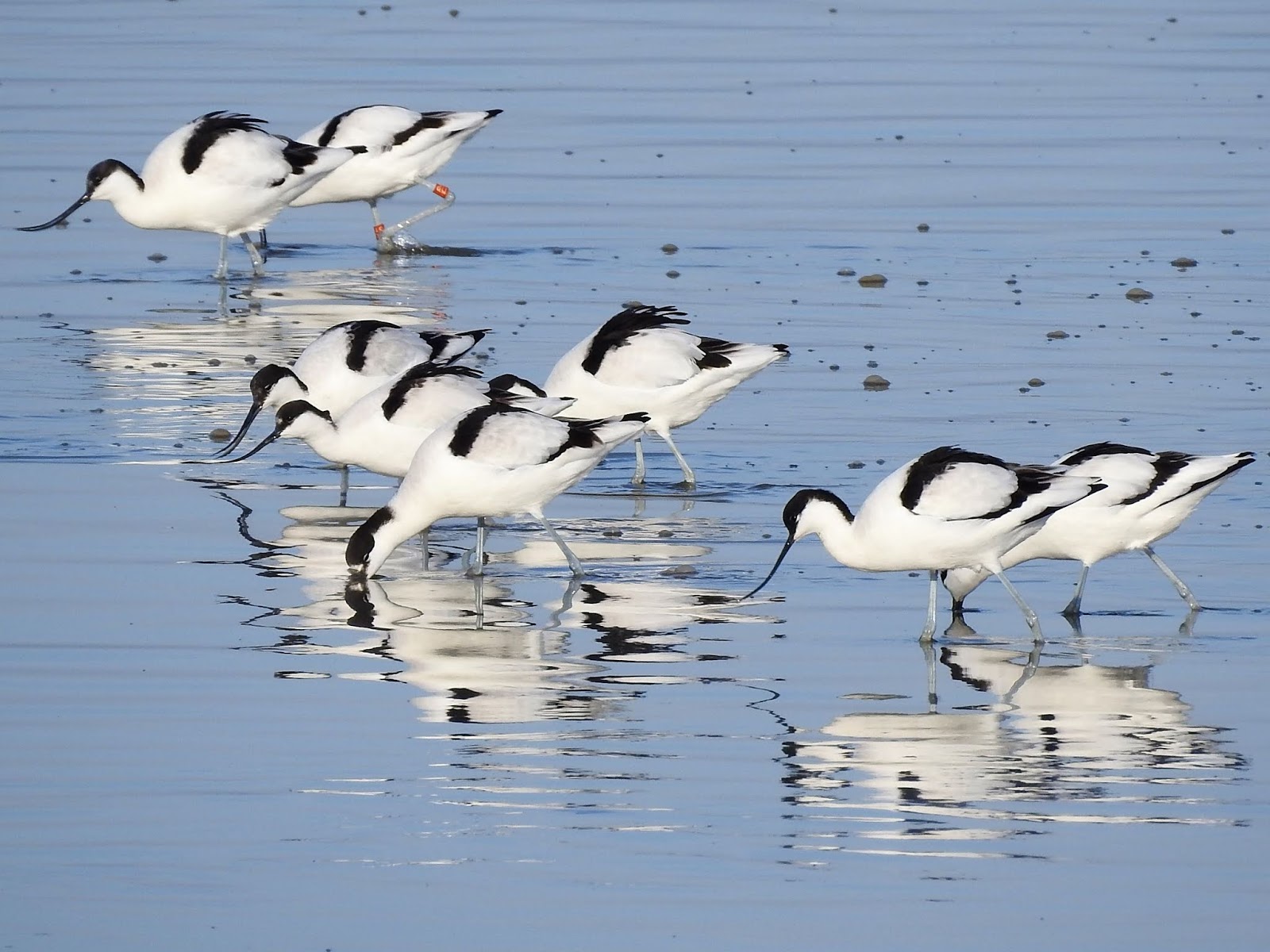
Avocet


Chiefly short-distance flights at present, switching between local breeding estuaries (east Anglia southwards) and local moulting grounds (such as the Thames at Cliffe). They then Settle on a choice of estuary for winter, usually within southern UK- but not necessarily the one they bred on.

Moult (adult)- postbreeding, complete. Flight feathers start in July, to October (November). Winter numbers on the Medway do not peak until after this time.

Average nos 1990-99 July 66 August 182
Average nos 2000-09 July 135 August 147
In recent years, due to increasing breeding numbers, July numbers have continued to grow, but most will have left for safer moulting areas by month end- August has similarly low numbers nowadays.


Ringed Plover


A collapse in numbers in recent decades, now almost extinct as a breeding species on the estuary. Any remaining local birds will be joined by birds from northern Europe for the winter, with 'tundrae' (birds from the high north of Scandinavia e. into Siberia) passing through in variable numbers during autumn. A definite early autumn peak in passage numbers, but birds 'short stop' and may only be present for a short period. Counts are often missed.

Moult (adult)- postbreeding, complete. Highly variable sequences, usually starting on breeding grounds, from mid-June to as late as October, most suspending the primary feather moult during peak passage period (August- September). Right now they will have grown a small number of new flight feathers to help their journey south, our breeders perhaps going as far as France/Spain while the Scandinavians 'leap-frog' us to go as far as Africa

Average nos 1990-99 July 124 August 904
Average nos 2000-09 July 12 August 155
In recent years numbers have remained low, just double figures most days, although the odd three-figure count does still get made- just as for breeding, Ringed Plovers find our increased activity and urbanisation have made the Medway less attractive. Any high shoreline fronts (their favoured areas) are too disturbed (or more often flooded by increasingly high spring tides) for hold them for long.


Golden Plover


A small number arrive around now and will remain to overwinter. Origins unknown, possibly British/ near continent.

Varying numbers then arrive in late autumn/early winter. ('last minute bookings' to escape harshest of the winter weather on the continent). Further urbanisation of the green areas surrounding the Medway will reduce the Medway's carrying capacity- birds that spend the day roosting on marshes such as Chetney do need inland fields in which to feed at night.

Moult (adult)- postbreeding, complete. Starts late May- July, often suspends July-August, restarting mid-September- early November. July August is the move from breeding grounds, the flight feathers are pristine at the start of winter ready for 'escape movements' from bad weather.

Average nos 1990-99 July 7 August 40
Average nos 2000-09 July 11 August 97
Numbers on the Funton mudflats have, in recent years, been slightly higher (up to around the 200 mark) and, interestingly, these birds then tend to continue to roost on the flats rather than join the later arrivals in the fields.


Grey Plover


First landings are usually  scheduled for late July, the start of adult passage, with youngsters then not turning up until September.

Moult (adult)- postbreeding, complete. Starts on wintering ground or on specific staging ground. Starts flight feathers between August- early October, but birds starting from September onwards will suspend from mid-October and only restart in spring. ('Suspend' another technical term; stops, then restarts later from point where halted earlier- so, different from 'arrest'.) Birds present on the Medway in early August will either be adults about to either pass through quickly, or here to establish a feeding territory and remain to moult. Why easy to miss the highest counts if only counting a few times each month.

Average nos 1990-99 July 180 August 1,556
Average nos 2000-09 July 7 August 131
Recent numbers still reflect 1990 figures. Most of the larger flocks do tend to favour the less-disturbed flats mid-estuary, perhaps hinting at their being 'short-stayers'.


Lapwing

Small numbers will have been arriving since June, mainly from the near continent. Some return year after year to winter, mainly late Sept-Nov, but the biggest numbers only will only be seen if they need to escape poor bad winter weather. Biggest numbers will always be on the fields rather than the mudflats.

Moult (adult)- postbreeding, complete. May/June- August/September. The species has a very fast moult of outer primaries to aid early autumn movements.

Average nos 1990-99 July 313 August 513
Average nos 2000-09 July 138 August 347
Another species where older records better reflect the present position- incomplete coverage has underplayed the estuary's true numbers. The drier the summer, the more easily detectable out on the mudflats (instead hidden up in the harder-to-view/count fields spread around the marshes).


Knot


Small numbers on autumn passage. Biggest numbers are December-February, made up of wintering wanderers who, having spent first part of winter elsewhere on the east coast, take a short flight to enjoy the Medway cuisine. Fussy eaters, Knot rely on molluscs more than many of the other calidrid species (why they are fixated with only certain muflats here).

Moult (adult)- postbreeding, complete. Might start on breeding grounds, but usually not until in wintering area. Subspecies canutus starts when reaches Mauritania in August-September, subspecies islandica start as soon as arrive in western Europe (July/August) but these stay mainly on recognised moult grounds (e.g. Morecambe Bay, the Wash); 'our' August birds are usually of the race canutus, from western Siberia, heading for Africa.

Average nos 1990-99 July 0 August 171
Average nos 2000-09 July 0 August 50
Recent years very similar, and erratic in number from year to year. A clear example of flight diversions by way of a departure from the scheduled route- here, birds usually relocate after a day or so, probably having overshot the Wash or the Waddenzee (Netherlands).


Dunlin


schinzii- Greenland/Iceland to Norway- small numbers on transit through the early autumn.
alpina- northern Europe to north-west Siberia- these are our overwinterers, not booking in until October/November.

Moult- postbreeding, complete. Just as each race has its own wintering preferences, each has a differing moult strategy. Schinzii moults after migration, alpina may start and then suspend before migrating, often to complete on other specific staging grounds along the flyway before finishing in October (just in time for many to make the final flight to their north Kent wintering grounds). Why many of the small number of adults seen now are likely schinzii, making short stopovers before racing off south.

Average nos 1990-99 July 350 August 1,774
Average nos 2000-09 July 8 August 443
One of the few species where a decline appears to have continued; hard work nowadays for three-figure count at this time of year. Clearly refueling elsewhere. If their main flyway is west to Norway then down through Europe, most will stick to the continental side of the Channel- when they do drift over, they stay more to the south coast than north Kent.


Black-tailed Godwit


Often higher numbers in autumn than in winter. First returnees from Iceland arrive late June, continuing to build through August, to make a moult stopover, with many then moving on to spend the later winter months on the south coast, over in France, or as far south as Portugal.

Moult (adult, islandica)- postbreeding, complete. The flight feather moult takes place after main flight from Iceland, from August to December, when birds may then move on. Birds seen now on the Medway will intend to stay here on the north Kent marshes to see out this important stage of their moult cycle.

Average nos 1990-99 July 232 August 979
Average nos 2000-09 July 298 August 570
Nowadays, four figure counts in August are the norm. (Reflecting the growth in breeding numbers in Iceland).


Whimbrel

Small numbers pass through in early autumn. A species which we see more in the spring than the autumn. The bulk of their population moving through the UK (breeding in Iceland) adjusts their flightline to Africa, sticking to the west via Ireland. The birds we see in the autumn are more likely from Scaninavian/Siberian populations.

Moult (adult)- postbreeding, complete. Usually not started until on wintering grounds in Africa, September/October onwards (a neat aide to separating from moulting Curlew in distant flight at this time of year). Stopovers here are for refueling purposes only.

Average nos not readily available from the old printed annual reports. Partly because they weren't here in any number then. Whimbrel can be fickle and switch refueling sites every few years. Recently a three figure roost has become regular around Nor/Friars/Oakham at this time of year, but only for a matter of a few weeks before continuing on to the wintering grounds to moult.


Curlew


Annual peak numbers are in the autumn, usually September. Safe moulting out around the Medway islands. The drop off in monthly counts later in the winter is probably down to feeding strategies as Curlew, more specifically the shorter-billed males, prefer to feed in fields as winter progresses. Further urbanisation will affect the Medway's carrying capacity.

Moult (adult)- postbreeding, complete. Primary flight feathers start in July/ August, shortly after arriving on wintering grounds. Take 12 weeks to complete.

Average nos 1990-99 July 786 August 1,599
Average nos 2000-09 July 134 August 178
Recent numbers reflect the more methodical counts of the 1990s. In fact, a series of counts will often produce peaks- like Oystercatcher, under certain tidal conditions/ disturbance levels, many of the Thames birds will join the Medway (and Swale) moulters. Another reason why counts should be coordinated not only within the Medway estuary, but on the Thames and Swale as well.


Redshank


Late autumn peak, although moulting numbers are already quite high. Rough and ready rule of thumb, most Icelandics overwinter, quite a few continentals carry on south. And some local movement to the near continent.

Moult (adult)- postbreeding, complete. Flight feathers start in late June to September. Usually remain on moulting grounds throughout, but can still continue on migration before finishedif needs must (a strategy more prevalent in continental birds).

Average nos 1990-99 July 2,294 August 3,523
Average nos 2000-09 July 208 August 404
Numbers moulting within my study area (the southern shoreline) probably reflect an autumn population perhaps only a little under those 1990 figures. Get the count time right (on the rise for birds retiring into the spartina) and single creek roosts here can exceed 700, 800 birds.


Greenshank


Small numbers build to a first peak at the end of July, when the bulk of the breeding adults arrive. A second peak follows two- three weeks later, as the juveniles join them. Very small numbers then remain to overwinter.

Moult (adult)- postbreeding, complete. Moult of flight feathers might start on breeding grounds, then suspend until reach moulting  grounds such as the Medway. Moult takes place July to September (though some may then suspend unifinished moult until they reach their wintering grounds).
Birds here in early autumn are here for safe moulting.

Average nos 1990-99 July 21 August 60
Average nos 2000-09 July 17 August 54
Greenshank behave a lot like their red-shanked cousins, and are often hidden up over the usual WeBS counting period (high tide itself); by counting birds into roost, three figure counts are in truth easily achievable during August.


Turnstone


Fennoscandian population: on transit for south
Greenland/Canada: arriving slightly later, for winter.

Moult (adult)- postbreeding, complete. Birds make a choice of two strategies. #One, starting late-June- August by birds intending to overwinter in northern hemisphere. #Two, for birds overwintering south of the equator, flight feather replacement commences mid-September.

Many of the Turnstone on the Medway in the early autumn peak show no sign of a wing moult, hinting at a short stopover and a long journey ahead.

Average nos 1990-99 July 97 August 726
Average nos 2000-09 July 22 August 43
Again, counts are more usually closer to the 1990s. A species that shows a clear weekend disturbance pattern (more often heading to central estuary roosts rather than the old hulks closer to the shoreline footpaths).

----------

Hopefully this short introduction to the Medway's early autumn bird migrants has helped illustrate the large numbers of waders that will use the estuary during an autumn. It is a complex situation, with every month different; making sense of the way the birds continue to use this estuary is challenging but highly rewarding. Because the estuary needs to be understood if we are to protect it- which brings me neatly back to our hosts tonight, the Living River Foundation- we really do need to know what effect plastic is having on our breeders, our migrants, our overwinterers, on their fuel living in the estuary? I'm sure we all wish them well in their monitoring work- and thank you for coming out and supporting them tonight.


Monday, 13 November 2017

Birding the north shore; Grain Oystercatchers, 13/11/17

I needed a holiday. Where better than the north shore, and Grain Foreshore Country Park?


Today's mission; count the Oystercatchers out of the Medway. All too often I concentrate on birds coming in, but a comfy cushion at the blockhouse really appealed, and the tide turned not long after after sun up; perfect.


The early morning departures were possibly birds from the first roost just south of Grain Light, where the concrete promenade ends; first dog walkers often disturb part or all of any roost here. Walkers can continue south along the Inings wall to Cockleshell hard, and my watches from Queenborough opposite have shown there are three or four morning regulars there as well; pre- 09:30  flights could easily be accounted for by such flushes.


The Dolly Bank started uncovering just after ten, but the flats to the north-west of the village start uncovering twenty minutes or so before that. Certainly the Oycs seemed to know this, with the birds moving out from around that time.

Only a few of the flights could be said to be large, around the three-figure mark, but the total by the time the flats were more than half uncovered had broken the four-figure mark. More had stopped short on the Medway flats, so a longer stay could have increased the total to levels more usually seen on a rising tide.

Relatively few other species were involved in the flight; Redshank and Dunlin were noticeable, Grey Plover and Curlew had to be worked for; throw in a handful of Turnstones and Sanderlings and it had been a good morning. 

Friday, 22 September 2017

Horrid autumn- 22/9/17

A quiet passage day:
Point: Chiffchaff 2, Blackcap, Goldcrest, Linnet 5, Reed Bunting.
Viz mig (west): Gadwall 2 (south), Marsh Harrier (south-east), Black-tailed Godwit 10 (south), Sandwich Tern 13, Common Tern, Swallow 17, Meadow Pipit 20, Rock Pipit 1, Grey Wagtail (east).

After that, Horrid Hill 08:40-16:00.
What? Yup, I hung on a bit today. I often have two or three short birding session a day this time of year, all around the estuary. Today I'd decided on a count known as a 'through-the-tide count' (TTTC). Seven sets of counts, one every hour, to give an idea of how an area is utilised. What today's count showed is precisely why estuary WeBS counts should be coordinated; once the tide was in, the birds spent varying amounts of time in up to six different subsites. This is the track of the Grey Plovers:


The map was taken from the BTO webpages. In reality, not been counted by seven different people for some years, Nor, Friars and Bishop counted by boat when first I returned. The interchange between Rainham Saltings, Rainham Creek and Motney saltings clear, and I've found over the years there is also routine exchange between Copperhouse Marsh and the whole of the bay to the east of Horrid Hill.

Motney is blue, as it is an area with a counter vacancy. Doesn't mean they don't still need counters for the other sectors; some of the best organised estuary counts around the U.K. have subs (-titutes, nor marines) to count on the actual date if the regular counter can't make it. The regular might do a week later to keep their own run complete, and both can be submitted- supplemental counts are welcomed by the BTO. Some of the very best organised estuaries even try for annual LTCs (Low Tide Counts).

The important thing is for individual counters to really appreciate the importance of co-ordination. There is every possibility of a major mis-representation, and here on the Medway, such movements as shown will mean under-estimates; birds may spend a lot of the time out of your area while you're counting, and they certainly not spending equal amounts of time in each- the probability is you will miss some of them. So, going at different times of the high tide period really isn't the best for waders either. Just covered? Numbers higher along the shore, but these birds may well be mid-Channel come high tide itself.

Hopefully I'm not teaching many WeBS counters their job here. The reason I mention now is that I've been told by a couple of counters this winters' counts will be more coordinated. Absolutely brilliant news. I don't know if that includes the islands, clear that it really should; but if the boat can still only go weekdays, then one can dream of enough volunteers to get a mid-week count as well as the core date around the shore; results would be intriguing- the different rates of area usage weekdays to weekends would be clear for all to see.

Back at the results, you don't have to go all pictorial, you can just as easily chart. Here's a screengrab of three species counts that day- Oystercatcher, Curlew and Black-tailed Godwit:


Oystercatcher- on the top of the tide, some birds are getting pushed off and wandering (by now, main roost is over on the northern shore, Kingsnorth Power Station apron wall).

Curlew- all off to Oakham saltings for the high tide, after finishing feeding at Rainham Saltings. They can often choose Motney, but often avoid for a few days after disturbance.

Black-tailed Godwit- classic early season feeding effort on a low tide through from dawn- enough light to feed up out towards centre, have a pre-roost rest before tide even fully covers (today they chose Oakham island); different from later in season when have to work flats hard and follow right up Rainham Saltings/ Rainham Creek.

A TTTC is of the sort of survey your average consultant undertakes. They will be full of data, but if they get interpretation wrong, it then throws the lot. Why worth having a go at few yourselves. Here I've seen some very odd conclusions drawn for the north shore- statements that certain species do not use at certain times of the tide; utter pants, but unless the locals go about assimilating good information, hard to present. Even if you have a grasp of things, these sort of counts help refine your understanding, and you can argue your case so much easier.

Nothing wrong with playing at this either, on your own beach/shore/mudflat- say a mini-version, 3 or 4 hrs over the covered rising waters, 3 or 4 hours over the covering mud. You don't have to be as mad/sad/lonely as me. What I've been concentrating on these past few years is just the one central hour, mud-flat covering time, collecting data for all whole south shore areas up to three times a month. I'm beginning to suss what happens, but I know from carrying out a few TTTCs as well there's a lot to learn about those other hours. You could also very easily clarify/discover a few things about your own area. Grab your chairs, flasks and lunchboxes.. Shouldn't really leave it just to WeBS/LTCs and those bloomin' consultants.

Monday, 28 August 2017

Horrid autumn- 28/8/17

A Horrid factoid- The two RSPB reserves on the estuary, Nor Marsh and Motney Hill, have no access for visitors. Horrid is the best viewpoint, where an interpretation board has been installed on behalf of both the RSPB and Medway Council, freeholders of Nor and Motney.

If you are prepared to bring your own folding chair, the board can act as a fairly poor windbreak.


-----------
28/08/17
06:00-08:00

Robin- common beach feeders on Horrid

Point- Single Reed Warbler.

Viz mig- Seven Yellow Wagtail south, five Common Tern south-west. Two Grey Wagtail east-northeast (the usual direction for early autumn dispersal as birds move downriver)

Offshore- Two Kingfisher on the rocks either side of the Point; once they met up, a chase to Copperhouse ensued.

So, quiet then- back to yesterday's game of count the dispersing wader roost. The texts will say waders tend to leave in a set order, this does does generally work as a rule. Each day brings differences; on a slightly lower tide, more Redshank had been able to hang on at the Rainham saltings roost and there was less urgency to return, and the Curlew had roosted on Oakham, so were in no mood to rush back.

In general though, tide-edge followers are first away. With few Dunlin in, it could be blink-and-you-miss-them. Black-tailed Godwit are happy to start feeding close to shore (and can remain until disturbed). Some Grey Plover and Redshank established territories on the flats. A good many others are still working as loose flocks; these mix-in, often wanting to get to their spots as soon as uncovered, so the movement is pretty much over once the main departure takes place. Turnstone aren't really living up to their names at the moment, carrying out an awful lot of 'peck-feeding' on the mud (most are refueling to continue their migrations south, our overwinterers have yet to arrive). The larger the wader, the slower out the blocks. Oystercatcher and Curlew are among the last to leave roost. Presumably their specialist feeding techniques mean they are not having to compete with other species that much, can feed up and retire. Or, they like to supplement the mudflat feeding with a bit of fieldwork when the ground is damp, so they can carry on over throughout a tidal cycle if needs be.

Not setting the world alight with such observations, just enjoying seeing the texts come to life, and getting to understand more about how all the habitats in and around the estuary play a part. The land migrants might be missing, but there's always something to enjoy.


-----

Rewarded myself with a second trip at high tide (having made a covering tide count nearby). Impressed to find a minimum of 880 Starling using Horrid as a high-tide roost. The idea that large roosts act as 'information centres' felt spot on; the constant short bursts from individual birds felt like a 'look at me, I'm well-fed'. Anthropomorphic twaddle, but fun nonetheless.

And something even the public noticed. A couple stopped me (thinking that I looked liked someone who'd know about birds, think the 'scope gave it away) to ask all about them, and then said they'd heard about murmurations thanks to 'Autumnwatch' and would love to see one. Gave them details, but made me think *memo to County Society/ local RSPB Groups*- why not hold a well- promoted/publicised trip to view a murmuration, for the general public? (You're welcome.)

Shame to see the Nor and Friars roosts cleared by a low-flying microlight. Certainly when Kingsnorth Power Station was operational the rule of the estuary was no flying below 150 feet; the reverend, working out on Oakham, was often reporting low-flyers. Today's disturbed birds made west for the Greenborough complex, or north (as in the case of the Curlew pictured) to Oakham. Birds need an awful lot of safe sites. Especially when somewhere like Nor (an RSPB reserve) isn't as safe throughout the tide as some believe.


Sunday, 27 August 2017

Horrid autumn- 27/8/17

A Horrid factoid- The wreck near the start of the causeway, found ad nauseum in any google image search of Horrid Hill, is the tug boat "Waterloo".  She was built in 1891 by Thomas Scott of Goole, Yorkshire, and was originally called "No. 6". She had probably often sailed past that most famous of U.K. bird peninsulas, Spurn, but somehow came to be a Feral Pigeon perch next to the estuary's not-quite so good peninsula.

Yes, the Power Station is in the background- this was 10/5/13

The Waterloo was known as a 'Tom Pudding' tug. 'Tom' meant large (think 'Tom Tit' for Great Tit) and 'Pudding' from the tug's removeable compartments which looked like black pudding. Each compartment could hold 40 tons of coal which would be hauled up by crane directly onto waiting ships. They were most commonly used on the Aire and Calder canals in Yorkshire, from around 1865 right up until the mid-1980s, moving coal from open cast collieries of South Yorkshire down to Goole. In truth, the Waterloo may not have seen Spurn that often, but still more than me (never been).

-----------
27/08/17
05:45-07:55

Point- Three Willow Warbler, singles of Blackcap, Garden Warbler and Linnet.

Viz mig- zilch

Offshore- Peregrine lazing on Nor.


So, time to spare.

Spent it making some sense of the wader movements from roost. A spring high at about 04:30 had pushed many of the Rainham Saltings roosters (predominately Redshank) out north onto Nor and Friars. Birds that roost here, just north of Horrid Hill, do not usually follow the tide out alongside the roost, but return to their favoured feeding areas. Whilst there is usually one big movement, quite a few birds tend to leave in dribs and drabs. Such small numbers often fail to register but can amount to a sizeable proportion of a roost.


Early-returning waders can be back to their feeding zone some time before they can set to feeding. From the go, Redshank were heading back to the just-uncovered Rainham Saltings roost site, where they waited for the mud to uncover. Birds moving slightly later tend to head for two main 'waiting zones' around Rainham Saltings, one along the northern edge close to Mariners Creek, the other the sheltered south-east corner of the saltings just above the Bloors drain.


Not all the species favour the Nor walls; Black-tailed Godwit for the main part, will use central Friars. Others may go that little bit further for safety. Curlew will use Friars, but change for Bishop to the north (or even Oakham over the main channel). Similarly, Oystercatcher are happy on neap tides on Friars (parts of the beach are slow to go under) but on springs prefer to put their toes on the hard concrete of the northern seawall at Kingsnorth. Only a small number of Oystercatcher make an early return to Rainham saltings, their preferred feeding being the shell beds east of Bishop and Friars.  

Blue- Oystercatcher   Pink- Turnstone   White- Grey Plover
Red- Redshank   Green- Curlew   Yellow- Black-tailed Godwit
This all goes to explain why Horrid is often quoted in 'Where to watch' guides as one of the better places for viewing waders. Timing is of course everything. Return movement may well start from around the 5.3 metre mark on the ebb, with largest movements usually over by around the 4.4 metre mark- but things can and do vary.

The tide would be good for the following morning as well, a good chance to make some comparisons. That is, if the migrants weren't keeping me busy..

Thursday, 6 April 2017

Growing pains

Just days after my note on Oystercatcher roosts, and the final paragraphs mentioning the rebuilt cairn out on the RSPB reserve at Motney Hill, it seems that tresspassers are continuing to add to the pile, now visible at a distance easily from the likes of Bloors and Horrid Hill.


From land I visit (with permission) out on Motney, the 'path' over the reserve saltings has become more apparent of late (the middle distance rich green to very left in picture)- on this particular morning a digger had used it to access Rainham creek beyond. In the latest Google Earth imagery the path can be made out as a pale line skirting the southern edge of the saltings.


Today I was told by a local that the cairn has been rebuilt as a marker for illicit landings. Bit of a tall tale? Probably. But if that cairn continues to grow in size, it will just as surely grow in attraction for the off-piste general public.

One to watch.

Friday, 31 March 2017

Subdivisions


The last post talked about Black-tailed Godwit sub-roosts. Time to strike while the iron is hot and add another element to the subject: satellite roosts.


Sub-roosts and satellite roosts- what's the difference?

A week or so ago the local Oystercatchers had been using their sub-roosts for longer, on the neap tides. They had not found themselves pushed off by higher waters and had managed to loaf quite well at some places that, this week, are just short-term pre-roost gatherings on high spring tides.

Bishop Ness (red circled) is one such spot.


The Google Earth image shows all of the Bishop complex at low tide, above South Yantlet Creek to the north of Nor/Friars. Bishop was once one body. Now the westernmost section is Darnet- Fort Darnet standing on Darnet Ness ('Ness' being a promontory). The large central section is Bishop Saltings (a major gullery) and finally, to the east, the rump of Bishop Ness.


As can be seen, not very much remains above water on a higher tide. And on the highest springs, Bishop Ness goes under so Oystercatchers from there, with a much larger number from Bishop Saltings, usually then choose to move north to the Kingsnorth seawall. Often when gathered on the wall, these Saltings birds and Ness birds still remain separate from each other. Check through them closely enough and you'll find you have mainly younger birds in the smaller group from Bishop Ness. This is a satellite roost.

The younger Oystercatchers are kept from the best roost sites. Experienced adults have earned the best spots. Bishop Ness is nowhere near as good a site as Bishop Saltings, so most of the young gather there.

Motney saltings had been used by the young Oystercatchers in spring and summer in the past, Again, not a prime site, going under on the highest tides (when birds switched to Friars saltings). Motney was used routinely in 2013, my first year back in North Kent. Sadly, the amount of human disturbance there increased in 2014 and, along with the Black-tailed Godwits, they gave up on using Motney that spring. The young Oystercatchers didn't bother to return in 2015, now preferring Friars and Bishop Ness. They did use Motney a few times in 2016, but they have given up on it as a preferred choice. One of the Medway satellite roost sites has been lost for now.

Put simply, an estuary can't rely on just one, or two, safe roost areas. It needs a choice of sites. A choice of main roosts, a choice of sub-roosts and for some species a choice of satellite roosts. Take away enough of any mix of these safe roosts and the birds will start to desert and decline, however good the feeding. Yes, it is possible in the worst case scenario they might try to aerial roost- stay in a holding flight pattern over their inundated safe spot for a half-hour, an hour during the highest point of the tide, but this is a real calorie burner and the birds aim for peak condition. Or waders could choose to go several miles to roost further down the estuary, or to another estuary. Would this affect condition? Oystercatchers may switch between the Thames and Medway for feeding/roosting for certain tides, but as yet they prefer not to do this for every tide.


Where to see the Oystercatcher roosts:

The following notes are made to help understand what might be going on- none are that close to shore, and Oystercatchers may rest up in numbers on any favoured flat, so it cannot be an exhaustive list of sub-roosts; hopefully knowing about them might allow birders to understand and enjoy the spectacle a little more. Breaking the southern shore into two;

a) The western basin, to the west of Ham Green-


1) RSPB Motney Hill saltings- now infrequently used as a satellite roost/ sub-roost.
2) Friars saltings- sometimes used as a satellite roost/ sub-roost.
3) Bishop saltings- often used as main roost, neap tides.
4) Bishop Ness- often used as a satellite roost on neap tides only, sometimes as a sub-roost.
5) Kingsnorth sea-wall- main roost on spring tides for southern shore birds. Also used in poor weather. The lack of disturbance here has come about because of the old Power Station behind the wall. The eventual site redevelopment may well change disturbance levels here.

b) The eastern basin, to the east of Ham Green-


6) Chetney Hill- a main roost; on springs birds may move a short distance up onto quiet sections of the adjacent private sea wall
7) Barksore- a back-up main roost, often first choice when Chetney Hill is disturbed (by poor weather or human disturbance). This might be on the seward side of the wall, or on the fields behind.
8) Greenborough- a satellite roost/ sub-roost.
9) Burntwick (note exact position cannot be viewed from the southern shore)- a main roost for Thames birds, more often chosen on night roosts than Deadman's.
10) Deadman's- a main roost, swollen by Thames birds especially on spring tides. Technically, the birds may often sub-roost on the flats immediately below the roost and walk up to the roost itself.O
11) Swale Ness- a satellite/ sub-roost.


-----


A
geing Oiks


Young Oystercatchers at this time of year are fairly easy to age; most guide books include illustrations of 'first summers'.The wing and tail feathers were not moulted after fledging and appear much worn and not as black as in older birds. Unlike adults, they retain the white collar through the summer and have a dark-tipped bill, paler eyes and much paler legs. They do not attain an adult plumage until their third summer. Second summer sees varying degrees of adult features coming through- brighter legs, traces of dark tips to the bills, all with enough variation to befuddle birds. When when we think they can't be told apart in their third summer, the birds themselves can do it- when it comes to choosing partners, the average age for first breeding is four.

For their first summer youngsters are often the furthest from home they will ever be. They then return a little closer each year after that which means (based on ringing evidence) collared youngsters we see here on the Medway during the coming weeks will (with luck) end up returning to nest back home in Norway. Older immatures here right now might be birds of Kent or Kentish birds (depending on which shore of the river they were born) waiting their chance. And some 'probable breeding pairs' you might find later in the spring dossing along the tideline will actually just be canoodling immatures- because, if really a nesting pair, one should really be sitting tight on their nest.

-------

The Motney forecast for spring '17? Not good- another cairn (after one there in 2015) has been built recently smack in the middle of the roost (see first photo) by some intrepid walkers/campers and will now, no doubt, lure a few more wanderers out onto the reserve saltings in the coming month. Still, those young Oiks have got other sites (for now).