Thursday, 26 May 2016

A ring from middle estuary- #GC34920

Although I restrict myself to the southern shore I trained as a ringer under my good friend Bill Jones out on Oakham Island, which is frustratingly mid-estuary, just north of the main channel. I hope no-one objects to my publishing an occasional map from some of his ringing recoveries over the years here on this blog for interest.

A May recovery date for this record, and just a very short-distance:

Little Egret Ring no. GC34920
Ringed as an adult, 31st December, 2009, Oakham.
Found dead: 18th May 2012, Hoo Marina (finder's comment- "drowned, in the Medway".
Found 869 days after ringing, 3 kilometres west of ringing site.

Although many local Little Egrets do go a little south in winter, a small number hang on. When operational, the old Kingsnorth Power Station outflow had kept the waters near Oakham some three degrees warmer than the surrounding area- why Damhead Creek was such a pull for feeding Egrets and the odd Spoonbill, and why this bird was out and about on Oakham on a New Year's Eve.

Bill devised a method of supplementing their diet. The station's intake screens often trapped a number of fish, and these were usually just disposed of (have you ever seen Little Egrets in a skip? I have!). But a daily bucket, transported out to Oakham, proved a draw for the Damhead birds in the cold days of winter. So much of a draw, they not only got to recognise Bill and his bucket, they could pick out his E.On van as he drove out onto the island, and fly along after him.

Of course, Bill had an ulterior motive, there's no such thing as a free lunch and all that. In return for those fish, it would be good to get some rings on the birds. By placing the freebie feast in the mouth of his large static funnel trap, there was a chance to trap and ring an unwary bird by walking into the trap. This normally meant a second ringer had to being hidden up in a small blind near the mouth of the trap some time before the birds arrived- they knew what Bill was up to, and would not settle until he left.

So this bird found at Hoo had been one that stayed on the estuary for the winter, using Bill's 'bird table'.


The funnel trap was quite a size, positioned over and along the hedge Bill had grown beside the access road. It had a large holding cage, big enough for even the odd Harrier or Owl, which was partitioned by a large mesh wall to filter the passerinessafely through into a smaller holding area. Google earth shows the frame is still in place (fractionally below centre); sadly, when the site closed for the demolition of the Power Station, the trap had to be secured to a state of permanently open.

At the mouth of the trap, autumn 2012. Complete with drinking trough drip-feeding a
small pond (just out of shot to right). The strimmed area became waterlogged in
winter and was where the offering of small fish was placed.

Inside, looking back through the baffles

The 'walk in' catching box.


For the ringers, a question- 'what's the difference between a funnel trap and a Heligoland trap?'. Answer- a funnel trap is always straight, a Heligoland always has at least one 'bend'. This acts as an additional baffle to help deter birds from doubling back round and straight out of the trap.


Saturday, 21 May 2016

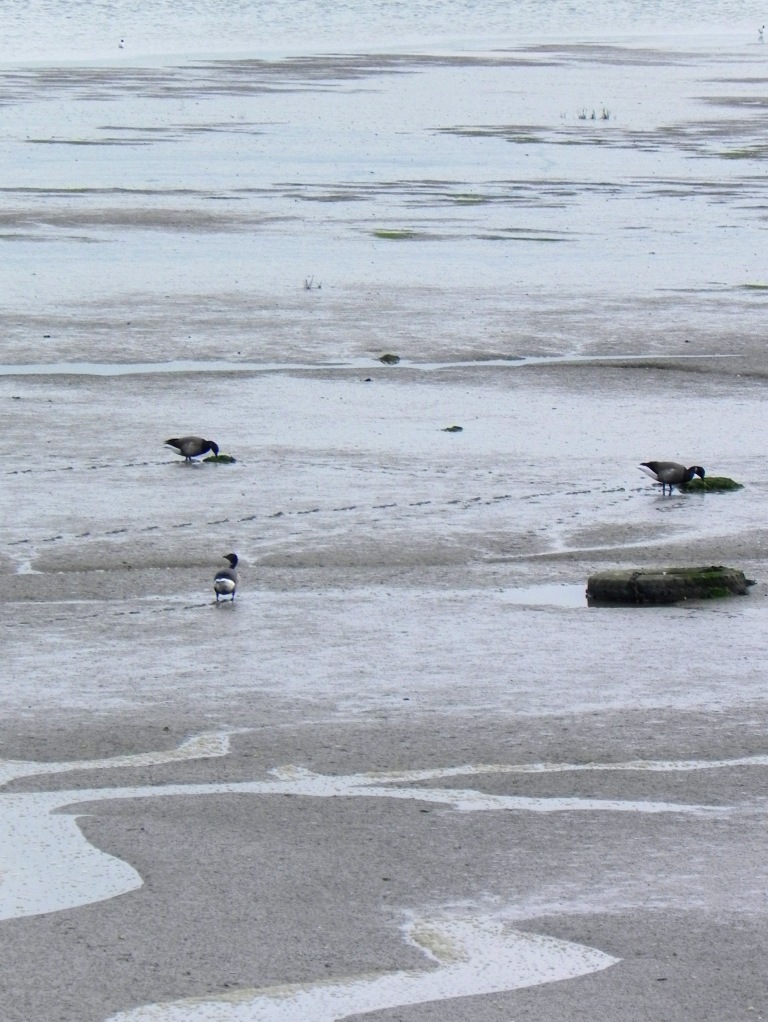
A picture post for young Geoff; Brent Geese in May

My twittersphere chum Geoff was taken aback by my tweet today on Brent still being in reasonable numbers  along the south shore of the Medway (944 the exact level of reasonableness).
Brent Geese can hold on into June if the weather is cold enough, and a small number oversummer. Since moving back I have recorded Brent in 41 months out of 41... but I'm sure Geoff's now gone and put the mockers on that for me.

Here's a selection of May pics from 2013- 2016 just for you sir:


The Brent Often feed on the regrowing enteromorpha (sea lettuce)

and will feed on floating enteromorpha in the shallower waters

Specks along the Millfordhope Creek-
only way to count birds spread among the islands
is from the vantage points

Groups readying to departing often loiter mid-estuary,
making aborted flights towards the mouth.
They favour leaving just after dawn.


The birds have chosen to short-stage here rather than the Waddenzee.

Many of our British winterers stage on the Waddenzee
at the same time- they do not like to arrive on their
nesting grounds until the snows are gone

Birds often follow the tide in close to shore

The birds are spread throughout, usually in loose flocks of between 20 and 50,
slowly coming together in groups of about 200 pre-migration


Saltmarsh regrowth is also taken in abundance in warm Mays


Individuals will cover some distance by foot to get to new supplies


Back in the 90s counts (for the whole estuary) were similar to this
(since then no full May WeBS coverage, and often under-reported
by birders)


Thursday, 19 May 2016

Plunderers

White specks on Bishop, April 2015


About this time last year I shared some allegations with RSPB Investigations about disturbance to the breeding gulls on the Medway, namely the theft of eggs from specific gulleries around the islands Although numbers of sitting birds had indeed dropped in those areas at the time (with three satellite groups deserting), nothing could be substantiated and no further unusual activity was recorded- that season.

Rumours had been rife during all three summers I'd been back on the estuary.

In 2015 the local sources alleged this desertion was due to the work of a small team, with the eggs being taken and sold for food.

Earlier this spring a third local source, unaware of my interest in the matter, freely informed me of the group and that it appeared they were about to become active again.

To date, nothing untoward appears to have happened (when viewed from the shoreline at least), but this week is potentially a ‘good’ time for any such visit, following on from the re-building and re-laying seen since the last spring tides a fortnight or so ago, especially among those outer satellite groups which are easiest to access.

Several of the more active local birders on the ground have been in the loop on this for some time. I had also updated RSPB Species Investigations again, and took an opportunity to speak informally with Natural England. Both now both feel getting the word out within the wider local birding community could be useful. Sadly it seems this type of wildlife crime does still occur routinely in the UK, and may be becoming more frequent. RSPB Species Investigations had already been dealing with a 'live' incident in Dorset, news of which they have made public this week.

The message for anyone about the estuary at this time is, essentially whilst our gulleries can and do take to the air en masse for several ‘normal’ reasons, if a gullery goes up and it appears there are people acting suspiciously within the colony, it is worth considering contacting the police on 101 (the Medway and Swale are of course served by a River Police Unit). Also worth getting a picture, however distant. It goes without saying never challenge such individuals.

Of course, there may be people out on the islands for other reasons; many are in private ownership an do boats, canoes, etc. can and do land on the islands, away from the main colonies from time to time, all quite innocently. Last year’s allegations were of a group of individuals watched working methodically through the gulleries, bending down, picking things up, stashing carefully in bags..

The trade in gulls' eggs hangs on legally- just. I first looked into this a couple of years back and found the background to the remaining high end restaurant trade can be found here in a 2009 article in the Daily Telegraph. Essentially there are just a handful of historical licences left, and there were no plans to issue new ones- the legal trade could well die out. A list of licence holders hasn't been found to date, although I'm informed might be available through a Freedom of Information request to the correct licencing office. At the present time, moot point for here. There are 'schedule one' species breeding with several of the Medway colonies, which are legally protected from disturbance.

In the meantime we can only keep watching.

Anyone interested in the legal background can visit the licencing pages here and here.

More information on all of the various gulleries around the estuary can be found on another of my blogpages under construction here.

Thursday, 5 May 2016

Up and down the Stangate Strip

During the winter months a rising spring tide from the Chetney sea wall provides one of the best wader spectacles on the estuary. Make the walk out from Raspberry Hill to close where the path cuts east over the Peninsula, and watch towards Slaughterhouse Point. As the waters keep rising to cover the neap roost sites, more and more lines of birds head past you towards Barksore saltings. At first, small groups of Grey Plovers, Godwits, Curlews- then a procession, chains of waders large and small coming off of Greenborough, Burntwick and the Chetney saltings. As the tide tops, large flights of Oystercatcher and Curlew may take to the sky just north of you, joined by big numbers of Lapwing, sometimes pulling the Golden Plover up with them. From then until the safer roosts uncover, wheeling flights of aerial roosters keep tripping overhead. All the excitement of the Stangate Creek complex- without actually viewing very much of Stangate Creek.

Historically, for the birdwatcher Stangate has always been difficult to view from land. Certainly there's a distant sight-line from the right lay-by at Funton, while further away, the panorama from up on the Saxon Shore Way, but as most birders are not content with counting specks these days, few bother (40 months back, still not bumped into a birder up on Tiptree Hill). Searching the various local birding guides very few authors have touched on the importance of the creek.


Starting from the mouth, working clockwise, the eastern flats opposite Burntwick, Sharfleet Creek and the north-east corner of Greenborough run into an unnamed (on the charts I have seen at least) large serpentine creek (A) that cuts into Chetney marshes for nearly a kilometre from low mark to seawall. For my purposes I've called it Chetney Creek (but if anyone can put me right...).

From the angles available up on Tiptree Hill the Creek appears to be a pool. It certainly has a good deal of standing water nearby in the form of dykes and reed-fringed fleets. Flights of duck are up and about as the raptors pass over.

On low waters, many resting wildfowl mainly line these flats, while the majority of the 'local' waders will have moved just north and east along the main channel by Blackstakes (B). Come the rise a number, of these waders move into Chetney Creek, more with any northern/eastern element to the wind. Many Shelduck and geese (wild and feral) will be either side of the wall here throughout the tidal cycle.

As you continue south south relatively little mud is exposed until you reach (the impressively named) Chetney Hill, The old Blackstump Creek (C) is still in good shape and is used by many birds over the tide, even though the sea wall has cut the creek off. Some excellent habitat around the Creek has been further improved with a pool/scrape, sadly obscured from the Chetney footpath (yellow) but is viewable, distantly, from the Saxon Shore way on Tiptree Hill.

The low mound of Chetney Hill is made into a round island by the Chetney canal that surrounds it. To the south and east the canal holds few birds at roost (due in part to the proximity of the public footpath and farm buildings), but the west and north are relatively undisturbed over the tide. The western edge is the site of the Oystercatcher roost birders can scan from the lay-by on the Funton road. Loafing Brent often use the roost (with birds still using it now in Mid-May). The late winter Knot flock, which more usually favour Greenborough or Chetney Creek, sometimes crams itself on here; this past winter the Knot actually usurped the Oystercatchers for a while, who retreated en masse to the old dock by the footpath.

(For any local historians, there is also the interesting story of the Chetney Hill Lazaret.)

Stangate Creek now has a dog-leg to the west. This borders the eastern end of Barksore (G), which has a remnant area of saltings now mainly covered by spartina; larger waders like Curlew can retreat here during a spring tide, and many Little Egret and Grey Heron will also gather, but the biggest numbers are now found at the end of Stangate; on our clockwise journey we now swing north onto Greenborough at the three-way junction with Millfordhope and Halstow Creeks (H) a substantial pre-roost gathering of waders and wildfowl builds, which can hold out spread along the old sea wall as far as Slaughterhouse point on a neap. This is an important shelter when certain winds, or disturbance, hit the Funton complex, and is where some/all of the 'Funton' Avocets will usually be found when reported as 'missing' from their main roost.

For the remaining journey back north out of Stangate Creek the western sea walls are covered by gulleries in the summer months. In winter, many waders are spread along the same walls. On the low tide these birds move, in the main, west to the larger flats such as Ham Ooze. As far up as Sharfleet Creek (I) resting duck and especially Geese will be sat on the western mudflats. The Greenborough shoreline is the more routinely fowled, when the birds drop east to Chetney. It is a similar usage picture for Sharfleet Saltings (J) and on up to the mouth at Stangate Spit (K).

That is Stangate circumvented; within that outline, the waters of the creek keep a good depth over the low tide period, and can be a magnet for birds. In winters when a local notable such as, say, a Long-tailed Duck or Common Scoter take up residence, over the high tide they try to keep to a good feeding depth of water, so move into Funton or Halstow with the tide, but then back out into Stangate on the drop. Any number of Goldeneyes and Mergansers present will follow the same routine, as do the smaller Grebes and the odd Diver. Stangate is a safer haven than the wide open waters of the main river channel along Saltpan Reach.

The distant waters of Stangate Creek at mid-tide
(foreground Barksore and the flats of Funton Creek).


(An aside. I still deliberately remain on land for my birding; the various boat excursions for bird/seal watching nearly always end up in Stangate Creek, invariably turning up a good record or two around there. The birders that travel out on them swear by them. Whilst I can't personally vouch for any, a trawl around Queenborough quayside, Riverside Country Park {and even the 'floating tea room' at Lower Halstow} will find details of several different owners offering sailings.)

So, that's birds around Stangate, birds on Stangate, and now birds over Stangate. The mouth of the Stangate is the preferred arrival/departure for many of the breeding Terns that, in the main, prefer to head out to the open waters of the Greater Thames to fish. The southern end of the creek is directly below the flight-paths from Millfordhope/Halstow for waders/wildfowl en route to safe roosts. All the time birds are switching east to west to east over the rest of the creek. When breeding, the gulls routinely follow Stangate out south for feeding, or simply 'hop over' onto the Chetney fields to loaf/feed. The Marshes here are also used, pre-breeding, as gathering sites for returning birds, a time when counts of Mediterranean Gulls can reach three figures just inside the Creek.

Meds 'n' Black-heads, Chetney, April 2015

Human usage is, in the main, as an overnight mooring for small craft during the summer months, mainly along the western edge of the deep water channel. More than a dozen boats can be anchored at a busy weekend, in the main seen as little threat by the roosters/nesters (it is the smaller craft, sailing close to colonies on the high tide, that cause most disturbance (landings are mainly limited to the unsigned Burntwick island, but most going ashore soon realise not to go near the colonies).

Of course, this guide is for the benefit of anyone seeing the seaplane playing on the 'runway' designated by Peel Ports; it is easy to appreciate the disturbance caused when on the strip, but disturbance to birds alongside, beyond the seawall as the plane banks low will be apparent to any observer.

One lives in hope Peel Ports may yet see the problems for this internationally protected and internationally important area.


Coming into land in south-west Stangate, over Chetney Hill, July 2015

Wednesday, 27 April 2016

Motley Crew

The fifth and final part of the seawall walks guide for St. Mary's Island to Motney Hill has just been added here.

Joking with a friend a few weeks ago, he said he thought the place would have been better named Motley Hill- I was quite pleased to pull up an old Ordnance Survey map from the 1930s and send him a copy;


A nautical aside. The obvious 'wreck' off of the northern end of Motley/Motney, marking the tip of Wallop Stone, and tidal rest spot for Cormorants, Turnstones, the occasional Grey Heron, Peregrine or Shag, is not an old boat, as some would have it. It was in fact a caisson, one of the special watertight containers that allowed workers down to set up foundations for bridges, locks, etc.

I recently found it mentioned in 'The Jottings of a Thames Ditch-Crawler', by Nick Ardley, an excellent read of tales afloat, ninety-five per cent of the time on the Greater Thames or the Essex saltings, aboard his Finesse class yacht 'Whimbrel', which can still be 'ticked' down here on the Medway from time to time- I'm a bit of a boat-dude, my notes have sightings of 'Whimbrel' as less than annual, whereas the eponymous wader is passing through in fair numbers right now:


Monday, 25 April 2016

On Willow Warblers

The facebook group, 'Kent Birding', recently found itself discussing Willow Warblers.

This cold spring has so far been most like 2013, in that it has been possible to see their spring migration around the estuary; downed birds along the seawall, some days reaching double figures. In the better conditions of 2014 and 2015 records were pretty much singletons only, when and if you were lucky enough to bump into one. And for me they are local breeders no more.

During the Facebook discussion I guided forum users to the excellent BTO BirdTrends pages and to regional results but for this supplemental note I decided to look elsewhere.

One of the old-style correlations for habitat preference, not used so often nowadays but heavily relied upon at the time of  'Birds of the Western Palearctic' and Simms' excellent New Naturalist 'British Warblers', was temperature. Species populations were often judged to breed between relative minimum and maximum isotherm which for the maximum in Chiffchaff was 26c in July, for Willow Warbler, 22c.

One needs only to play on the excellent Met Office website to pull up a map of the UK showing the mean average maximum July daily temperature during 1981-2010, the period for much of the local decline; the whole of the North Kent Marshes is mapped at "greater than 22c". Local warming appears to be just another of the many nails in the coffin for Willow Warbler here.

(For birders in other parts of Kent, bearing in mind the debate on strength of remaining local strongholds, that map is well worth studying. The south face of the North Downs, under a cooling influence from the prevailing south-westerly winds, still came in below the 22c threshold. Perhaps part of any explanation why some in those parts still feel able to comment Willow Warbler remains relatively simple to find there? Another reason to always think beyond the 'political' county overviews.)

It is also easy to stick with those older texts to answer an imprtant question as to what the differencereally  is between a Willow Warbler and a  Chiffchaff- not in appearance, but in habitat preference. They were, after all, 'sister species' (I say 'were' due to the taxonomic fluctuations in species/races- they certainly remain within a recently evolved sister clade) so not really any shock they are hard to separate in the field for some. But there must have been something that triggered the specialisation, something perhaps rooted in habitat/behaviour.

Simplistically, Chiffchaff is more purer woodland, Willow Warbler more a scrub/wood (with good understorey growth) mix.

Scrub has been a long-neglected habitat, with many of the regrowth transitional zones between, say, woodland stands and grasslands, lost in recent decades. Thinking is slowly coming around to appreciating scrub more, but all too often 'scrub bashing' is a required 'norm', and birch automatically cleared (guess which species of tree provides most food for Willow Warblers during the breeding season?).

Are the larger amounts of shade in ideal Chiffs territories why they can put up with higher temperatures? Questions, questions, questions.

In another interesting twist to the local tale, one of the last Willow Warblers holding territory alongside the estuary, a bird at the Lower Halstow Brickfields in 2013 and 2014, was a 'song switcher'. This is a bird that switches between phrases of it's own song and phrases of another species in the same burst (in this case singing Willow then Chiff).

'Song switchers' should not be confused with 'mixed singers', where individual notes from two species' songs are 'mashed up' and come out as an essentially unrecognisable song, not resembling either species. There is some debate to the causes for both conditions- switching being thought down more to copying, mixed song perhaps down to hybridisation. For anyone wanting to know a little more on the phenomenon, this article is worth a visit. Perhaps, when young, this Brickfields bird simply didn't hear enough Willow, and ended up picking up a Chiffy accent? Whatever the reason, it was perhaps a little fitting that such an interesting individual helped note what might yet be the end, locally, for breeding Willow Warbler.

One of this spring's passage birds, ringed April 12th.
Seen to be still carrying plenty of fat reserves for the
remainder of it's migration. 

So, I could say this year's Willow Warbler spring passage has been relatively good so far. Good in the 'selfish' sense there have been a few more to see, but poor in that most of these sightings will have been birds not really wanting to be stopping off here. I'll certainly still try to find a local territorial bird or two over the next couple of months before the return passage in late July/ early August and youngsters start practicing their songs. However they sound.

Friday, 22 April 2016

The annual question

Each year here in Kent around this time the pulses start to quicken; migration, vagrants, rares. Each year around this time pulses start to quicken that little too much- why isn't Kent anywhere near as good as it should be in the early spring, why isn't it as good as some of the other south coast counties?

Each year I try to explain the reasons why. And at least I'll now be able to refer people to this post to explain some of them.

April is early doors. We have returning passerines setting up shop, but not too many in transit for further north yet. There's only really Scandinavia higher up, and when they do make for there, makes a lot of sense for birds to come in along the western edge of the mainland continent- why risk a water crossing? This google earth screenshot oversimplifies things but allows an easy answer to the question- if you want a short journey with fewer risks of drift and overshooting, there's not many other routes you'd choose.


Yes, of course there are passerines spread out on this flyway, coming in through Kent, just in smaller numbers than elsewhere. We just shouldn't be expecting Kent to as good as elsewhere.

And spring migration is not autumn migration. In autumn, passerine migration can be summed up as adults getting out quick, youngsters bumbling about a bit first to try to find good spots to come back to. In the spring, successful returning adults know where they're going; a high level of site-fidelity. Young that have survived the winter have a fairly good idea too, having learnt a lot about their natal area during the weeks leading up to post-juvenile moult and the onset of migratory restlessness. They know where they want to be. The adults have a slight advantage over the young still, they've made the return before, the young haven't.

Read the migration texts and the point is often made that autumn warblers and the like funnel out through the south-east. Never that they really funnel back that way. Kent is, to a fair degree, in the shadow of south coast sites further west for numbers of UK returnees. Funneling up through Iberia and western France, if you come in over Kent, there's a pretty good chance you could find your nocturnal flight lumps you out over the North Sea. If you come in over Dorset, plenty of land to the north. Certain species are genetically pre-disposed not to come in over the Channel from the southeast, but to make landfall from the south- southwest. Welcome to (a small-scale version of) loop migration.

You also get a lot of chat about migrants being held up at this time. The spring passage window is shorter than autumn- the race is on to breed. Adverse weather patterns don't have as much stopping power, birds do strike out in 'sub-optimal' conditions and why numbers of adults on territories continue to rise slowly at present here, even though the weather this year is more like a mild late winter. Take the past week- an obvious local arrival of female Chiffchaffs. Migration carries on. This last week/ ten days in April never really disappoints, just some good years stick out more in the memory than others. The birds' internal mechanisms drive them, there are more on the move right now.

 If someone asks me to pick a good day to witness migration, I usually don't look more than two-three days ahead, the forecasts aren't good enough. What I'm looking for isn't just overnight rain, but the edge of the rain band laying over the estuary at around dawn. Best wind is a south-westerly, moving birds along from the main flyway. We've had one good morning like that so far, and it did not disappoint. A bit of drift from the birds arriving to the west of North Kent, then a reluctance to try to push on through the rain. I chose to ring on a local farm and had a fall of Willow Warblers, Chiffchaffs, Goldcrests (mainly later moving females, if ringed found to be carrying plenty of fat), the odd Ring Ouzel and Wheatear around the site, Yellow Wagtails calling overhead throughout the morning. On an easterly, I'd always expect a lot less here. In fact, an clear south-westerly overnight will still produce a fair number of common migrants. (Don't just take my word for it- there's a lovely barometric chart in the Helm avifauna 'The Birds of Norfolk' showing just such a scenario as good for migration there as well.)

By the time I've answered their question in this way, the penny starts to drop and the questioner might then start asking when best for scarces and rares. Not my cup of tea, but I have a go.

Timing starts to have a play. We get hung up on early dates because of our predisposition towards recording 'firsts for the year' and tend to lose sight of the bigger waves coming later in the month. And at the same time we have the start of larger numbers of passerines heading for northern Europe. About now, the last ten days of April, is from when Kent might start to get excited about a good 'rare' popping up.

A caveat is to remember these internal mechanisms are pre-programmed to wind down and switch off close to base. Every year someone asks why the Bluethroats aren't crossing the Channel to breed, what with global warming and all. Well, they're pre-disposed to return to those natal areas. Their migratory drive is switching off by the time they get to Northern France. Crossing the Channel is so unappealing now. It will be the same with a lot more of the species breeding sur la Manche. It takes a lot to get them to stay. And even if a pair are on our side of the Channel, an argument gaining some strength is that the visual cues for a prime breeding site simply aren't there in the habitat we have- the floral sward is vastly impoverished compared to that present on mainland Europe.

When the Scandinavian Bluethroats are on the move their migratory systems aren't switching off this far south- chances are if they land they will leave as soon as possible. So May always has more of a chance of bumping into something, but more than likely a short-stayer.

This is still based around migrant passerines by the way- non-passerines, with their tendencies not to return to natal areas until old enough to breed, may well find a new site on their wanderings which is to their liking; shorter-lived passerines can't risk that sort of thing, they may well only get the one chance to reproduce in their short lives (why the classic 'overshoot' species are more often non-passerines).

So, come May I'll still be hoping for south-westerlies here. Plenty of 'Brit' migrants pouring through, plenty of good days full of 'common' movement. For an easterly influence to knock rares and scarces down around the estuary up here in north-west Kent, there would have to be bad weather and a lot of birds would be suffering, I never want for that. I'm much more content to try looking for a scarce or two around their appointed dates on their 'migratory calendars'. If that's what you like, check out when certain species are most likely to be pulsing up along the French coast and hope for one with an internal compass on the blink.

Me, I'll be watching the gulls.

------

(For detailed general info you cannot go much wrong with Ian Newton's New Naturalist, 'Bird Migration', or Peter Berthold's 'Bird Migration; a general survey', though you might need a bank loan to get them...)