Wednesday, 20 July 2016

Sic transit gloria dunli


The Dunlin are back. Only a trickle, but enough to be interesting.

This post is me trying to spin them interesting, trying to see if I understand what goes on with them at this time of year.

Prior to my return in 2013 I swatted up on autumn numbers for the whole Medway in the autumn, and for Dunlin one September peak stood out:


1993. Now what was that all about? More than 12,000 birds, compared to nowadays reported average of less than a hundred since the turn of the century. Curiosity piqued.

I set out to get counts for each sector every ten days to compare to these published counts and to known migratory trends. And things have started to come together, mostly through understanding those migratory timescales.

As a species, after completing breeding there is a relatively prolonged movement to their wintering grounds that for some spans the period of their main annual moult. So birds stop en route ('stage') to either moult or to just refuel. If moulting, individuals may stick around for two-three months. If feeding up, might stay a day or so, a week or or so.

The choice of where to do what is essentially driven by race. We have three races of Dunlin pass through east-southeast England. With all three, failed breeders move first, then usually successful females followed a short-time later by successful males. Juveniles leave the breeding grounds last of all.

Trawling BWP and several more recent publications, I made a sort of 'Dummies Guide' guesstimate of timescale/numbers for the south-east of England:


An explanation:

Arctica is a small population up in n-e Greenland. From biometrics gained through ringing, some are known to refuel in England and so it is possible that a small number might drop into the Medway on passage.

Schinzii is a bigger population; se Greenland, Iceland, s. Norway, UK and again a race only needing to refuel here if it stops here at all. Whilst early autumn records of juveniles are believed to be the source of many English 'inland' reports, difficulty in differentiating schnzii from the third race, alpina, in the field makes any ruling out of the latter difficult down here in the south, bearing in mind the number of alpina rriving from the west- northwest to moult. More northerly migration hot-spots such as Spurn may well estimate the majority of their birds in July will be schnzii, but we're further south and in line for that other population...

For alpina that winter in Britain and Ireland, from the western part of their extensive breeding range, their main moulting area is in the Waddenzee. Juveniles don't arrive on there until about the time the adults complete their moult and are ready to move off. Why we see the annual big increase in numbers in October, as birds that have staged for both reasons on the Waddenzee arrive en masse.

The trick is that while the bulk of that adult population moult on the Waddenzee, a substantial number (00,000s) use the Wash and a small number are known to use the Greater Thames estuary. They are here early. So any small number of that alpina population could easily swamp any schnzii and arctica present here.

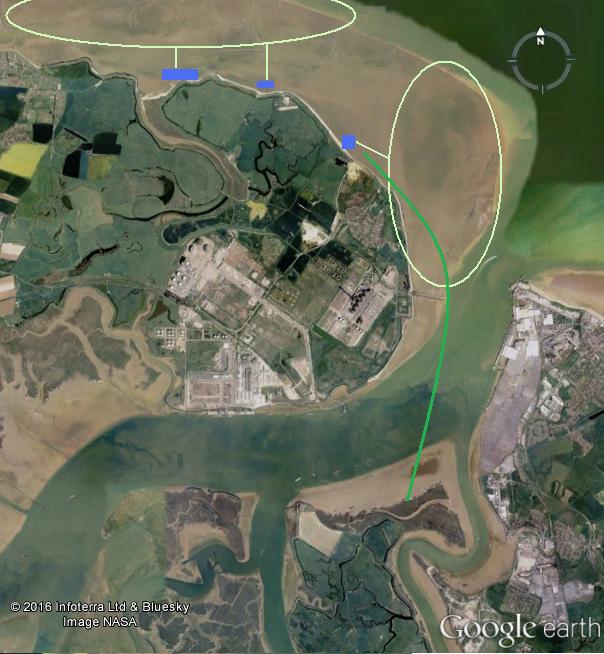
A Dummies guide to routes in early autumn:
Arctica: down through western flyway to Africa
Schnzii: same, from se Greenland, Iceland, s Norway, UK
Alpina: to main moulting ground in Waddenzee, and the Wash

The above map is not based on anything other than my whims. Helps me frame questions coming up as I type this out. Do arctica favour UK west coast more than east? Do Norwegian schnzii cross North Sea to UK, or go via Waddenzee? Do the Wash alpina favour a direct route to the Wash over the southern North Sea or follow the German/Dutch coasts? (I really need to read up more!)

The main thing is, here we're in the firing line for alpina.

Back to now and early autumn- can you tell them apart? Two schools of thought.

(1) On plumage and jizz, yes, some with difficulty. 'Birds of Norfolk' notes "Very small numbers of arctica occur in Norfolk mainly in July and August- they are often mistaken, by inexperienced birdwatchers, for Little Stints as they are halfway between the size of most juvenile Dunlin and a Little Stint." That's a start then. 'The Advanced Bird ID Handbook' tries to nail it; the smallest subspecies with the shortest bill (equal to or shorter than head-length). Schnzii is small as well, with bill about same length as head, while alpina has a longer bill, much more down-curved. That's a clue to what we're playing with. Several texts go on to list other subtle differences, the main point for here is that they're almost do-able with hard work. For those field birders keen to push boundaries, e.g. finding the true status of these transient species here in Kent, further i.d. pointers can be found in this link to a Birding Frontiers piece on arctica. Even if you're not interested in the status, one text goes so far as to say if birders really want to find scarce and rare calidrids, they had better get to know the Dunlin extremes at least.

(2) Of course, if moulting, there will be a whacking great 'hole' in the wing from a week or so after arriving on chosen staging grounds. These are likely to be alpina. Simples (I wish).

What did happen back then in the 90s?

In 2005 the BTO attempted to make sense of changes in Dunlin numbers here. Proportionally, Medway wintering nos. had dropped from 10% to 5% in the decade from 93/94, as well as seeing a continual decline locally (in relation to Thames and Swale). Wintering Dunlin certainly weren't just shuffling over an estuary. Such attempts to make sense of wintering numbers might have a correlation to autumn, but not considered. And no comment was made in the county bird reports at the time.

Presently? Well, numbers are certainly not as low as reported mainly via the uncoordinated partial coverage WeBS figures used since the millennium. Numbers in excess of those reported for the whole estuary are now usually achievable along the southern shore in autumn.

But that September '93 peak was really huge. Certainly shouldn't have been either of the two transient races, did alpina have problems elsewhere at that time? At this point I'm reminded of James's 'Birds of Sussex' when commenting on highly variable October totals for that county- "Clearly much depends on whether the presence of large numbers of migrants coincides with the date of the count!" Did something lead to a slightly early movement?

Well, easy enough to look at the other two estuaries that make up the North Kent Marshes- the Swale and (the Kentish part of) the Thames. That 1993 peak was reflected in both, albeit on a smaller scale. And interesting to see the Thames had an 8,000 influx in an August a few years later that seemingly showed up in the Medway as well:


Probably too late to ever resolve those peaks, but great to be alert to such any such arrival now. For boring old me, a four-figure Dunlin count in August or September here is now high on my 'wants' list.

For drawing any 'normal' picture of occurrence, best to leave those blips out of any averaging. General trends in both the surrounding, more coastal, estuaries are clear, we should, perhaps, be just a little below them. But is there room for improvement on numbers being recorded within the Medway? Are they a true picture? 2016 is now my fourth autumn, and by the end of this September I intend to revisit this post and confirm there's a more 'greeny-yellow' trend along my southern shore at least. Watch this space.


Yesterday, on the rising tide off of Bloors, I had a grand total of... two.

Like most of 'my' birds here they stayed out at 'scope distance. They usually head out to the island complex to roost, so no close up grilling to race for me (phew). All I can do a lot of the time is just dream about where they've come from, or where they're going to.

For most birders, two Dunlin really would not warrant a second glance. I watched them for nearly an hour.

They seemed new in- uncertain of where to go, allowing the tide to lift them and, for a few minutes, make them into passable phalaropes. Then, rather than flight low to roost they were off skywards, higher and higher. Wanting to stick together, one would try to lead north-west but the other would refuse, drawing them back in and then try to lead north-east; they continued in this zig-zag fashion, higher still, until lost from view way off north over Hoo.

What were they, and what were they about? Who says birding is dull this time of year?

Monday, 11 July 2016

A picture post, from July 2014

Ringing- Kingfisher

Black-headed Gulls, Rainham Saltings

Horrid Hill

Ringing- Sedge Warbler

Boarders, Queenborough

Deadmans Island

Black-headed Gulls, Rainham Creek


House Sparrows, Otterham Quay Lane

Walnut Tree Farm

Spot the Ringed Plover

Pinup Reach
Rainham Creek

Sunday, 10 July 2016

Late news just in

Re-reading the excellent 'Memories of Upchurch' this morning. It features a quote from 'The Examiner' newspaper of November 11th, 1810. Clearly the birding grapevines took many months to get news out back then, as this item was many months old-

"In the week before Lent an immensely large eagle was shot by a looker belonging to Mr Murton, in Greenborough Marshes, in the parish of Upchurch, Kent. It was, in the first instance, only wounded, and for a long time kept at bay both the man and his dog: it soon, however, became sick and threw up a kitten, soon after which it was killed. It measured from the bill to the tip of the tail three feet and a half, and with the wings expanded, eight feet..."

Ticehurst was clearly not a subscriber to 'The Examiner', as the bird did not feature in his avifauna 'A History of the Birds of Kent' published some 99 years later. Ticehurst does note that most claims of Golden Eagle in Kent had, when investigated, had proved to be White-tailed Eagle. Easter that year was April 22nd, so the incident occurred in early March, and Ticehurst noted White-tailed Eagle as a scarce winter visitor in the 19th century, the first specimen being from 1816.

In terms of official records, one that 'got away'. Unlike the kitten.


('Memories of Upchurch' can be obtained via the very useful and informative 'Upchurch Matters' blog- details at bottom of this post)

Monday, 4 July 2016

Fifty Shades of Estuary

I only have a very few Facebook chums nowadays. About a year ago, on impulse, I just about shut it all down, all gone save for a very few close people and a handful of groups. So this blog post is for the 600 or so I culled at the time. Sorry about that, but it did my head some good. At the time I did add a header photo for you all explaining what I'd done, but this post is an additional explanation for those who still haven't noticed it.

I was prompted to this after reading a friend's Facebook post tonight. A racing pigeon owner lured him into a loaded conversation about local Buzzards, before going on the offensive and demanding a cull.

Most comments in reply were on the button, focusing on the individual. But it was friends of my friend's replies, such as "Unintelligent pigeon fancier, why are there so many ? Maybe we need too cull them?" and "Are all pigeon fanciers idiots or is it just the majority?" that made me smile wryly.

Just a few hours earlier, down by the sea wall, I'd seen a chap parked up with the rear open on his estate. Two wooden crates could just be made out. I nodded as I passed, then a short distance on set up store and scanned the flats. Then a 'whoosh' of racing wings and I turned to see some 30 or so pigeons were off up into the sky.

Now I have something of a fixation on Woodpigeon migration, and some long-standing questions I'd been wanting to be ask on just how many racers do get into trouble dessus de la Manche. A wander over, an introduction, a friendly chat, answers duly obtained (for another day and another post- 'phew' I hear you say).

During the course of that conversation I also found out the chap was local to the estuary, that he also owned an orchard and a small wood with breeding Buzzard, Kestrel and Little Owl and (now he knew I was birdwatcher and a ringer) would I be interested in visiting his wood? He wants to know more about what he has there as he hopes to protect it long-term; regular phone calls from building company reps saying they see he owns land prime for development and offering to buy off him for silly money make him worry for the long-term future.

So, later on this week I'll be dropping by and having a stroll around with him, seeing how I can help. Human friend request accepted.

Would that conversation have even taken place if I'd been keeping up with the Facebook opinions? Pigeon racer bad, Birder good?

When on the sea wall I always chat with those I was routinely told were the enemy; the landowners, the CA supporters, the wildfowlers, the game shooters, the gamekeepers, the poachers, the bait diggers, the anglers, the dog walkers, the off-road bikers, the joggers, the doggers, the dealers (those last two by accident I hasten to add!). And now, the pigeon racers. They're all human. Heck, I even talked with a passing birder today.

So, belated apologies to all those who didn't make the Facebook cut. It really was nothing personal. Hopefully I'll see you on the sea wall for a good old-fashioned natter some day instead.


Sunday, 3 July 2016

Rookhoppers and Jackshanks

After an early morning visit to Queenborough I called in on Lower Halstow to see if any Godwits were loitering (a handful of Black-tails, nothing to write here about) and ended up spending most of my time watching the corvids. A mix of some 100 Jackdaws and Rooks kept approaching Halstow Creek from Great Barksore direction, hesitating over the yacht club as the boat owners went about their work. Finally they made a murmuration of sorts and crossed high, then low, to alight on the enteromorpha. Scanning the adjacent Twinney Creek, some further 150 corvids were already way out strung out on the green algae.I'm used to Rooks feeding on the flats, and crows in small groups, but Jackdaws do so less often. Today it was clear that some of the younger daws were not that sure what was best to eat.


Having seen en route the Funton rooks doing exactly the same it was clear the feeding must be good now, and safe. Inland, gunshots could be heard from time to time, and the birds remain wary of such threats. Knowing that groups would be doing exactly the same from Wallop Stone through to the Strand, I mused on what sort of total might be reached with a co-ordinated corvid low tide count. Musing over as, chased off by the tide, they took to the air back to the Barksore fields.

Around the same time last year I photographed some of a flock of a similar size on the Twinney saltings, and a few weeks earlier Rooks among the cord grass over the top of the tide at Funton. I might have to make them honorary waders at this rate.


Saturday, 2 July 2016

Catching on

An early morning visit to Motney, a late evening visit to Ham Green, mostly thinking about Oystercatchers. I've mentioned  Oystercatcher movements within the inner basin in general terms already, so a little more explanation of what goes on in the outer basin might be appropriate now. 

At the lowest point of the tidal cycle many Oycs will be feeding on the large oyster beds found in the Ham Ooze area. As the tide covers this stretch early the birds retreat mainly via Millfordhope Creek, sometimes heading straight to the Chetney Hill roost, often detouring into Twinney and Halstow creeks to take advantage of the additional feeding time. Eventually all these birds also move off to Chetney Hill, where they are joined by Funton feeders. On higher springs the roost might move to the old dock below the hill, but if disturbed by walkers then inland to the fields. Sometimes a small roost can sometime be found inside Barksore as well.


Then there's the Deadmans Island roost. This picks up local birds, but is also a refuge for Thames Oycs under certain conditions. On spring tides their usual Grain beach roost site can go under. At other times it suffers disturbance (at present there is no official footpath there, but walkers and fishermen often visit) when Sometimes these birds might head for Yantlet or another nearby beach, but more often they head south-east and south into the Medway to Deadmans. Back in the early nineties Grain was my 'patch', and in the 25-odd years since their dependency on Deadmans has grown. Simple fact is Yantlet can be one of the more disturbed roost sites. East of Grain, The Flats and Grain Spit are excellent feeding areas, and viewable from Deadmans. The flight might be longer, but it is a good, safe choice.


Right now it's time for Oystercatcher numbers to increase. Certainly most immigrants from the continent arrive in August and September, A rough and ready guide to numbers using these three core areas outside the 'wintering' months?

In the 1990s four-figure counts for the whole of the estuary in May, June and July were usual, but by the turn of the century counts had become erratic and incomplete. Of course, it does not help that birds change roosts (and rivers) but since returning in 2013 my counts in each ten-day period are pointing towards the present usage being more in line with the good old days. The graphic includes the Thames birds in blue, so as to give an idea of numbers feeding in the southern Medway. If you were then to add in the known main roosts on the northern shore (the Kingsnorth Power Station sea wall under certain conditions, and more routinely Oakham Marsh) then four figure on co-ordinated counts for the whole estuary should be achievable.


The casual birding visitor might miss out on all this; it has taken me a few seasons to catch on fully. With the main oyster beds being some distance from shore, and Oystercatchers prone to being one of the first species to go to roost, a birder might pick up on the thin spread of birds, sometimes in pairs, close in to the sea walls. Some will be breeding pairs, but there are not as many as one might at first think; sexually mature from around three, but possibly not breeding until four, five or later, places like Horrid Hill are a 'back of the bike sheds' for some Oystercatchers. Optimal breeding habitat is thin on the ground, and pairs are often found on the brownfield areas. Mid-river, the concrete jetty out to (and beyond) Oakham used to have a number of nest trays, lovingly re-shingled each year by the Power Station Environmental Officer after he discovered the birds would try and nest among torn lagging on the pipework. The photograph is from 2012- whether they are still in use in 2016, who knows?


Friday, 1 July 2016

News, just in

Funton for the evening covering tide. With just enough time for a decent game of 'New in or not new?' Now A lot of birders might slow up and go chasing moths, butterflies and dragonflies because it's 'quiet' this time of year, but things are starting to happen. Numbers of waders on the flats are beginning to creep up. What's not to like? While I work through each bird out there, I play this game to brighten things up. Have any of these birds just arrived from outside the estuary?

Grey Plover- a handful in the Creek, a handful in Bedlams. And more than 40 out on the Reach. Not new. These have to be over-summering immatures that keep switching between here, Greenborough and Blackstakes, the numbers add up nicely.

Turnstone- a brace. Not new. Same spot for the tide as per all of the last month. Easy game this.

Black-tailed Godwit- New in! Or, err, hang on, possibly not. Sure, Icelandic birds by plumage, but is somewhere else on the marshes missing some of their over-summerers about now? Oh, I'm going off this game- hang on, where did that extra dozen just drop in from? Popped up of of nowhere on the edge of the Creek.

Greenshank- No arguments- these are new in! Back of the net, woo-hoo, choo choo choo; much better than watching the Belgians, this.

Avocet- Deffo not new. Just making a few positional changes. Given up playing out on the right wing, playing down the Creek and Reach now.

Oystercatcher- not new (and no sign of any youngsters getting a run out yet).

Lapwing- a good scattering of recently fledged among nearly a three figure count, but then this number has been steadily building over the last few weeks- so surely local? These'll have to go down as not new.

Redshank- a nice half-century, they've doubled up out on the mud since last visit so could be a few new in, but not 'acting' like just arrived? Seem settled in their routine, look- all up and over together to the Barksore hidden roost pool- yup, not new I reckon (who's going to argue?).

Curlew- bang on schedule, numbers rising- there's new in! among those summerers for sure now. Some are watching where others are heading off to roost, heading up to join 'em. Oh, they're new. Result.

Bar-tailed Godwit- Heh, you're not fooling me, you well may be a loner up front out there today but I bet you've just got separated from your mates who've been about here all summer so far- that's a not new for you then.


Well, that was fun. And, as always, I reckon 110% right with my forecasts. Now to head home and see just how many the Welsh got tanked by. 3-0 I predicted. I just reckon I'll have been 110% right with that as well...